
On 9 September 2026 the Education Policy Institute, which describes itself as an independent, impartial and evidence-based research institute, published “Retrain or recruit? Comparing routes to more specialist teachers”, a report by James Zuccollo, its Director for School Workforce, funded by the Gatsby Foundation. It opens on a shortage: “England’s secondary schools do not have enough degree-qualified teachers to cover the STEM curriculum, and the problem is getting worse.” In physics, “55 per cent of teaching hours are delivered by a teacher with a relevant degree and, in maths, only 46 per cent.”
The shortage is uneven. “In the most disadvantaged schools outside London, fewer than one in five physics teachers holds a relevant degree, meaning a degree in physics or a closely related subject under the Department for Education’s classification.” Measured in teaching hours, disadvantaged schools “now trail affluent schools by 23 percentage points in physics and 20 points in maths”, and both gaps have widened since 2010/11, “when they stood at 7 and 12 points respectively.”
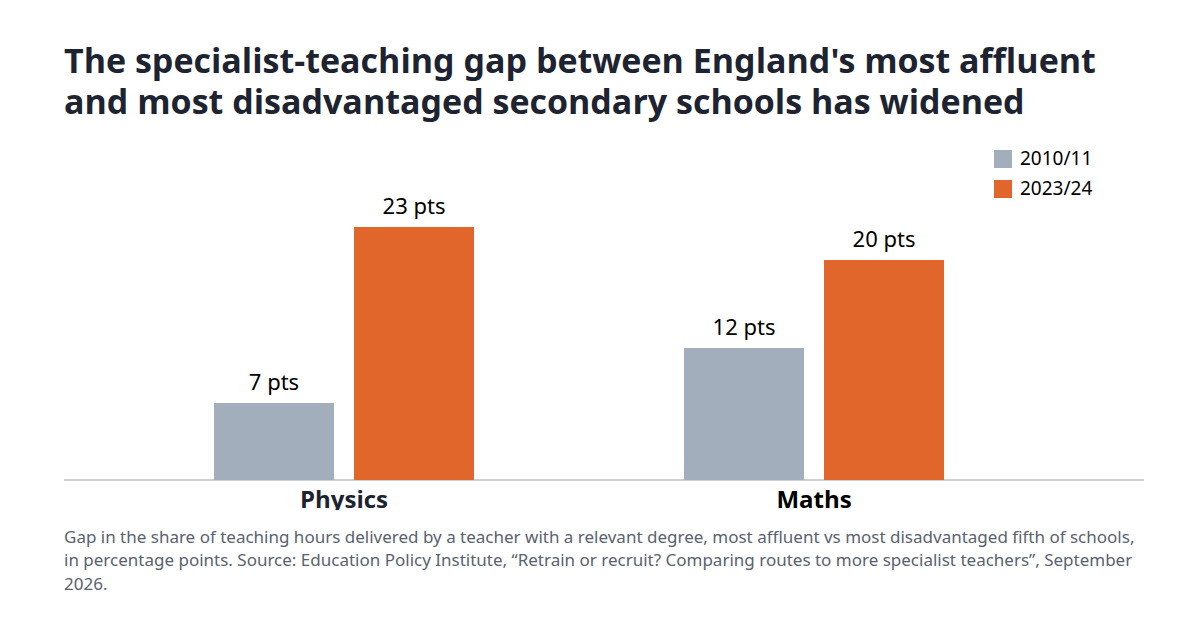
Gap in the share of teaching hours delivered by a teacher with a relevant degree, most affluent versus most disadvantaged fifth of schools. Drawn by us from the figures in the Education Policy Institute report of September 2026. © Vardix Group
What the report proposes
The report compares two ways to get more specialist teaching: recruit more graduates into teacher training through the training bursary, or retrain teachers already working in schools. Recruitment has not closed the gap on its own: “In 2025/26, physics recruited 1,095 postgraduate entrants against a target of 1,410, reaching 78 per cent of target.” The report finds retraining the cheaper route for each additional year of specialist teaching, and recommends that the government fund at least one programme that retrains serving teachers to A-level depth in physics.
It is careful about what that would achieve. “No programme in physics today trains teachers to the depth required to teach the subject at A-level.” And: “At their current scale, retraining programmes cannot replace graduate recruitment, and neither route alone will put a qualified specialist in front of every physics class”. Expanding retraining, the report adds, depends on “removing the barriers to participation, in particular the cost of releasing teachers from timetabled lessons, which evidence from current provision identifies as the main constraint on completion.”
What it means in the classroom
The report gives its reason for caring about degrees: “Teacher subject knowledge is associated with how much pupils learn, as measured by their attainment.” Whichever route the government takes, building subject knowledge takes years, and the lessons do not wait. Today almost half of the physics teaching hours the report counts are delivered by a teacher without a relevant degree, and in the most disadvantaged schools the share is higher still.
Where an interactive 3D classroom fits
ROQED Science is the school product of ROQED, a company of our group: physics, chemistry, biology and earth science taught through interactive 3D models and simulations. Teachers build lessons from those models, and the class works in the same models. For a teacher covering physics outside their own subject, that means a lesson can start from a model of the thing being explained, which the whole class looks at together, rather than from a diagram the teacher has to draw and explain unaided.
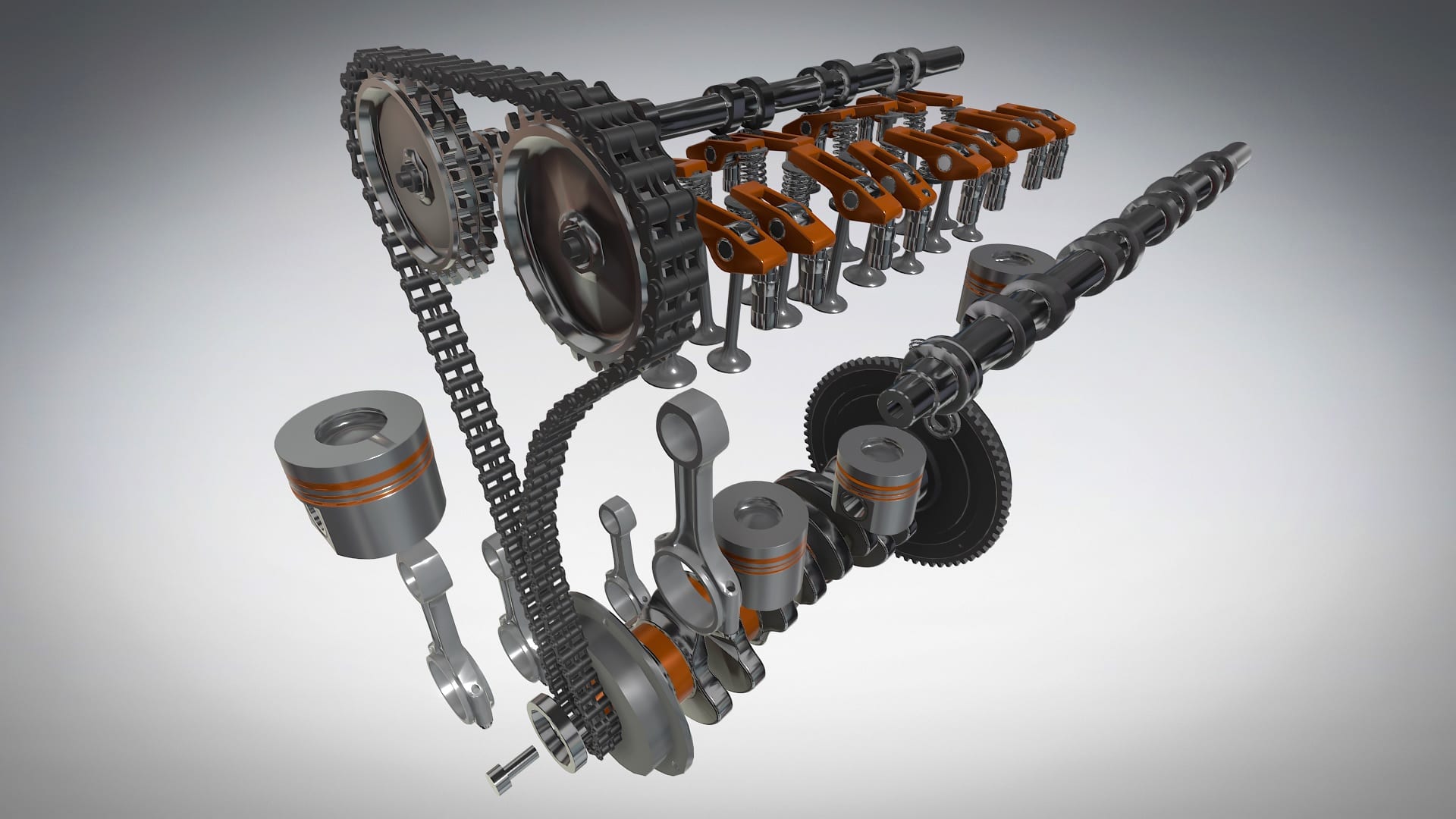
Study mode in ROQED Science, as shown on the product's own page: a mechanism as a 3D model, with its parts separated. © Vardix Group — ROQED
What it does not do
It does not give a teacher a physics degree, and it is not a substitute for the retraining the report recommends. The report does not assess software of any kind; it is about teachers’ subject knowledge and how to build it. What a 3D classroom offers is narrower: the teacher and the class look at the same model, so a phenomenon is shown as well as described. This article makes no claim about the product’s effect on pupils’ attainment.
For a partner in education
If you already sell to schools, school chains or ministries of education, ROQED Science is one product covering four sciences, already shipping in more than eighteen languages, with installation, training, localisation and technical support from our team. Tell us which country and which schools you work with, and we will set up a partner demo.