
In January 2026 a worker in Queensland suffered serious foot injuries when a load of about 4.5 tonnes struck their foot. The load was being moved by an overhead crane with the worker assisting, and it hit as it was lowered into position. WorkSafe Queensland describes the case in its incident alert “Workplace incident: serious injury by crane load”, last updated on 27 October 2026, and says its findings are not yet confirmed and that investigations into the exact cause are continuing.
The alert does not say why it happened. It lists the typical hazards of overhead travelling cranes, also called bridge cranes, and one line on that list is about the person at the controls rather than the machine: “unintentional crane movements or collisions from improper direction of crane movement resulting from unfamiliarity of directions on pendant and orientation of operator”. Next to it are background noise that gets in the way of communication, loads crushing against obstacles in a crowded area, and loads that swing after rapid changes of direction or accelerations.
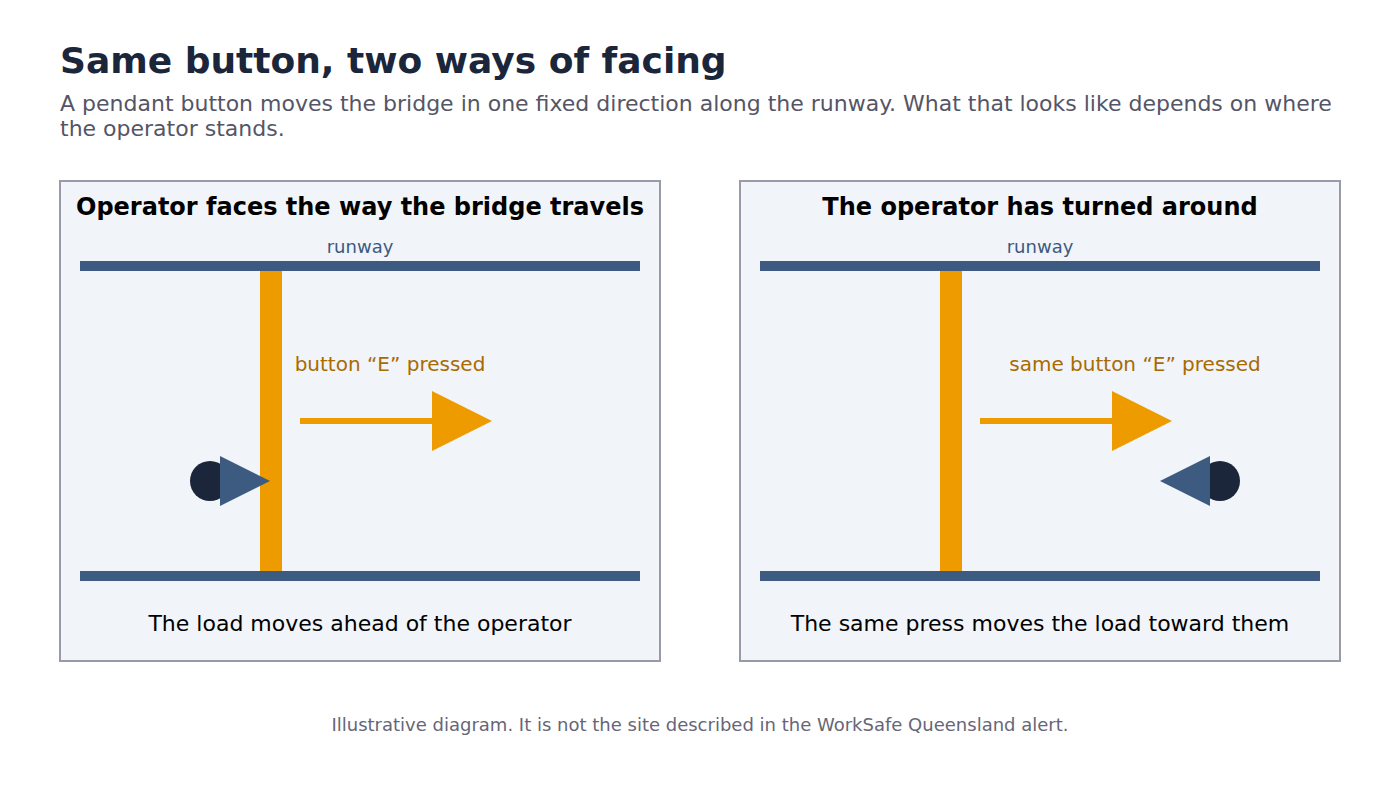
An illustrative diagram, not the site in the WorkSafe Queensland alert. © Vardix Group
A hazard list that changes from bay to bay
Read against a real workshop, most of what the alert asks for is local. Operators are to know “the particular model of crane to be operated, its characteristics, functions and limitations”. Exclusion zones are to be sized from a written risk assessment, and workers are to stay outside the crush zone while a load is lifted and lowered. The alert asks for an understanding of the load’s landing area and of clearances to other plant and structures, and for a reliable method of signalling between the crane operator, the dogger and anyone else assisting. It also notes that with pendant controls the operator may have to move with the load and be reasonably close to it.
Each of those answers is different in another building: where the runway ends, what stands beside the landing area, how the pendant is marked, where the operator walks while the load travels. In our reading the pendant line is the clearest example: on a pendant whose buttons are tied to the crane’s directions, a button drives the crane the same way along the runway whichever way the operator is facing, so after a turn on the shop floor the same press can look like its opposite. That is learned on one crane in one bay, and a generic course cannot teach the bay a trainee will actually work in.
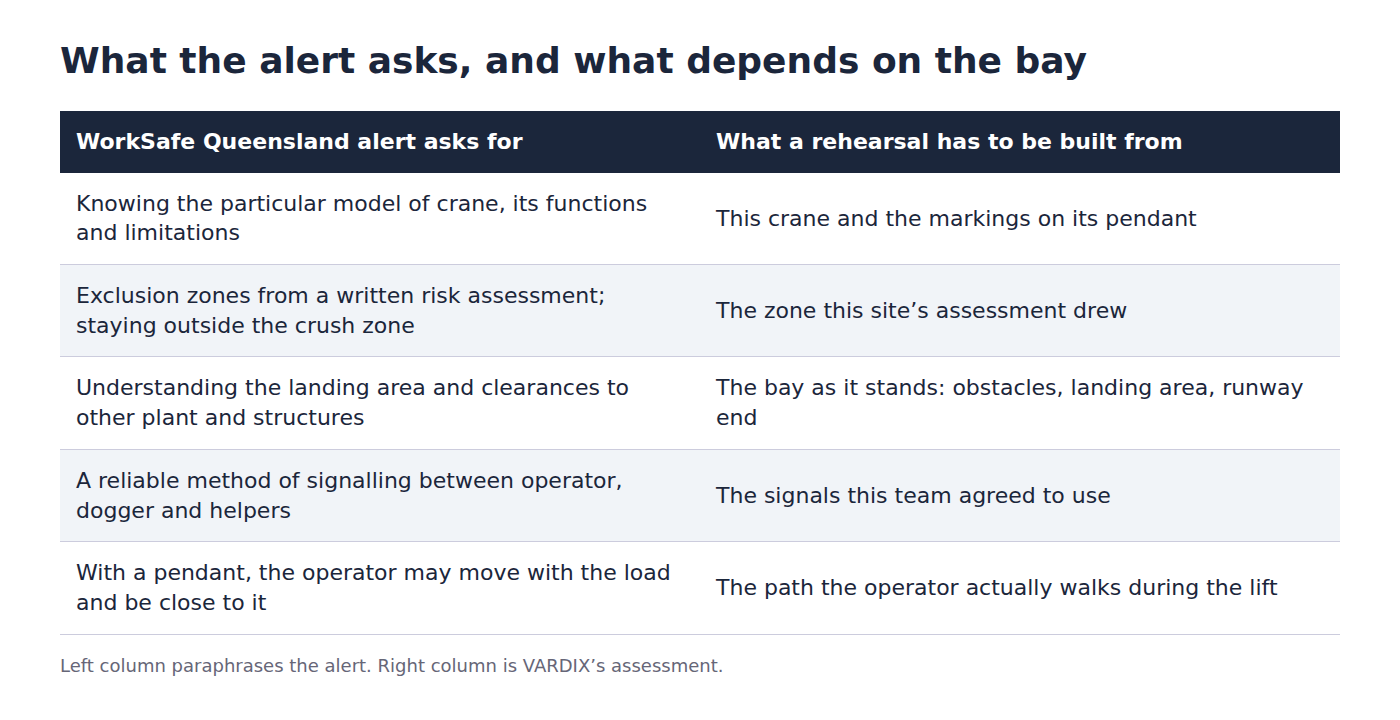
Left column paraphrases the alert; right column is our assessment. © Vardix Group
Walking the lift before the load is in the air
This is the part of the job a custom simulation can take on. Our VR, AR and MR development team builds custom training simulations, among them equipment operation training and simulations of hazardous environments. For a crane, such a simulation can be built from what a customer actually has: the bay and its obstacles, the crane and its pendant, the landing area and the exclusion zone the site’s risk assessment drew. A trainee can then go through the lift in a headset before standing near a suspended load: press the pendant buttons from the spot they will really stand on, see where the crush zone falls as the load comes down, and practise the signals the team has agreed to use. When the layout of the bay changes, the model can be updated with it.
What a rehearsal does not replace
The alert sets the limit itself. It asks businesses to work through the hierarchy of controls with the aim of eliminating the hazard, and it says that administrative control measures and PPE rely on human behaviour and supervision and, used on their own, are the least effective in minimising risks. In our reading, training belongs to the same tier, because it too depends on people and supervision. A rehearsal does not replace the exclusion zone, the pre-operational check the alert expects before each work shift, or the high-risk work licence it names for some classes of crane. Its job is narrower: people arrive at the lift already knowing the plan those controls describe.
For a partner, the conversation with a buyer then starts from the customer’s own lifting plan and risk assessment, and the rehearsal is built from those two documents.