
On 6 November 2026 the Health and Safety Executive published a press release, “Scaffolding company fined after trainee scaffolder killed in five-metre fall”, about a hearing at Leeds Magistrates’ Court two days earlier. Ask Scaffolding Ltd pleaded guilty after Michael Swales, a trainee working for the company, died on 5 July 2023 at a housing development near Ripon in North Yorkshire. He and a colleague were erecting scaffolding at the front of a two-storey house under construction when he fell five metres after standing on an unsecured scaffolding board. Emergency services attended. He died at the scene.
The same release records what the investigation found about that day. The investigation found that the scaffolding work being carried out on the day of the accident was unsafe and did not follow industry guidance. The company had failed to ensure work at height was carried out in a safe manner, so far as was reasonably practicable. Safe zones had not been established, and neither Mr Swales nor his colleague was using a harness or lanyard while working. Ask Scaffolding Ltd is named because the regulator named it. We have no relationship with the company.
Collective protection is named first
The release does not leave the order of the controls to be inferred.
The guidance identifies the use of collective protection measures to create a ‘Scaffolder’s Safe Zone’ as the primary means of preventing falls. Personal protection, such as a harness and lanyard, should be used when a scaffolder is working without a safe zone.
A harness is described there as the measure for a scaffolder who is working without the zone. A rehearsal that begins with clipping on, and never builds the zone, trains the fallback as though it were the method.
The investigation reached earlier work
The failures were not confined to 5 July 2023. The investigation found that previous scaffolding work had not been carried out in accordance with the guidance. A post-accident inspection identified that guardrails had not been installed where they should have been. Several witnesses also indicated that scaffolding work was regularly carried out by company operatives without following the guidance. Read as a training problem, that is a repeated sequence, not one loose board on one house.
Author the incomplete lift
A scene that opens on a completed bay, with the rails already in place, never asks anyone to do what this crew was doing: to keep working while the standing surface is still being made. The board in the release was not secured. The zone the guidance puts first was not there.
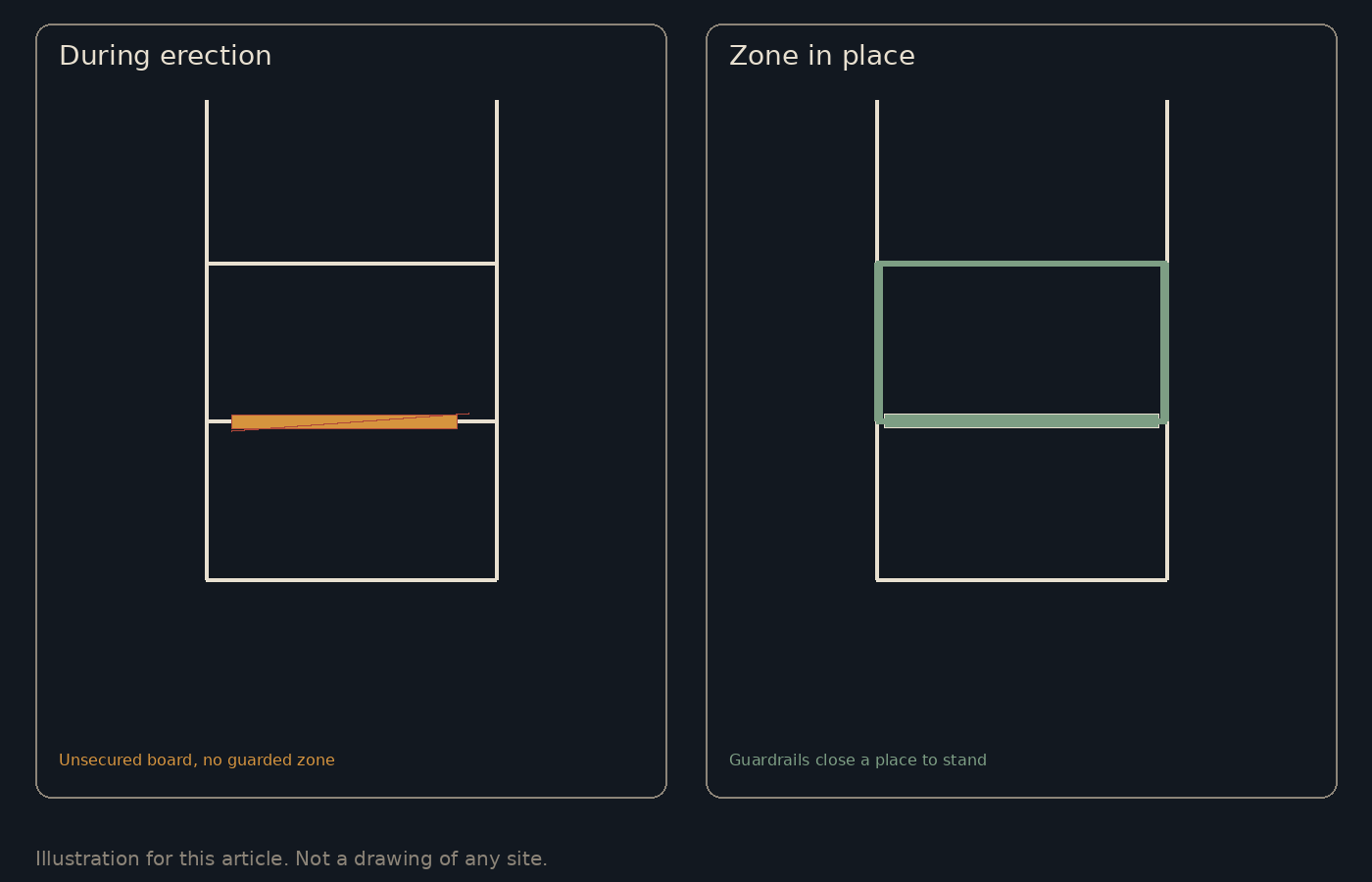
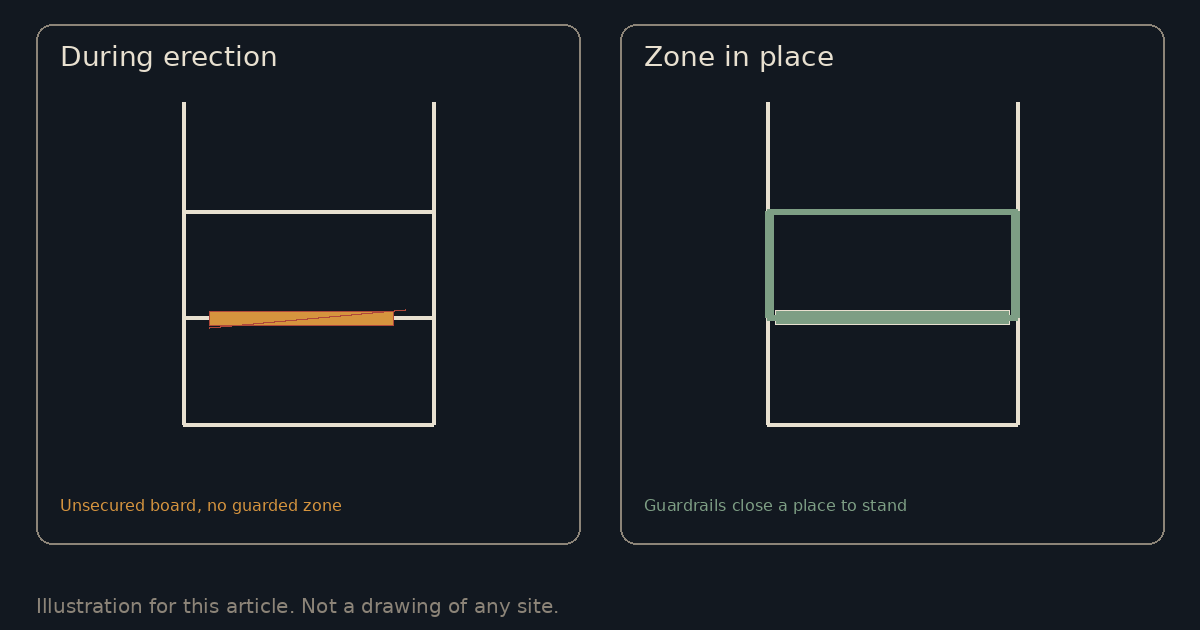
Illustration for this article. Not a drawing of any site. The amber board stands for the unsecured board in the release; the green rectangle is a guarded standing zone. © Vardix Group
A generic fall-from-height module is a different task from the one in this release. The release says that all scaffolding must be erected, dismantled and altered safely. Those are three intervals in which a platform is unfinished. Our reading is that a scene limited to a finished bay covers none of them. The death itself was during erection. The release does not say it was during dismantling, and we are not adding that.
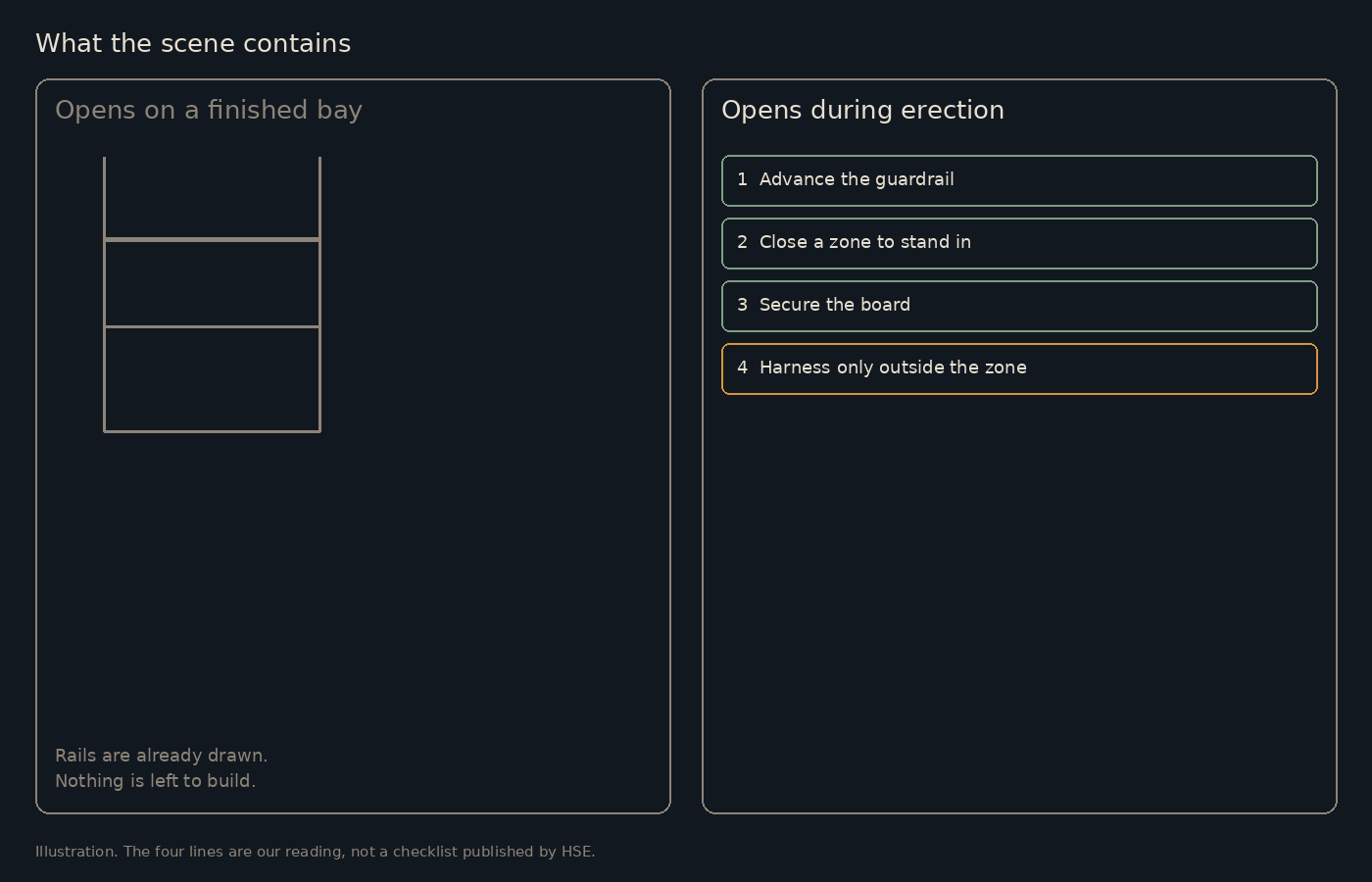
Illustration. The four lines are our reading, not a checklist published by HSE. © Vardix Group
The four lines on that diagram are our reading of the order in the release. The release does not number them, and they are not a method statement.
What the two pages actually say
The construction guide on this site, under the heading “Fall protection & working at height”, lists “Edge, opening and scaffold work with harness, anchorage and access procedure”. On the same site, VR / AR / MR Development is the service a partner commissions. The service page describes scenario-based learning, and hazardous-environment simulations among the work. The construction guide addresses its own reader with this distinction, quoted here: “Generic modules teach the concept; a real program models your projects, your method statements and your incident history. Custom scenario authoring is where a program earns its keep.” That is the page describing an offer. Nothing on it is a description of the housing development near Ripon.
A guilty plea is not a trial of a headset
The court result should stay narrow in a sales conversation. Ask Scaffolding Ltd pleaded guilty to breaching Regulation 4(1)(c) of the Work at Height Regulations 2005. The release does not describe training the company gave or failed to give, and it does not mention simulation. We are not filling that silence. A scenario can make the missing sequence familiar: a safe zone first, and personal protection where a scaffolder is working without one. It cannot install the guardrail the inspection found missing, and it does not move the duty off the contractor in control of the work. HSE Inspector David Beaton, quoted in the release, said the accident “underlines the importance of those in control of scaffolding work making sure that it is being done safely and in accordance with industry guidance”.