
On 26 October 2026 the journal Anatomical Sciences Education published online a study from Yonsei University College of Medicine in Seoul, “Impact of open-book examination in a pathology course on medical students' learning experiences and long-term academic performance”, by Kim and Lim of the university's departments of medical education and pathology. Yonsei moved the exam in its second-year Introduction to Pathology course to an open-book format in 2020, during the pandemic. The authors analysed five cohorts, 2018 to 2022, 582 students in all, and measured long-term academic performance by the pathology score in the nationwide Comprehensive Basic Medical Sciences Examination, which the students sat eight months after the course.
Students who took the open-book exam reported higher satisfaction and engagement, and the authors' analysis of their open-ended responses pointed to more self-directed learning and less rote memorisation. Eight months later they outperformed the closed-book cohorts in pathology, particularly among lower-achieving students, which the authors read as better knowledge retention. The comparison is between years rather than between randomly assigned groups, and the authors themselves write that further refinements are needed and that the effect on clinical competency is still to be studied.
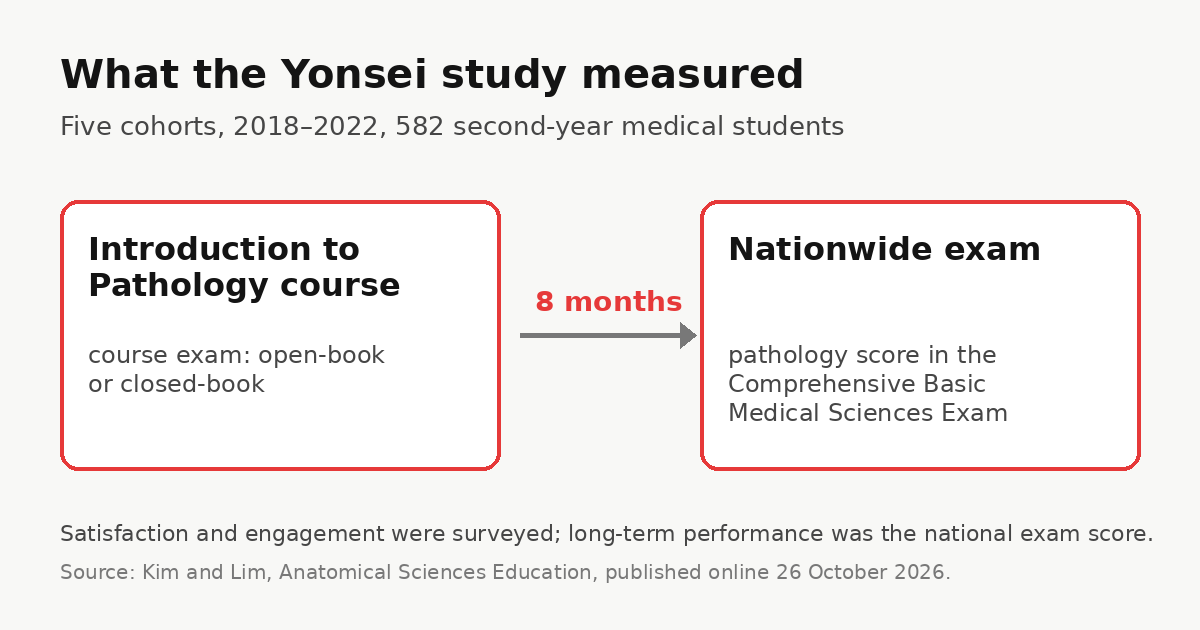
What the study compared, as described in the authors' abstract. © Vardix Group
What students said the format lacked
Among the challenges students identified were short examination time and insufficient pre-exam guidance, which, the authors write, hindered their exam preparation.
We read that as a change in what preparing means. When the textbook is on the desk, an exam cannot reward knowing which page to open; it rewards looking at a change in an organ or a slide, recognising it, and reasoning about it quickly, and a short time limit makes that sharper. Students know how to revise for a recall exam. For this one, we think, the missing guidance is about how to practise recognition, not what to read.
Practice that looks like the exam
Pathology3D is a 3D simulator for general and special pathological anatomy that Vardix distributes to medical and pharmacy universities. A student picks a disease or syndrome, loads the target 3D organ and changes it stage by stage at the macro level, then matches the case against histological preparations at the micro level. After the modelling a results table analyses the student's answers, so they can check themselves and track progress on their own or with a teacher. It runs on Windows, Linux and macOS.
That is the kind of preparation we would put into the gap the Yonsei students described: repeated recognition of pathological change, with feedback, before the exam rather than in it.
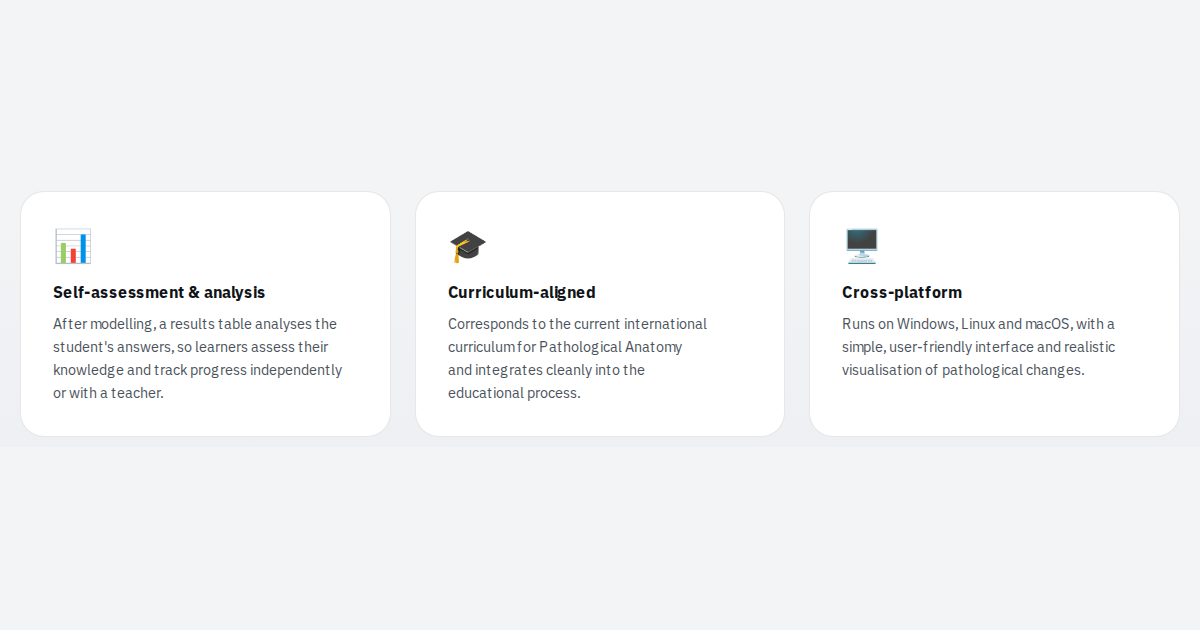
Pathology3D: a results table after each case, on Windows, Linux and macOS. © Vardix Group — Vardix Group
The study did not test Pathology3D or any 3D tool, and it says nothing about whether software improves open-book scores. A department that adds a simulator to its preparation would learn whether it helped the way Yonsei did, from its own exam results over time.
Where the conversation with a department starts
For a distributor calling on a pathology department, the useful first question is how the course is examined: whether it has moved, or is moving, to open-book or applied questions, and what students use to prepare. Where the answer is the textbook and last year's slides, a tool for practising recognition has a clear place in the course.