
On 28 September 2026 the journal Health Education & Behavior published online, ahead of print, a randomized controlled trial by researchers at Tokat Gaziosmanpaşa University and Sivas Cumhuriyet University in Türkiye: “Animation-Based Nutrition Education Improves Nutrition Behavior, Symptoms, and Quality of Life in Heart Failure”. Sixty-three patients with heart failure took part. Thirty-three received nutrition education delivered as animated video; thirty received the standard procedure. Both groups were measured at baseline and again at one, three and six months.
According to the abstract, the animation group showed significant improvements in nutritional behaviour, a reduction in symptom burden and better quality of life, with time-by-group interactions favouring it. The authors add that the size of the changes exceeded established thresholds for a minimal clinically important difference — the point at which a change is large enough to matter to the patient, not only to the statistics.
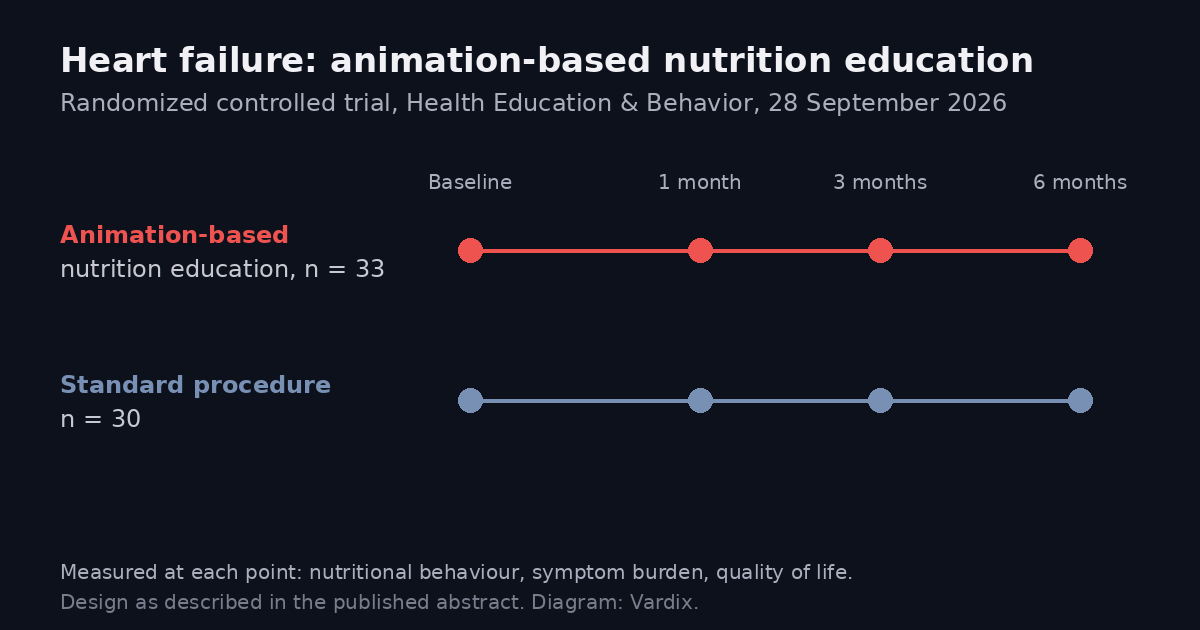
The trial design as described in the published abstract. The diagram is ours. © Vardix Group
What the result points at
The most useful line in the abstract is not the headline. The authors ran a mediation analysis and found that the effect on quality of life was fully indirect: it was transmitted through improvements in patients' nutritional behaviour. The sequential pathway they had hypothesised, involving symptom burden, was not supported. In other words, by this analysis the video improved quality of life through the change in how patients ate rather than directly. For heart-failure patients, most of that eating happens at home, between clinic visits, where no clinician is present.
That is the problem the study makes sharp. In a chronic condition like heart failure, much of the treatment is carried out by the patient, and the explanation they receive in the clinic has to survive the walk home and the months after. A spoken explanation differs from one consultation to the next and is gone when the conversation ends. A film is the same every time it is played, can be watched again, and can be subtitled in the language the patient reads.
What the trial does not show
It is one trial of sixty-three patients. The abstract describes the comparison only as animation against “standard procedure” and does not say whether the control group received the same amount of education time, so from the abstract alone the effect of the format cannot be separated from the effect of receiving more education. The abstract does not say how the animation was made, and it reports significance and thresholds rather than effect sizes. The authors close by saying that digital education yields superior outcomes to traditional approaches; we read the trial as a strong signal for one condition and one setting, not as a settled general rule.
Where medical 3D films come in
Patient education is one of the six types of work our Medical 3D Films service produces: animations that explain diagnoses, treatment pathways and post-operative care to patients in language they can understand. Every script and storyboard is reviewed by a medical advisor before production begins, and films are delivered with subtitles in the required languages and ready to embed in a learning management system.
An anatomical illustration from the Medical 3D Films service page on vardix.com. © Vardix Group
For a partner who sells into hospitals, pharmaceutical companies, device manufacturers and universities, the trial suggests a better first question than “how long should the film be”. It is: which behaviour should change after the patient has watched it, and how will we know at one, three and six months? In our experience a commission that starts from that question produces a different film — shorter on mechanism, longer on the few things the patient must do — than one that starts from a list of topics.
Start from the behaviour the film has to change, not from the anatomy it could show.
Keep the film identical across sites and languages, so the clinic can compare like with like.
Plan the measurement before production: the trial measured at one, three and six months, not only on the day.