
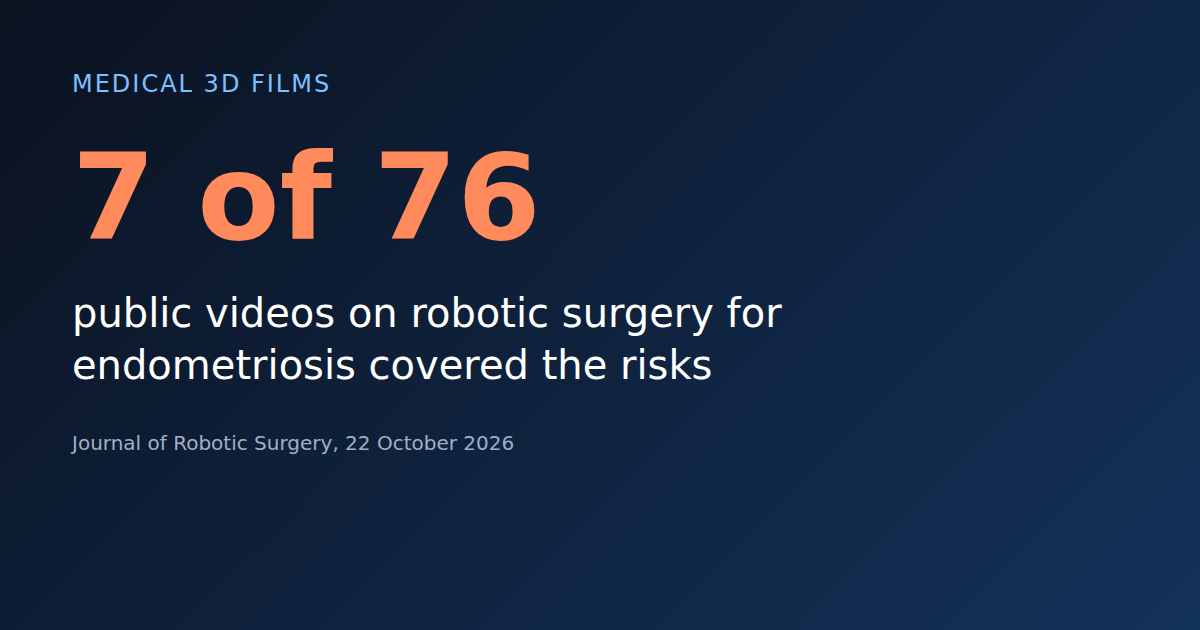
On 22 October 2026 the Journal of Robotic Surgery published a cross-sectional content analysis by Sema Karakas, Zinar Serhanoglu and Basri Çakıroğlu, "Decision-relevant patient information in YouTube videos on robotic surgery for endometriosis". The authors searched YouTube in September 2026 with six English- and Turkish-language search strings and, from 101 unique records, kept 76 fully accessible videos that explicitly address robotic surgery for endometriosis. Two reviewers independently coded every eligible video against the study's checklist and settled differences by consensus.
Against a nine-item index of decision-relevant content, the median video scored 1 of 9; even under a looser rule that counted any broad reference, the median was 2. Deep endometriosis came up in 29 videos and organ involvement in 25. The risks of the operation came up in 7, a comparison with laparoscopy in 6, non-surgical options in 5, multidisciplinary care in 5, fertility and ovarian reserve in 14, and recurrence in 2. Almost every video, 73 of 76, made some broad reference to surgery or candidacy, but only 18 met the authors' strict reading of indication and patient selection.
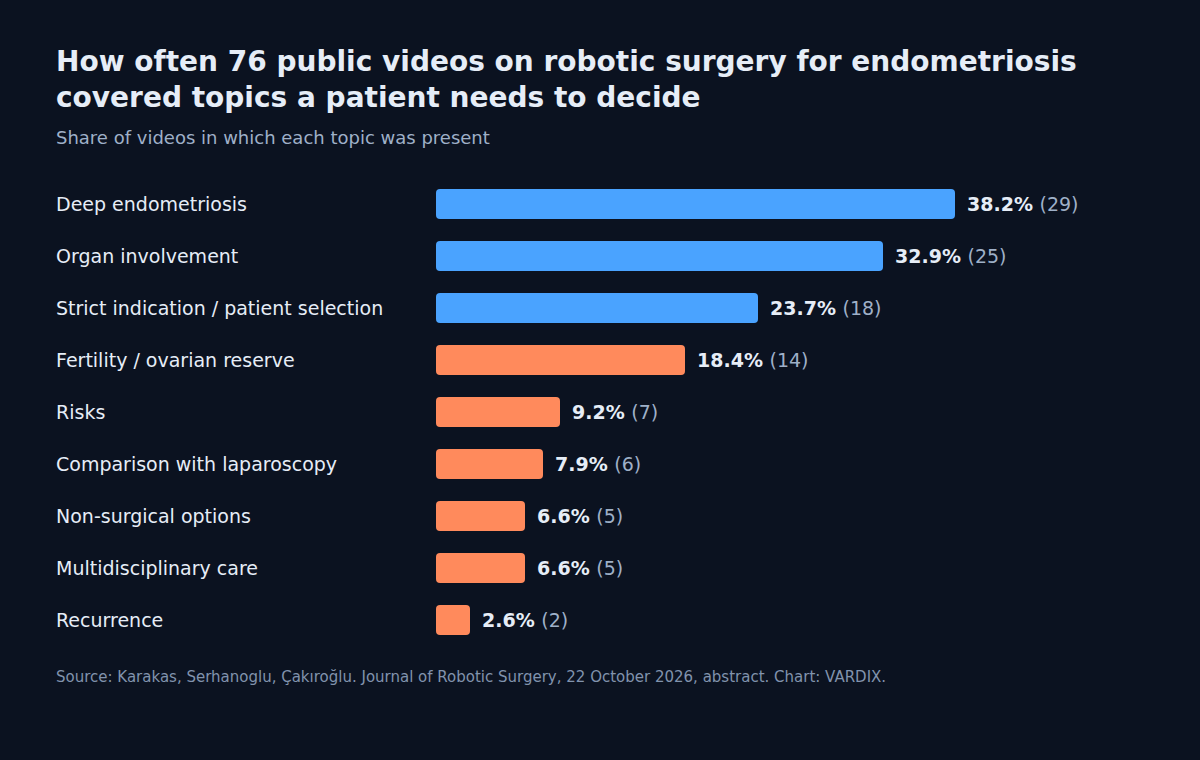
Figures from the abstract of the Journal of Robotic Surgery study, 22 October 2026. Chart drawn by VARDIX. © Vardix Group
The conversation before consent, item by item
Read the chart from the bottom up and it describes much of the conversation before a woman agrees to the operation: what else could be tried, how this compares with a laparoscopy, what can go wrong, what happens to her fertility, how likely the disease is to come back. In this sample those were the topics least often present, while the disease itself, deep endometriosis and organ involvement, came up most often. Whether she is a candidate sat in between.
The authors are careful about what the sample does not show. They did not classify who each video was made for or why, so the findings do not establish that every video was meant for patient counselling, or that the omissions affected anyone who watched. The strict indication score was recoded after the fact from retained notes, the search dates were documented for only part of the records, and they call the sample exploratory. In our reading it is also narrow: one platform, two languages, one procedure.
Writing the storyboard from the other end
In our assessment, video is where many patients look when an operation is offered, and in this sample public video carried little of what the decision needs. A hospital, a surgical department or the maker of a surgical system can commission its own explanation instead, and that is the work behind Medical 3D Films, the VARDIX service that produces medical 3D animation for pharmaceutical companies, device manufacturers, universities and healthcare institutions. Patient education is one of its six film categories: animations that explain diagnoses, treatment pathways and post-operative care in language patients understand.
A checklist like the one in this study can serve as the brief: each topic could become a scene, and the film could be checked against the list before anyone renders a frame. Our pipeline already has a medical advisor review the script and storyboard before production begins, to verify anatomical accuracy, and a qualified medical advisor reviews every project before delivery; in our assessment, a decision checklist belongs at that first review. Subtitles are delivered in the languages required.
Illustration from our Medical 3D Films page. Anatomy is where such a film usually begins; the scenes a decision needs come after it. © Vardix Group
A film does not replace the surgeon's conversation or the consent the patient signs, and it does not decide who is a candidate. It can arrive at that conversation having already covered the same ground for every patient, in the clinic's own words and with its own clinical sign-off.
What a distributor can ask a hospital
The study's list also works as an audit of what a surgical department or a device maker hands patients today:
Which decision does the patient face, and which alternatives does the department actually offer?
Which of the topics in the study's list does the material patients receive today cover, and which does it leave out?
Who on the clinical side signs off the script, and who signs off the finished film?
In which languages do the department's patients need it?