
The OECD has released PISA 2025 Results (Volume I): Future-Ready Students, with the public-use data file released on 8 September 2026. More than 760,000 students took part, representing around 33 million 15-year-olds in 91 countries and economies, and this cycle focused on science. The OECD average science score was 482 points, down from 489 in 2015. On average across OECD countries, 26% of students did not reach baseline proficiency, Level 2.
The report defines that baseline in one sentence:
Level 2 is the point at which students are beginning to use science as a tool for reasoning: explaining, interpreting, evaluating and making decisions in familiar real-world situations.
Across the 35 OECD countries with comparable data, the share of students below that line rose by three percentage points between 2015 and 2025, while the share of top performers stayed where it was. On 5 October the European Commission added its own reading in an Education Policy Brief on the report: in the EU, one in four 15-year-olds, 25.9%, underachieve in science, against a 2030 target of below 15%, and disadvantaged students are four times more likely to underachieve in science.
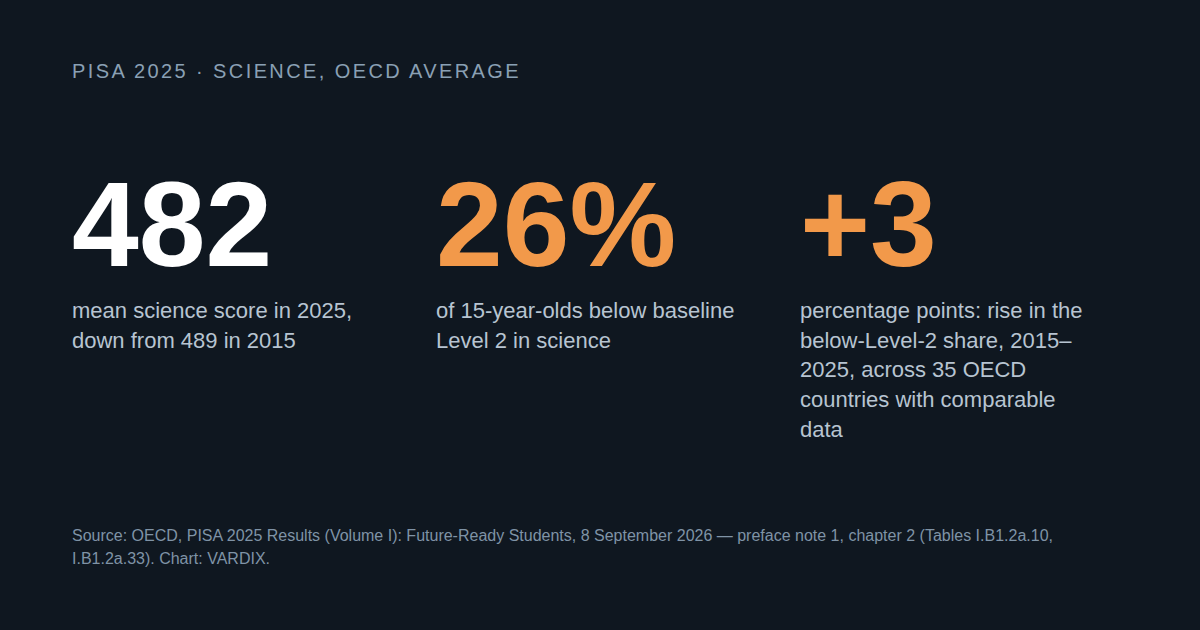
The numbers are the OECD's, from PISA 2025 Results (Volume I). The chart is ours. © Vardix Group
What PISA asks a 15-year-old to do
PISA does not only measure whether students can reproduce what they have learned; it also assesses whether they can apply it. It divides science into three competencies, and the first is to explain phenomena scientifically, which the OECD defines as "the ability to recognise, construct and evaluate explanations and models for natural and technological phenomena". The other two are to "construct and evaluate designs for scientific enquiry and interpret scientific data and evidence critically" and to "research, evaluate and use scientific information for decision making and action".
The report is careful about what its subscale results mean. They show where each system stands out relative to other systems, and the OECD says outright that they should not be read as one competency being stronger or weaker than another in an absolute sense. So the honest reading is not that students fail at models in particular. It is that explaining phenomena with models is one of the three competencies the assessment counts as science, and that on average across OECD countries 26% of students are below Level 2, where reasoning with science in familiar situations begins.
Two findings that matter for schools
Volume I also reports on the conditions of learning, and two findings matter for anyone who sells into schools.
The gap is social. On average across OECD countries, socio-economically advantaged students scored 85 points more in science than disadvantaged students. The European Commission's brief puts the same pattern in its own terms: disadvantaged students in the EU are four times more likely to underachieve in science.
Materials are short, and shorter than in 2022. On average across OECD countries, more than one-quarter of students attended schools whose principals said a lack of material resources, such as textbooks, libraries, laboratory material and buildings, hindered instruction at least to some extent. Principals reported more shortages of material resources in 2025 than in 2022, on average across OECD countries. The report also says that, in most countries and economies, shortages of education staff are reported more often in socio-economically disadvantaged schools than in advantaged ones.
Neither finding is about software, and the OECD does not draw any conclusion about classroom products. They describe the conditions a school system works in when it tries to improve its science results.
Where ROQED Science fits
ROQED Science is the group's school science product: physics, chemistry, biology and earth science taught through interactive 3D models and simulations. ROQED describes it as a computer program that turns a regular classroom into a virtual laboratory, where middle and high school students simulate and conduct educational demonstrations in the natural sciences.
Its Study mode is a sandbox: teachers and students rotate, take apart and examine a model from any angle. Teachers build lessons, interactive homework and classroom assessments from the same models. ROQED's product page lists 450 or more biology, 330 or more physics, 370 or more chemistry and 40 or more geography models and courses, and the product is available in 18 languages, from English, Arabic and Turkish to Kazakh, Romanian and Japanese. It runs on Windows and the web, so a pilot does not start with a headset purchase.
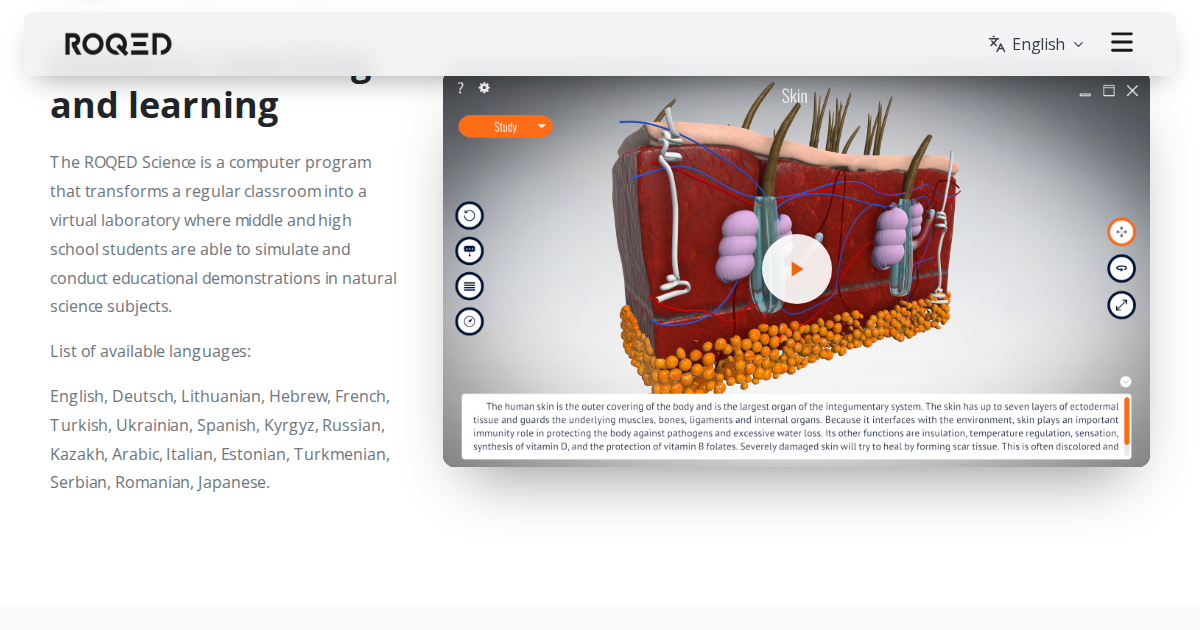
ROQED Science in Study mode, from ROQED's own product page. © Vardix Group — ROQED
Our view, and it is a view rather than a measurement: when explaining phenomena with models is one of the competencies the assessment counts, a class that can turn the model in front of it practises exactly that. Where a school lacks laboratory material, a virtual demonstration lets a teacher show the process the textbook can only draw.
What it does not do
It does not raise a PISA score by being installed. Nothing in the OECD report or the Commission's brief evaluates a classroom product, and we do not claim an effect on results that nobody has measured.
It does not replace hands-on practical work where a curriculum or an exam requires it. A virtual demonstration is a way to show a process, not a substitute for a pupil doing the experiment.
It does not close an 85-point social gap on its own, and it does not replace a teacher. The same report records that staff shortages are reported more often in disadvantaged schools; software is used by teachers, not instead of them.
For distributors
Participating countries and economies have their own PISA 2025 science results in Volume I. Our assessment is that the question education buyers will ask of those results is a practical one: what can change in a science lesson next term. Education distributors who already call on schools and ministries can bring them ROQED Science: four sciences in one product, already available in 18 languages, with installation, training, localisation and support from VARDIX.