
On 19 October 2026 the journal Frontiers in Education published a quasi-experimental study from the University of Amsterdam and Amsterdam UMC: “Use of a GenAI-patient for medical communication training for undergraduate medical students”. In February and March 2025, 383 first-year medical students prepared for their first conversation with a standardized patient. 182 were given the usual e-learning. 201 were also offered a text-based virtual patient they could question online, from any browser, as often as they liked.
Of the 96 students in the offered group who returned the questionnaire, 49 had used the virtual patient for at least one conversation of more than ten questions, and 35 of them used it only once. On nervousness, preparedness, self-efficacy and self-perceived competence the authors found no statistically significant difference between the groups. Students who were offered the tool and did not use it did not differ from the control group on any outcome.
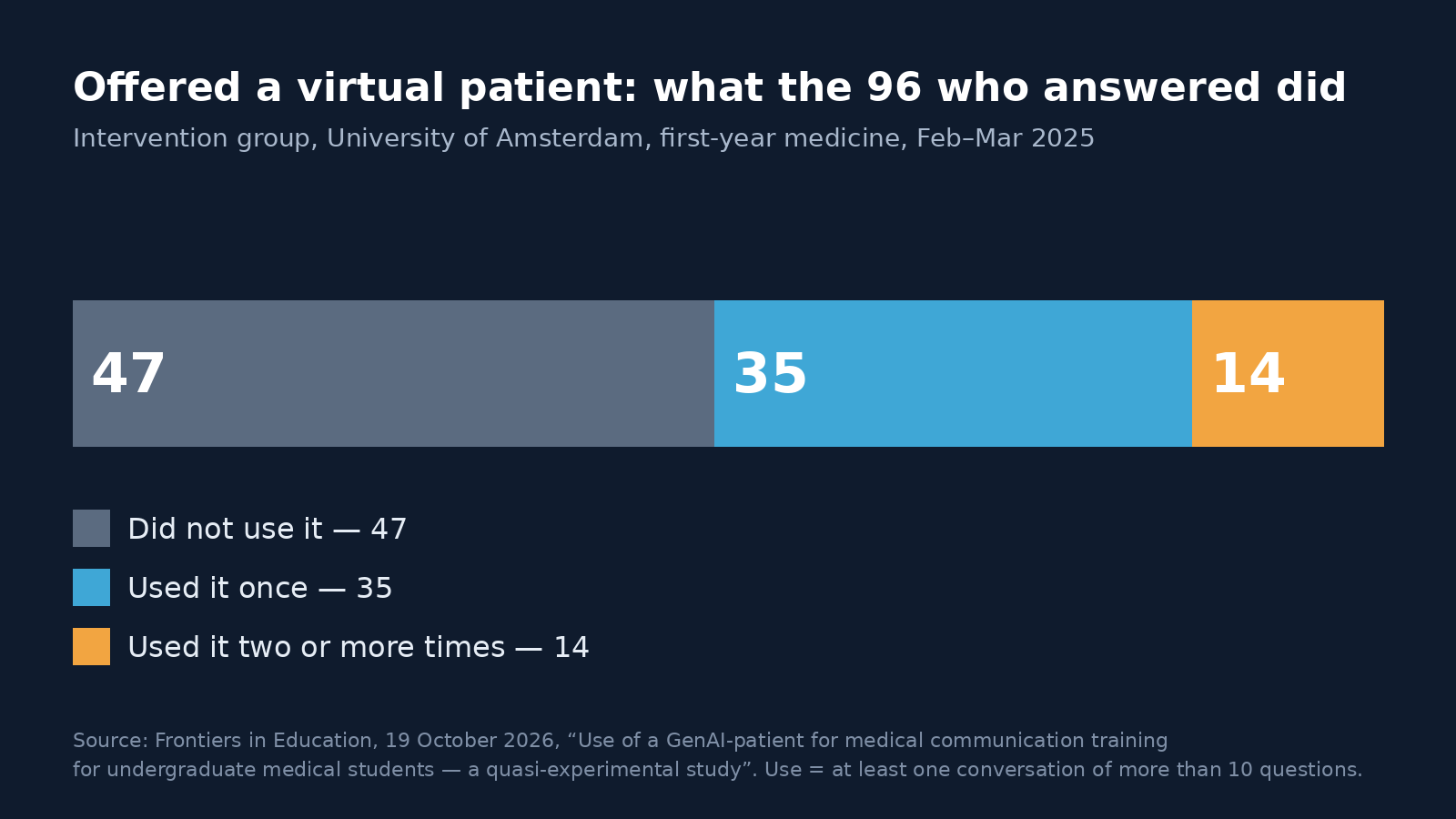
Almost half of the respondents who were offered the virtual patient never held a conversation of more than ten questions with it; most of those who did, held one. © Vardix Group
The students liked it, and the course never asked for it
Among the 49 users, 71% called the tool a useful addition to their preparation and 63% wanted to use it in future. The design of the study explains the rest. The virtual patient sat beside the compulsory e-learning and, in the authors’ words, “was not credited, not compulsory and not assessed”, with a window of one to two weeks before each student’s class. Of the 19 non-users who gave a reason, six cited competing coursework or examinations, six technical or login problems, four felt the tool was unnecessary, and three did not know what to expect from it or that it was available. The authors read roughly half of the non-use as access and communication rather than a verdict on the format.
Practice without correction
The second gap was feedback. The tool gave none. Weighing this against the missing voice and face of a real patient, the paper calls it “arguably the more consequential omission”: without feedback the tool offers “repetition without correction, which is practice but not deliberate practice”. The authors’ conclusion lists what a next version needs: mandatory minimum engagement, multiple patient cases, automated feedback and higher-fidelity multimodal interaction.
What the instructor has to be able to see
For a faculty choosing a simulation platform, the library of cases is the smaller half of the decision. The larger half is whether the virtual patient lives inside the course, assigned and visible to the instructor, or beside it, where a busy first-year student meets it once or not at all.
That is the job VARGATES Medical is built for. It ships pre-built modules for anatomy, pathology, pharmacology and surgery, runs in a web browser with no hardware required to start, integrates with the university’s learning management system so training data flows into existing student records, and tracks every session, score and error, with instructor dashboards on student progress. Whether a case is compulsory stays the faculty’s decision; the platform makes that decision checkable, so the instructor can see who has not worked through a case before the class rather than after it.

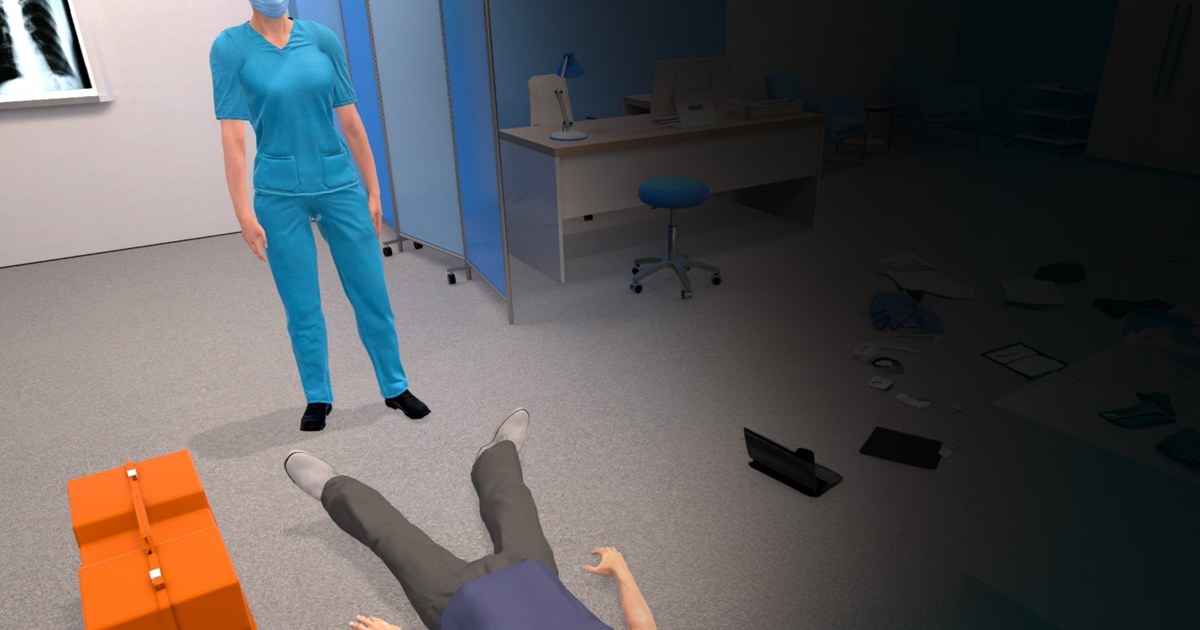
A clinic room in VARGATES Medical. © Vardix Group — VARGATES
The Amsterdam study tested a single text-based case, for one class, with self-reported outcomes. It does not show that any virtual patient, ours included, improves communication skills. It measures how an optional, unassessed tool without feedback gets used, and that is worth knowing before a purchase.
One question to bring to a dean
Who in the course will see that a student has used the virtual patient, and what happens if they have not? A distributor who sells simulation, anatomy or LMS products into medical faculties can ask this in every meeting. If the answer is nobody and nothing, the Amsterdam numbers are the likely result, whichever product is bought.