
On 15 October 2026 the Journal of Science Education and Technology published “A Classroom Intervention Study to Assess the Potential of a 360-Degree Virtual Reality Learning Environment to Enhance Conceptual Understanding and Engagement in Physics” by Eliane Barbara Merki, Andreas Lichtenberger, Volker Eisenlauer, Andreas Vaterlaus and Sarah Isabelle Hofer. 313 students from the advanced track of upper secondary school took part. One group worked through a physics topic — Galilean transformations of uniform motion in position-time graphs — in an interactive, desktop-based, low-immersive 360-degree environment; the other worked through it on paper and pencil.
Both groups improved their conceptual understanding, and, in the authors’ words, “no significant difference between conditions was observed.” The students in the virtual environment did report “a stronger inclination to perform well.” The authors read this as support for “certain aspects of self-reported student engagement related to effort”, and say further research is needed to understand how learning outcomes can be improved.
Both groups got the same predict-observe-explain framework
Both conditions worked with multiple representations inside a Predict-Observe-Explain framework — a format in which students predict, observe and then explain. The paper group got that structure too. So the study does not compare a structured lesson with a screen; it compares two formats built on the same predict-observe-explain framework — and on understanding, the study found no significant difference between them.
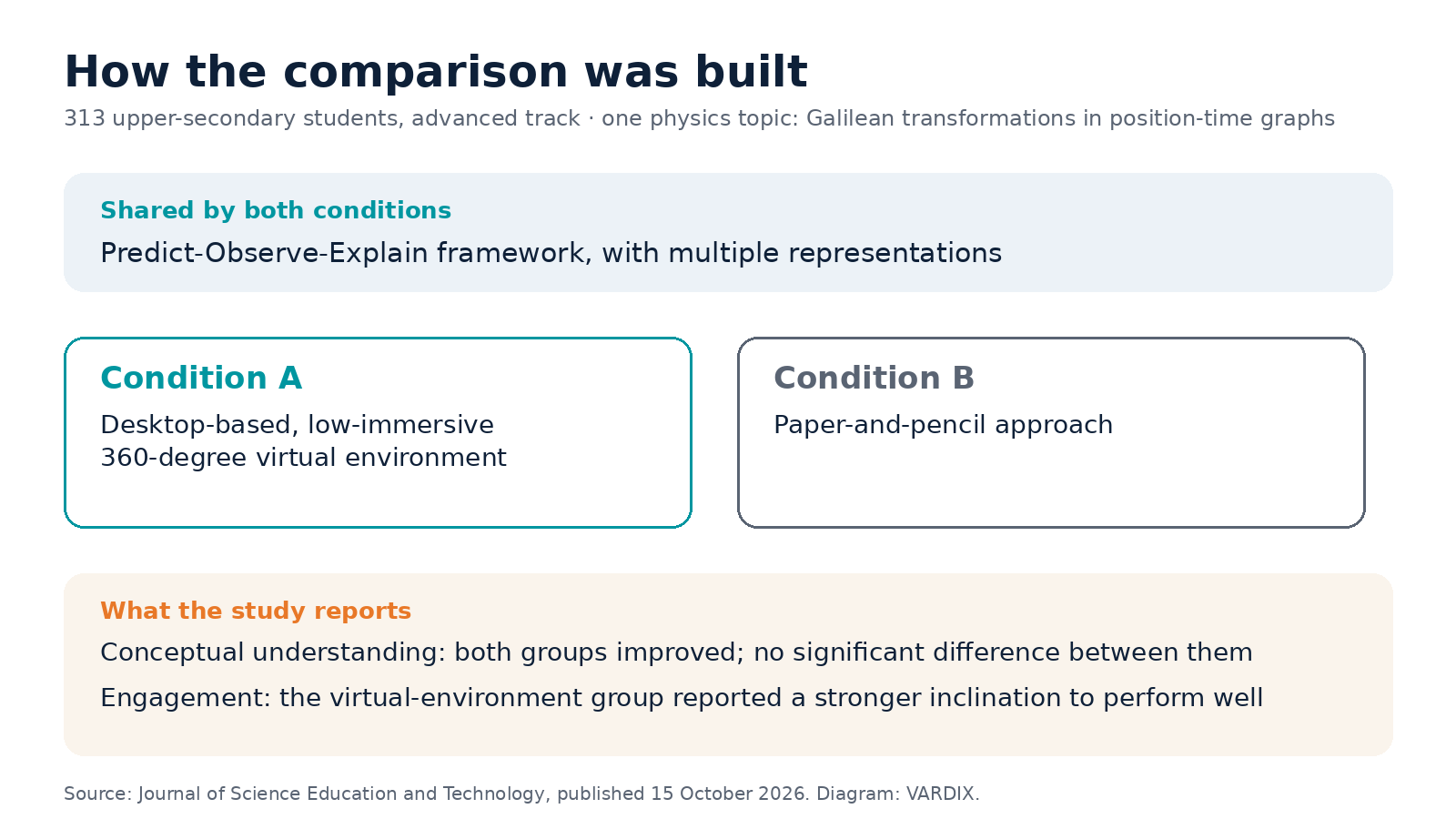
How the comparison was built, from the study’s abstract. Diagram: VARDIX. © Vardix Group
We read that as a warning about the promise, not about the product category. A school that is told a desktop 360-degree environment will raise understanding beyond paper is being sold the claim this study tested and did not find. A school that is told its students will report more drive to do well is being sold the effect the study did report — self-reported effort, which the authors measured and are careful not to overstate.
What a school is actually buying
If neither format showed a significantly larger gain, the question to ask of any classroom science product is whether a teacher can build that structure inside it: set up a situation, let the class predict, show the model behaving, and come back to the explanation. A library of impressive models without that is a demonstration. The setting matters too: the environment was desktop-based and low-immersive — a screen, not a headset.
ROQED Science is built for that kind of lesson. It covers physics, chemistry, biology and earth science through interactive 3D models and simulations; teachers assemble lessons from those models with a lesson builder, the class works in the same models, and classroom management tools run the lesson across a class rather than a single demo seat. It runs on Windows and in the browser, so a pilot can start on the computers a school already has, with no headset requirement.
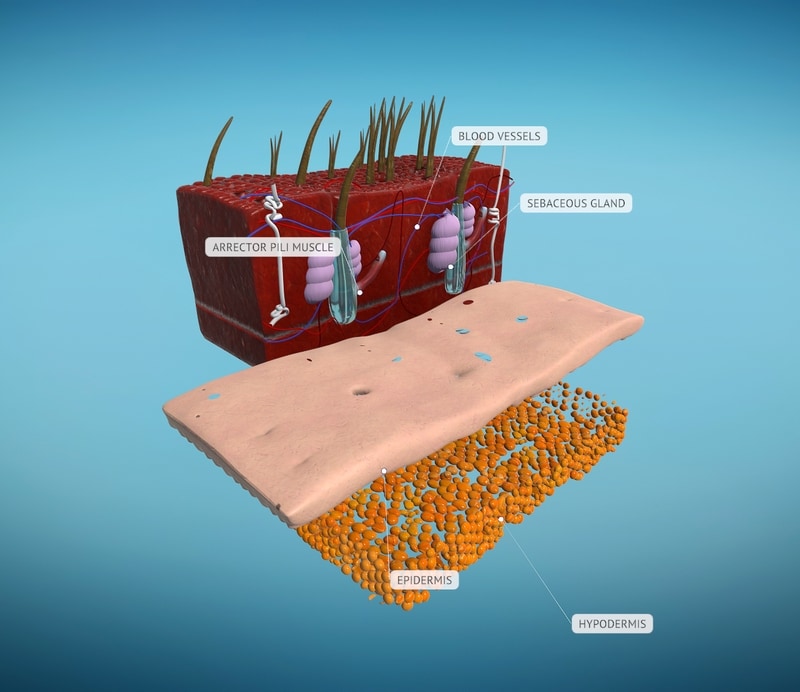
A labelled 3D model from the ROQED Science classroom. © Vardix Group — ROQED
None of this makes the gain automatic, and we would not tell a school it does. The model gives the teacher something to predict about and something to observe; the explanation still belongs to the lesson, and the lesson still belongs to the teacher.
Agree how the pilot will be judged before it starts
Education buyers can read studies like this one, and a distributor who has promised higher scores may meet it in a procurement meeting. In our experience a narrower offer is easier to defend: name the topic where students struggle, show how a teacher builds a predict-observe-explain lesson on it, and agree how the school will judge a pilot — understanding, effort, or both — before the pilot starts. That is a conversation a partner can have in any of the eighteen-plus languages ROQED Science already ships in.
If you already sell to schools or ministries of education and want to add a science classroom to that conversation, the partnership form is the place to start.