

In its September 2026 announcement, the UK Nursing and Midwifery Council (NMC) added new stations to the OSCE, part of its Test of Competence for nurses and midwives. The notice sits on the NMC page “CBT and OSCE Preparation materials”, under the heading “Adult Nursing, Mental Health Nursing and Children’s Nursing OSCE Announcement – September 2026”. It describes the change as part of the NMC’s “regular replenishment of the Test of Competence”.
The list is long. Fifteen new stations apply to all fields of nursing: seven on evidence-based practice (among them donor human milk, oxygen saturations, physical restraint in mental health care, and smoking and schizophrenia) and eight on professional values (among them unsafe staffing levels, racism in mental health care, use of bed rails and hand washing). Mental health nursing gets five more: APIE stations on psychosis and PTSD, and skill stations on medication adherence, the mental state examination and non-suicidal self-injury. Children’s nursing gets three: an APIE station on allergic reaction, and skill stations on aseptic non-touch technique and medication given through a nasogastric tube.
Six weeks from notice to exam
The date is the part a preparation centre feels first. The NMC says that candidates sitting their exam for the first time from Monday 26 October — six weeks after Monday 14 September — may meet any of the new stations and should use the updated marking criteria, which include criteria for those stations. Candidates whose first sitting comes before that date continue with the current material.
It is not a one-off. The same NMC page carries a January 2026 announcement of eight new adult nursing stations, and a March 2026 announcement of new stations in midwifery, children’s and mental health nursing. September is the third replenishment on that page this year.
The problem: rehearsal does not scale with the station list
A new station is not a new chapter to read. The NMC publishes marking criteria for each station. In our view, rehearsing a station properly takes a scenario, someone to play the patient, someone to mark, and a room — for every candidate, for every new station, inside the six-week window. This is where a preparation programme runs out of capacity first: not on knowing what changed, but on giving each candidate enough supervised runs of it.
That gap is what a virtual clinic is for. VARGATES Medical is the group’s clinical simulation suite for medical universities, teaching hospitals and clinical-skills centres. Students interact with virtual patients — performing examinations, making diagnoses and prescribing treatments — and a case can be run again until it is mastered. Instructors can track every session, score and error, so the scarce human hour can go to the candidates and the steps where it is needed.
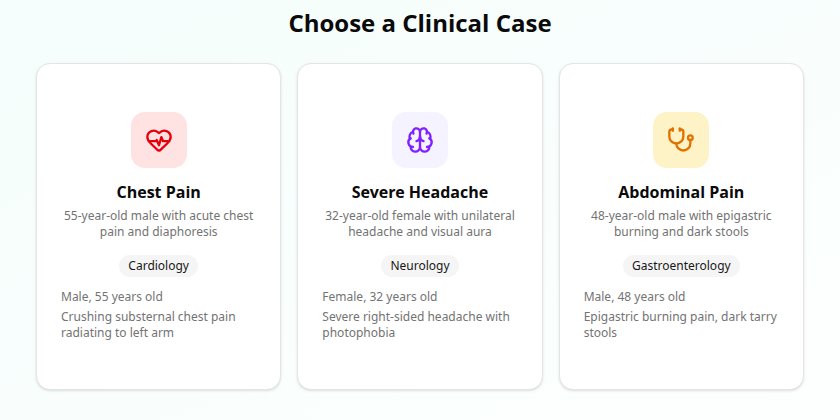
Demo cases on the VARGATES Medical site, as shown on the page: chest pain, severe headache and abdominal pain. © Vardix Group — Vardix Group — VARGATES Medical
Where it fits, and where it does not
We want to be precise about the boundary, because a skills centre will ask:
VARGATES Medical does not contain the NMC’s stations or marking criteria. The criteria are the NMC’s, and a centre prepares against them.
Virtual cases suit the reasoning half of an OSCE — assessing a patient, planning and evaluating care, explaining a decision — more than the hands-on half. Aseptic technique or a nasogastric tube is still practised on a manikin, with an instructor watching.
What a virtual clinic adds is repetition and a record: more runs per candidate than a timetable of actors allows, and a view of who is struggling before the exam rather than after it.
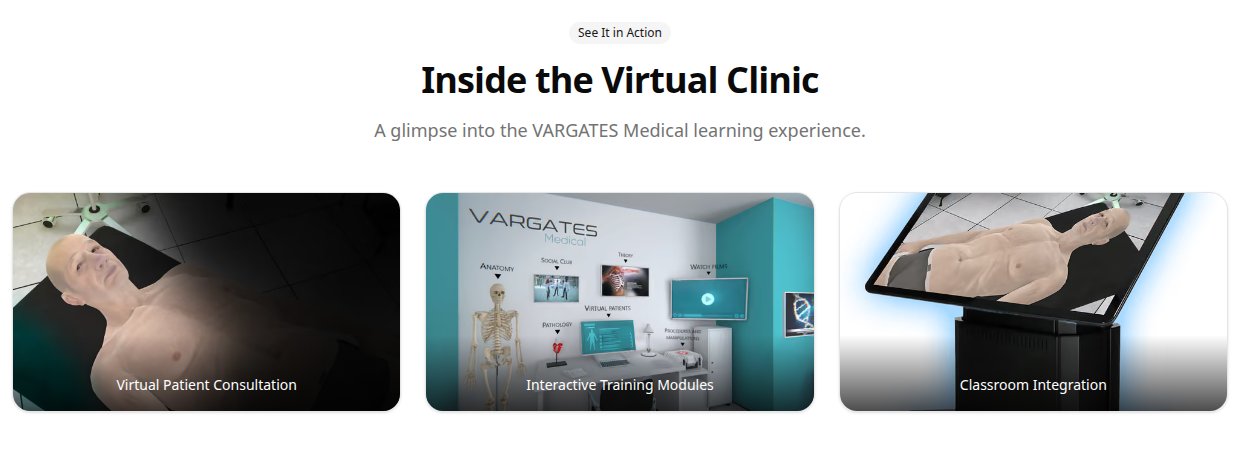
Inside the virtual clinic, as shown on the VARGATES Medical site: virtual patient consultation, interactive training modules and classroom integration. © Vardix Group — Vardix Group — VARGATES Medical
For distributors
The buyers here are already known to anyone selling simulation: nursing and medical faculties, clinical-skills centres, and providers that prepare internationally trained candidates for exams like the NMC’s. Each change to an exam’s station list is a recurring reason for those buyers to revisit how much rehearsal they can offer. A partner who already sells manikins or simulation rooms into that buyer can add a virtual clinic beside them, with VARDIX handling onboarding and support.