
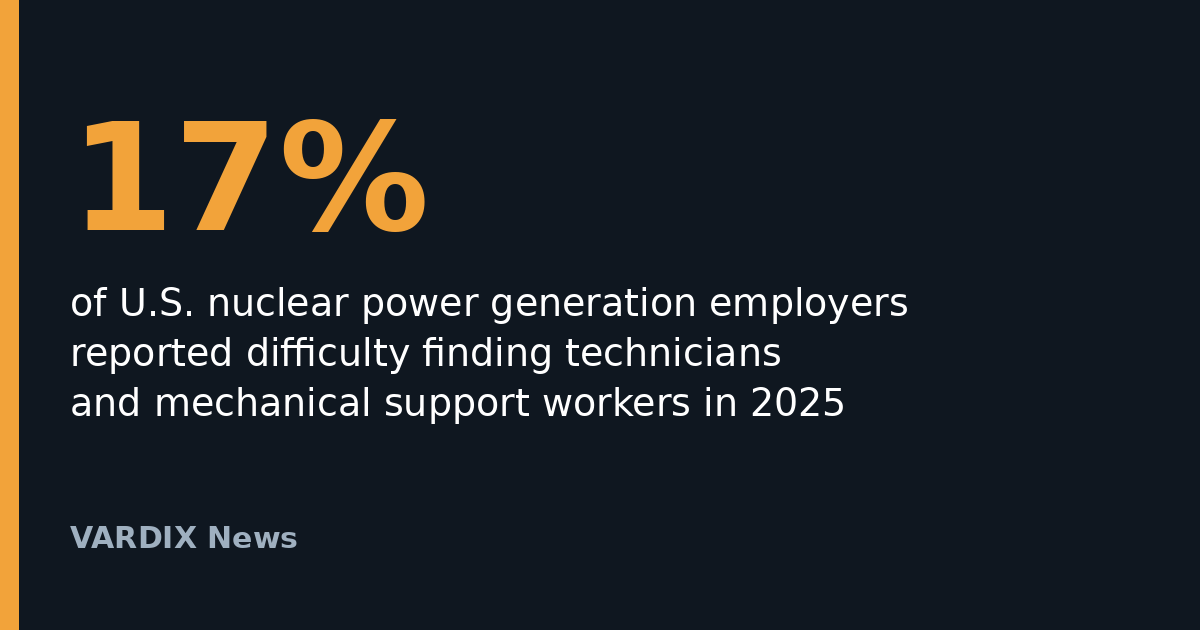
On 20 October 2026 the U.S. Department of Energy's Office of Nuclear Energy published "4 Workforce Trends in Nuclear Energy in 2026", a summary of the 2026 U.S. Energy & Employment Report. The nuclear energy sector grew to more than 70,000 workers in 2025, and employment in nuclear power generation rose 4% from 2024 while employment in electric power generation overall dropped by 2%. In nuclear fuels and in nuclear electric power generation alike, 65% of employers reported some hiring difficulty. Engineers and scientists were the hardest roles to fill, with 32% of nuclear fuels employers reporting challenges, and 17% of employers in nuclear electric power generation reported difficulty finding technicians and mechanical support workers.
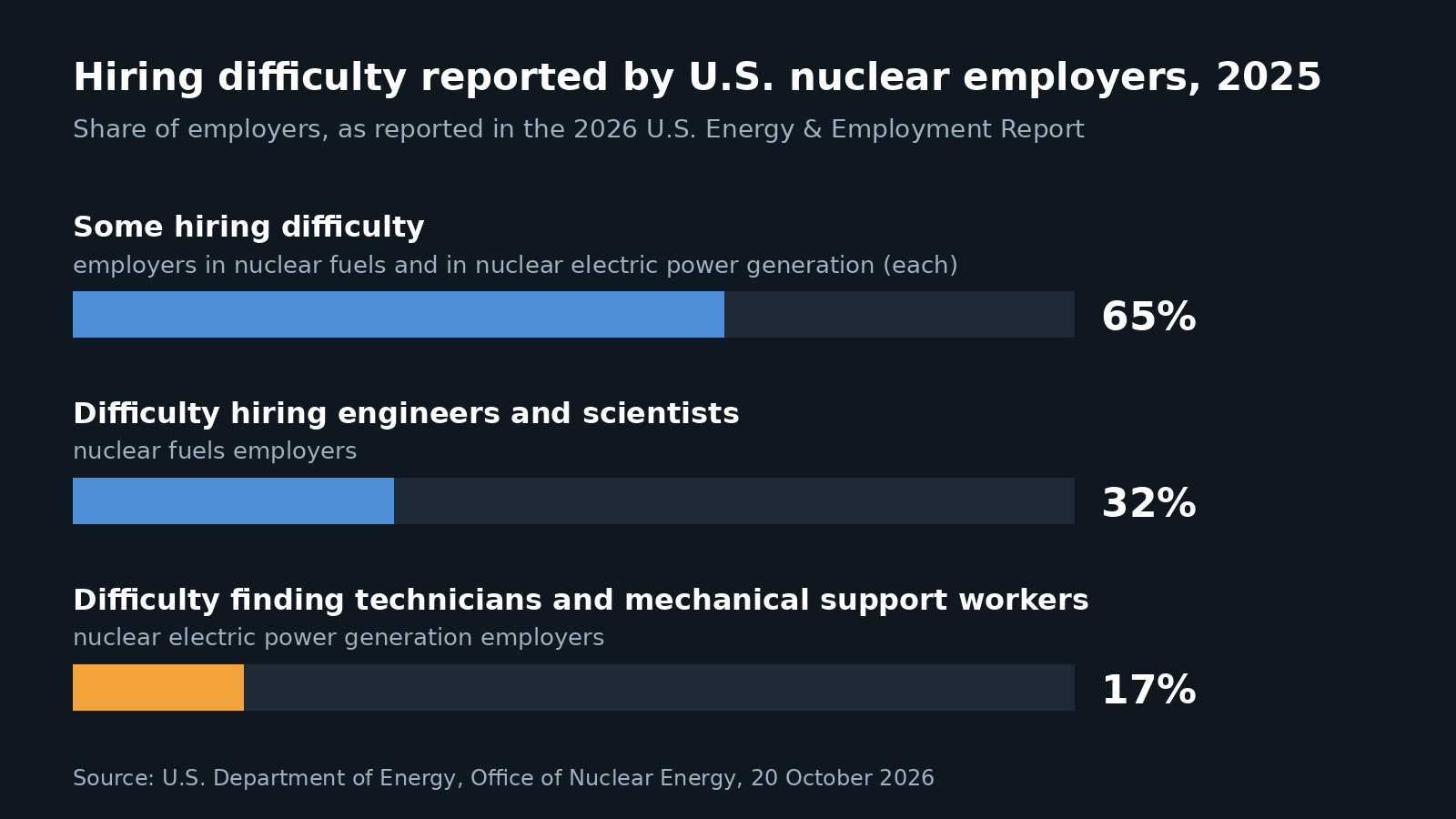
Figures as published by the U.S. Department of Energy, Office of Nuclear Energy, on 20 October 2026, from the 2026 U.S. Energy & Employment Report. © Vardix Group
The same people, wanted by data centers
DOE warns that the pressure could grow. As more plants are built, the department writes, nuclear employers could face increased competition for skilled workers from data centers, infrastructure development and advanced manufacturing, industries that rely on overlapping pools of electricians, engineers, technicians, construction workers and other skilled tradespeople. In the broader electric power generation sector, 76% of construction firms already reported hiring challenges.
The department's answer is a training pipeline: the Nuclear Energy University Program, running since 2009, and the Nuclear Reactor Safety Training and Workforce Development Program established in fiscal year 2025, which funds nuclear safety training and work-based learning such as apprenticeships and made awards to ten university-led projects earlier this year.
Hiring is only the first half of the gap
As we see it, a technician recruited from another industry usually arrives with a trade and tools, but not with this plant's equipment. The usual place to learn that equipment is the equipment itself, next to an experienced crew. At a generating station that is the hardest classroom to book: a unit is opened when maintenance is planned, not when a new hire needs a lesson. That is why a shortage like the one DOE describes is, in our view, paid for twice: once when the vacancy stays open, and again in the months before the person who fills it can work on the plant's machines unaided.
Taking the model apart instead
ROQED Mechanicum, our group's product, addresses that second part of the problem. Equipment is rebuilt as photorealistic 3D models, and a trainee opens it the way a maintenance crew would: part by part, in the order the instruction gives, on a screen or in a VR headset, as often as training needs, while the real unit keeps working. A course is built from the plant's own maintenance, repair or HSE instructions, with tasks filtered by job and specialty, and the same course runs on PC, mobile, VR headsets and industrial panels. It can be integrated with the customer's existing learning management or ERP system, and nuclear and heavy industry is among the sectors ROQED builds Mechanicum courses for.
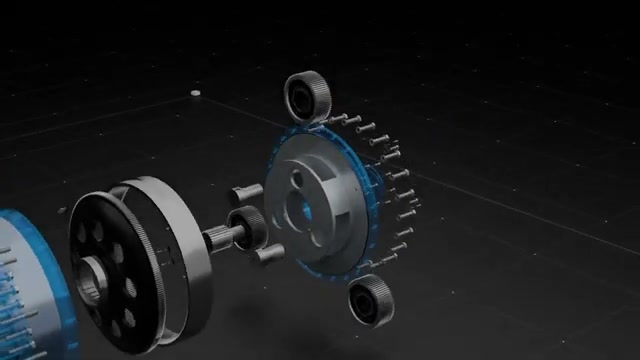
A gearbox taken apart in ROQED Mechanicum. It shows the kind of model a course is built on, not equipment from a nuclear plant. © Vardix Group — Vardix Group — ROQED Mechanicum
What a model does not replace
DOE's safety training program funds work-based learning such as apprenticeships, and as we understand it, a plant's own qualification rules still decide who may work on which system. A 3D course prepares a person for that time on the equipment and, in our view, shortens the part of it spent learning what is inside; it does not stand in for it. The models shown on the product page today are a gearbox, an electric motor, a radial engine and a mining excavator, so a course for a particular station starts with modelling that station's equipment.
The figures are American, too. The report describes the U.S. energy workforce, and whether a plant elsewhere sees the same pattern is a question for its own personnel data. What carries across borders is the shape of the problem: scarce technicians, competing industries, and equipment that cannot be stopped to teach on. A distributor already selling into power generation, mining or heavy manufacturing is talking to exactly the people who have to solve it.