
On 8 October 2026 the journal Advances in Simulation published a study titled “Immersive versus partially immersive virtual reality for training clinical reasoning and patient management in undergraduate medical education”. Ninety-one medical students worked through one or both of two emergency department scenarios developed by Oxford Medical Simulation, in a head-mounted display and on a laptop; eighty completed both sessions, and each scenario was attempted twice, with immediate feedback and faculty debriefing. According to the published abstract, performance scores did not significantly differ between the two (p = .069, d = 0.21).
For anyone who sells simulation to a medical school, that result changes the first conversation. The question a faculty usually brings is “how many headsets do we need?”. This study suggests a different first question: which cases do the students need to practise, and on what device can every one of them practise them this term.
What the study measured, and what it did not
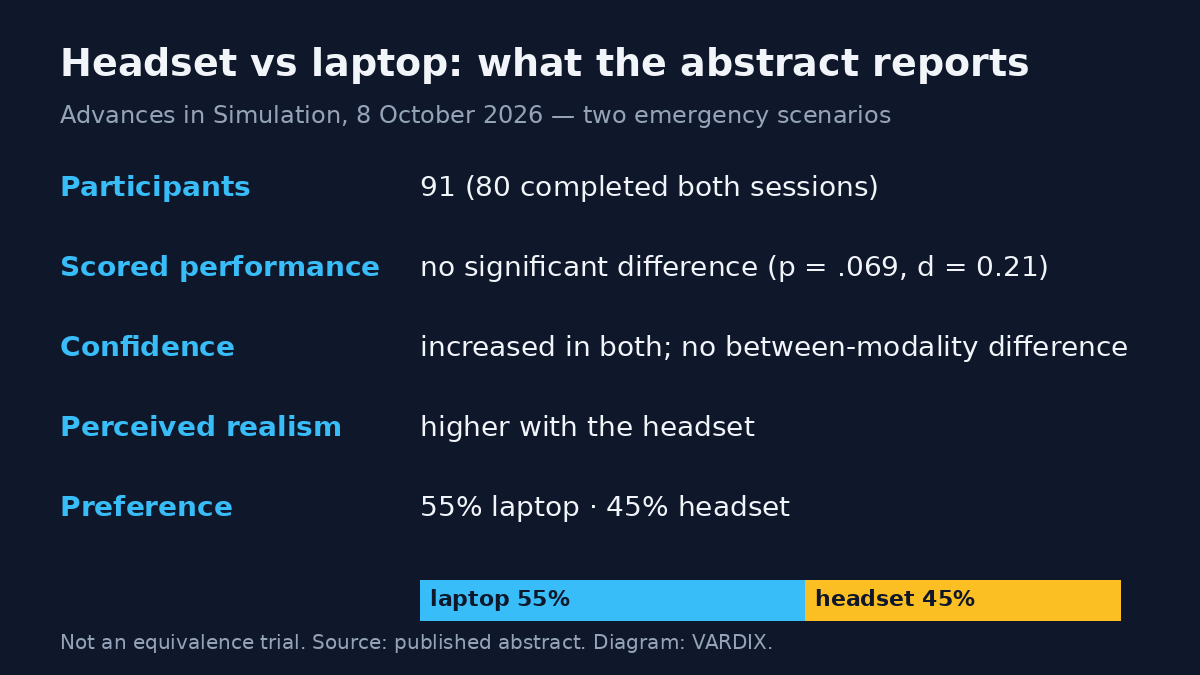
What the published abstract reports. The study was not designed to test equivalence. © Vardix Group
Among the results the abstract reports: performance improved significantly from the first attempt to the second in both modalities. Scored performance did not significantly differ between headset and laptop. Confidence in technical and non-technical skills increased in both modalities, with no between-modality differences. Students were split on preference: 55% favoured the laptop and 45% the headset. And the headset was associated with higher perceived realism, but with no detectable additional benefit in measured performance or self-reported confidence.
The authors are careful about the limits, and so should we be. In their words, the study was not designed to test equivalence, so it does not prove the two formats are the same. It used two emergency department scenarios developed by Oxford Medical Simulation, not a whole curriculum. What it does say, again in the abstract’s own words, is that laptop-based simulation may offer a more scalable option.
The problem it makes sharper: access, not realism
Scale is where simulation programmes usually get stuck. Headsets have to be booked, charged, cleaned and supervised, and a cohort shares a small number of them. If the scored part of a case is learned about as well on a laptop, then the bottleneck is not realism. It is how many students get to run the case at all.
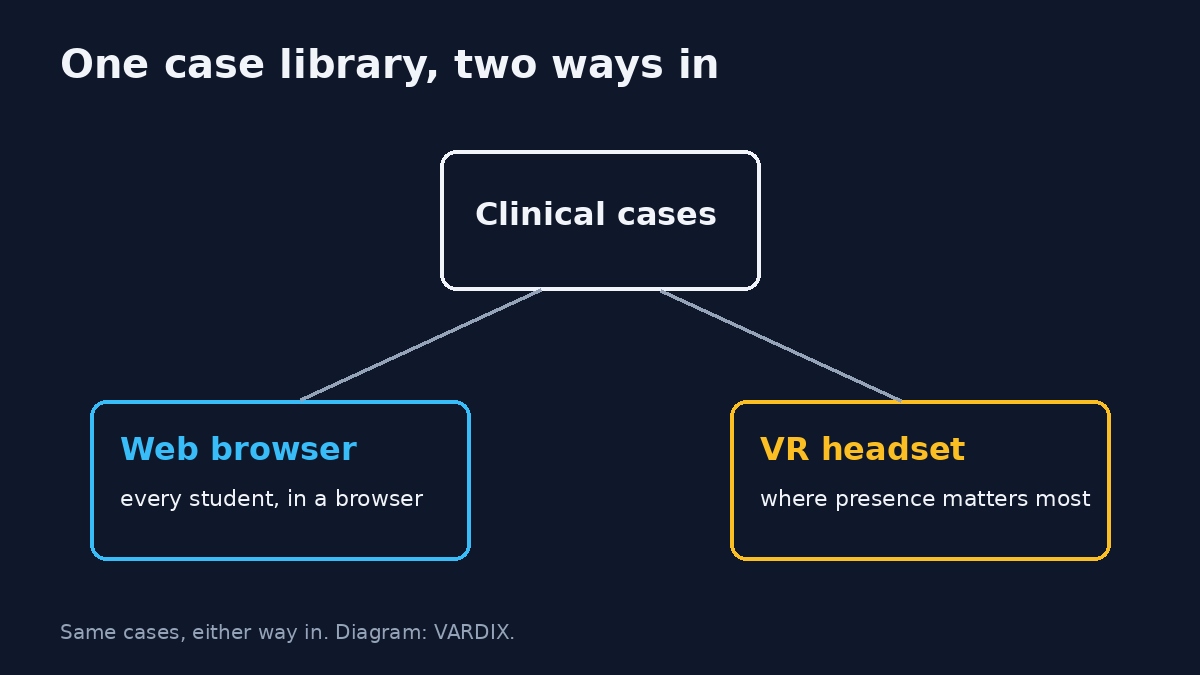
One case library, two ways in: the browser for every student, the headset where presence matters most. © Vardix Group
VARGATES Medical is built for that split. The same programme of clinical cases is accessible via standard VR headsets or a web browser, and institutions get LMS integration, so training data flows into their own systems. In our view, the sensible default for most schools is the browser for every student, with headsets kept for the cases where presence and spatial work matter most — rather than a headset programme that only part of the cohort ever reaches.
What this means for a distributor
A distributor who leads with hardware is selling the part of simulation that this study found no measured performance advantage for. A distributor who leads with cases, and lets the school choose the screen, can start with the faculty’s existing computers and add headsets later as a deliberate upgrade. That is an easier first purchase to approve, and a more honest one.
We work with partners who already sell to medical universities and hospitals. If that is your territory, we would like to hear from you.