
On 25 September 2026 the U.S. Coast Guard published a final rule in the Federal Register, “Implementation of Training Requirements for Personnel Serving on U.S.-Flagged Passenger Ships That Carry More Than 12 Passengers on International Voyages” (docket USCG-2022-0649). It takes effect on 26 October 2026. Its two main changes: every person serving aboard such a ship must complete passenger ship emergency familiarization “before being assigned to shipboard duties”, and crowd-management training, until now required of masters, officers and the personnel on the muster list who assist passengers, is extended to ratings qualified under Chapters II, III and VII of the STCW Convention. It also adds officers to the safety training required of personnel who serve passengers directly.
The requirement is not American in origin. The rule implements amendments to the STCW Convention and Code that were adopted in 2016 and entered into force on 1 July 2018, and that set out a five-tier approach to passenger-ship training. By the Coast Guard’s own count, the U.S. rule reaches 51 ships — 38 of them small passenger vessels under 100 gross tons — and 1,230 personnel for the familiarization; the widened crowd-management requirement adds 44 ratings.
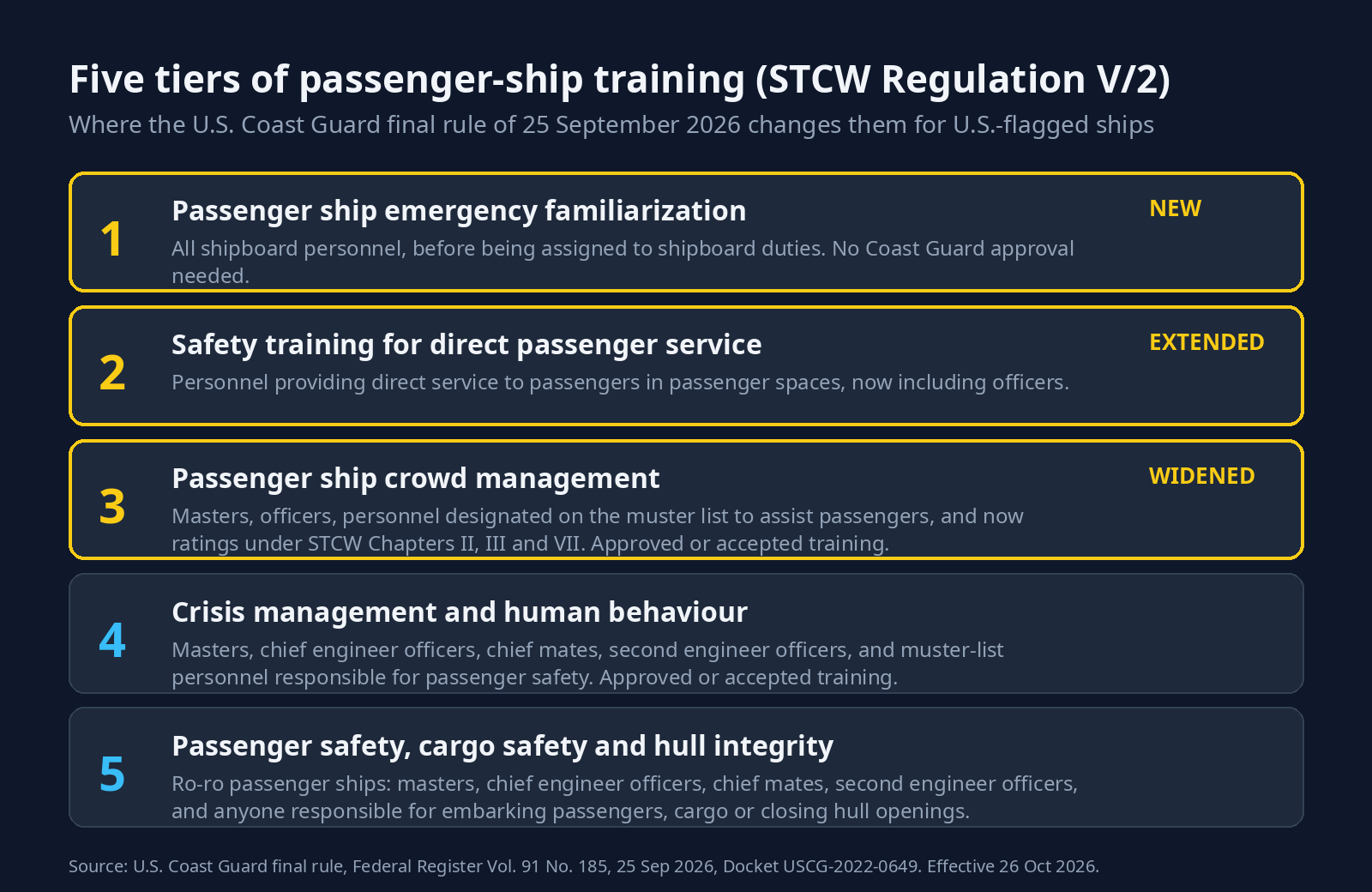
The five tiers, and the three the U.S. rule changes for U.S.-flagged ships. © Vardix Group
What the familiarization has to cover
The rule lists the topics: the general safety features aboard the ship, the location of essential safety equipment including life-saving appliances, the importance of personal conduct during the implementation of emergency plans, and restrictions on the use of elevators during emergencies. Personnel must also be able to communicate with passengers during an emergency, in the working language of the ship and non-verbally, and to understand one of the languages in which emergency announcements may be broadcast.
“Operating companies must ensure personnel are familiarized with the shipboard layout, their shipboard duties, and emergency procedures,” the rule says, and the company or the person must keep documentary evidence that this was done. The familiarization itself does not need Coast Guard approval. Crowd-management training does: it must be approved or accepted training.
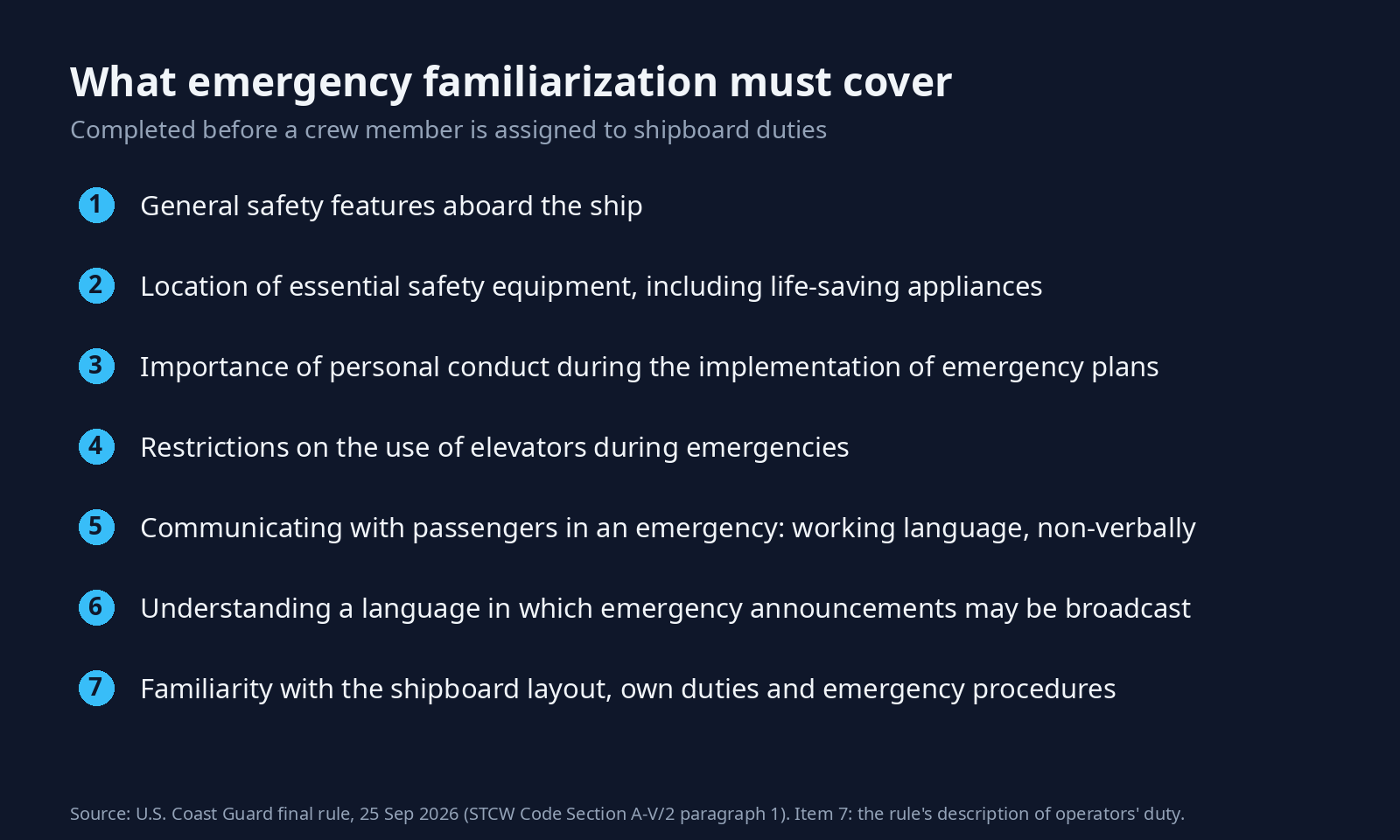
What a new crew member has to know before the first shift, as the rule describes it. © Vardix Group
The difficulty is the ship, and the crowd
Almost every item on that list belongs to one particular vessel: where this ship keeps its life-saving appliances, how its decks connect, what its emergency plans ask of each person. The rule’s own cost analysis describes the familiarization as “conducted on board when personnel report for duty”. In our reading, that places the learning on a ship that is already in service, in a new crew member’s first hours aboard.
In our view, crowd management is harder still. To show why the training matters, the rule recalls the Costa Concordia, which struck a reef off the Italian coast on 13 January 2012 with 3,206 passengers and 1,023 crew aboard; 32 people died. The Coast Guard is explicit that there are no examples of major accidents among the U.S.-flagged ships the rule covers; the Concordia is its illustration from the foreign fleet. Among the contributing factors the Coast Guard cites from the Italian accident report are “delayed management of the emergency response and evacuation process”, “inconsistencies in assignment of duties”, communication issues, and passenger confusion over which crew were trained to help. Its conclusion is that “clearly communicated emergency procedures and experience with crowd management could have aided both crew and passengers”. Experience of a crowd in an emergency is, in our view, exactly what is hardest to give a crew on a working ship.
Where a ship-specific simulation fits
This is the kind of problem our VR / AR / MR Development service is built for: custom training simulations with scenario-based learning, branching, scoring and integration with a learning management system. For a passenger ship, as we see it, that means a model of the vessel’s own decks, muster stations and life-saving appliances that a new crew member can walk through before boarding, and crowd scenes in which a rating practises directing passengers who do not do what they are told — a scene nobody can stage with a full ship.
For partners in maritime training
The five tiers come from the international convention and have applied to its parties since 2018. The question the U.S. rule makes pressing — how a person comes to know one particular ship before being assigned to duties on it — is, in our view, not a U.S. question only. Maritime training centres, crewing agencies and suppliers to passenger-ship operators are the partners who can bring this service to the operators who need it. If that is your market, we would like to talk.