
On 16 September 2026 the U.S. Chemical Safety and Hazard Investigation Board (CSB) released its final investigation report, Furnace Explosion and Fire at Shell Polymers, Monaca, Pennsylvania, report No. 2025-05-I-PA. On 4 June 2025 flammable cracked gas flowed back from a downstream quench tower into the firebox of an ethane cracking furnace, Furnace 5, reached lit pilots and exploded. Fifteen employees were evacuated. In the words of the board's chairman, no one was killed or seriously injured.
The furnace was being returned to service after its coke trap had been cleaned for the first time. Two motor-operated valves isolated it from the downstream equipment, and Shell's policy, when removing the furnace isolation, was to open only one of them. The task of opening the tower-side valve went to a process control engineer who, the report says, "had never performed the task before" and "was assigned the task during the daily production meeting". The written job aid listed its steps out of sequence, the valve screen refreshed mid-task, and the engineer opened the furnace-side valve instead, then the tower-side one with it. The report adds that the engineer "had limited process knowledge and was unable to appreciate the process hazards" of that combination.
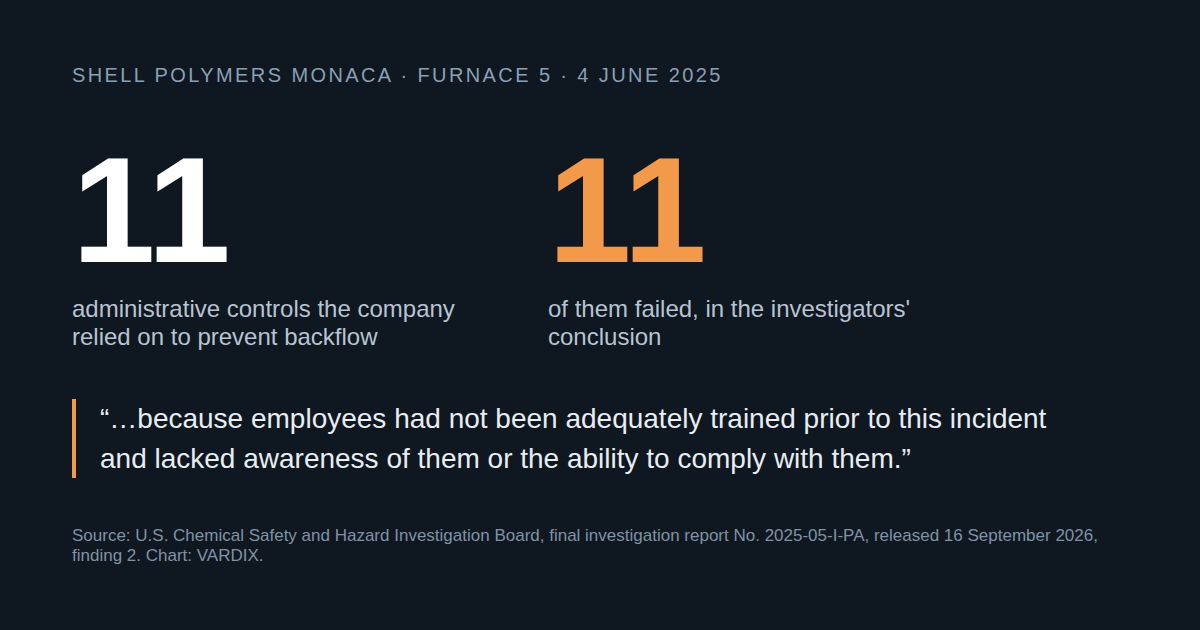
Finding 2 under Administrative Controls in the CSB report. The chart is ours; the numbers and the quotation are the board's. © Vardix Group
What the board recommends, and it is not more training
It would be easy to read this report as an argument for training. It is not, and a material that sells training should say so first. The CSB makes two recommendations to Shell, and neither is about training: review the ethane cracking unit's hazard analysis to identify process deviations addressed solely with administrative controls, and implement an inherently safer design or an engineered control for any such scenario that could result in a fatality, serious injury or substantial property damage; and implement and maintain an engineered control that prevents cracked gas from flowing back into a furnace in all modes of operation. The report also finds that the screen showed three nearly identical valves whose tags differed mainly by the final digit.
This incident demonstrates the importance of using engineered safeguards to control serious process hazards in all modes of operation, rather than relying solely on procedures and worker actions.
What the report says about training anyway
The same report is precise about what happened to the procedures the plant did rely on. Shell relied on 11 controls that it believed should have prevented the explosion, and every one of them was administrative: it depended on people knowing what the policy required and following it. The board's conclusion is that "all 11 controls that Shell identified failed because employees had not been adequately trained prior to this incident and lacked awareness of them or the ability to comply with them."
It also says what a working administrative control takes: the company "provides adequate training and drills, qualifies employees on the policies and procedures, and regularly validates the effectiveness of the controls." And the chairman, Steve Owens, put the first lesson in one line: the importance of "ensuring that the personnel who are assigned to critical tasks actually have the experience to do them".
Read from the employer's side, that is a question asked at a specific moment. A procedure nobody has been trained on is a document, not a control. And the daily production meeting where a task is handed out is the moment when someone either can see who has been trained and qualified on it, or cannot.
| What the CSB found | The question for the employer |
|---|---|
| The engineer assigned to open the valve had never performed the task and was assigned it at the daily production meeting. | Before a critical task is assigned, can the person assigning it see who has been trained and qualified on it? |
| All 11 controls Shell identified failed because employees had not been adequately trained and lacked awareness of them or the ability to comply with them. | For each control the hazard analysis relies on, who is it meant to reach, and has it reached them? |
| After the incident, training was provided to all process control engineers and operations personnel on the change in who opens the valves. | When a procedure changes, how does the employer know the change has reached everyone it covers? |
Where KNOWIKA fits
KNOWIKA is the group's learning platform for industry, built for mining, oil and gas and heavy industry in Kazakhstan. It works on the employer's half of the questions above. Subject experts build courses in a drag-and-drop editor, with templates for safety instructions and equipment manuals; the company assigns them to the employees they cover; follows completion in reports; and issues certificates. The result is a record the person handing out work can look at, rather than a recollection of who attended what.
Two features matter for the third question in particular. When a procedure changes, the updated course can be assigned to everyone it covers, and the progress report shows who has completed it and who has not. And one course can be delivered at three depths, strategic for management, operational for engineers and practical for workers and field operators, which is relevant where, as in Monaca, the work crosses a role boundary: Shell's policy expected field operators to open and close the valves, but only a process control engineer could open the tower-side valve when the furnace isolation was removed.
For plants in Kazakhstan the platform starts where the law already requires training: courses for compliance with Kazakhstan law come first. Content, tests and certificates run in Kazakh, Russian and English; training works on a phone at the mine or the rig, with an offline mode for sites without a connection; and it can be deployed inside the customer's network, including closed sites without internet access.
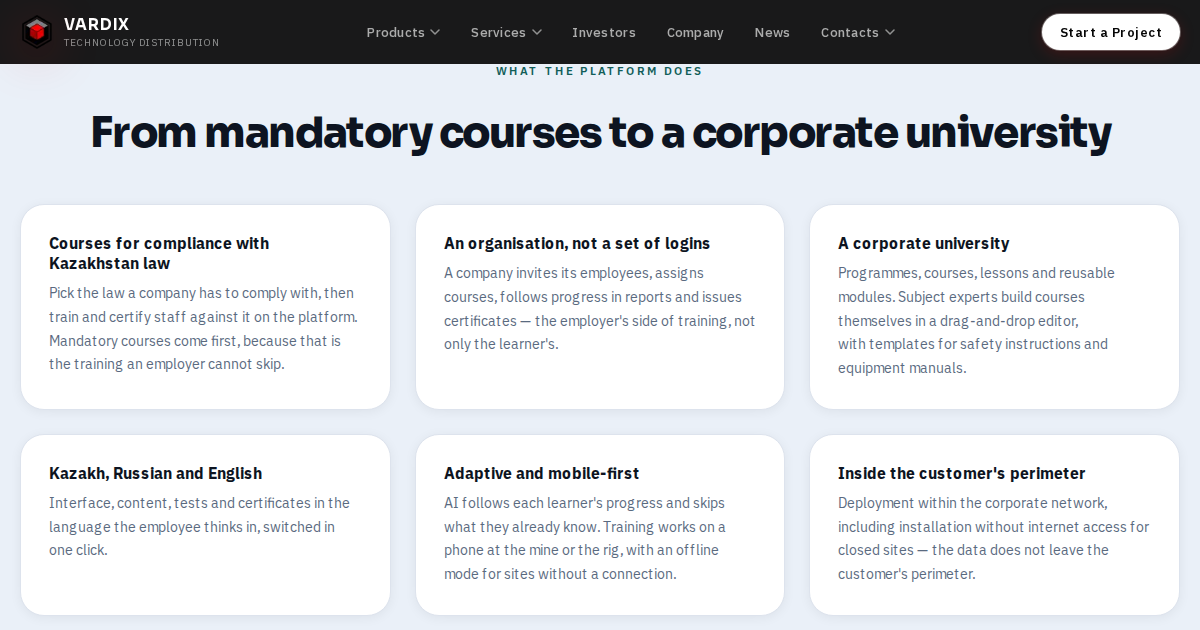
What the platform does, from the KNOWIKA page on this site. © Vardix Group
What a learning platform does not do
It is not the barrier the CSB asked for. Where a scenario left only to administrative controls could result in a fatality, serious injury or substantial property damage, the board recommends an inherently safer design or an engineered control; for cracked-gas backflow it recommends an engineered control in every mode of operation. No course replaces either.
A completed course is not experience. The board writes about training and drills and about qualifying people on the procedures; the drills and the hands-on qualification happen on the plant, not on a screen.
It does not fix a job aid whose steps are out of order or a screen on which three valves look alike. Those were findings of the same report, and they are engineering and document-control work.
What it does is narrower and still worth having: it makes the answer to "has this person been trained on this procedure?" a record rather than a guess, at the moment the work is assigned.
For distributors
Every plant relies on procedures for something, and every plant assigns work at a morning meeting. Industrial distributors and training partners who already sell into mining, oil and gas and heavy industry in Kazakhstan can bring KNOWIKA to those customers, starting from the courses Kazakhstan law already requires.