
On 10 August 2026 the U.S. Chemical Safety and Hazard Investigation Board (CSB) released its final report on the explosion at the U.S. Steel Clairton Coke Works in Clairton, Pennsylvania, on 11 August 2025. Coke oven gas was released and exploded, killing two people and injuring 11 others, five of them seriously. The report is titled Fatal Coke Oven Gas Explosion at U.S. Steel Clairton Coke Works, Investigation Report No. 2025-03-I-PA.
The explosion happened during maintenance. Plant employees and contractors from MPW Industrial Services were trying to fully close and reopen an isolation valve on the piping that supplied coke oven gas to one of the plant's coke oven batteries, Battery 13. What the investigators found about that task is a question about training as much as about equipment, and it is the question this article is about.
What the report found about the task
The plant had a written operating procedure for “exercising” the valve: closing it and reopening it to make sure it could move through its full range. Employees told the CSB they occasionally had difficulty closing a valve fully, because residue built up in the valve seat. The exercising procedure allowed steam at a limited pressure; it did not mention water, and the plant had no formal procedure for washing valves with water. According to the report, plant employees had nevertheless used pressurized water to clean valves this way, on an ad hoc basis, for at least three years before the incident.
On training, the report is direct:
Neither U.S. Steel nor MPW workers were trained on the correct sequence of steps to safely conduct the valve washing operation.
It adds that the contractor's workers “had no procedure for and were not trained to perform” the washing, and that a supervisor could direct the operation “without prior planning, a procedure, training, a work permit, or sufficient hazard analysis and mitigation.”
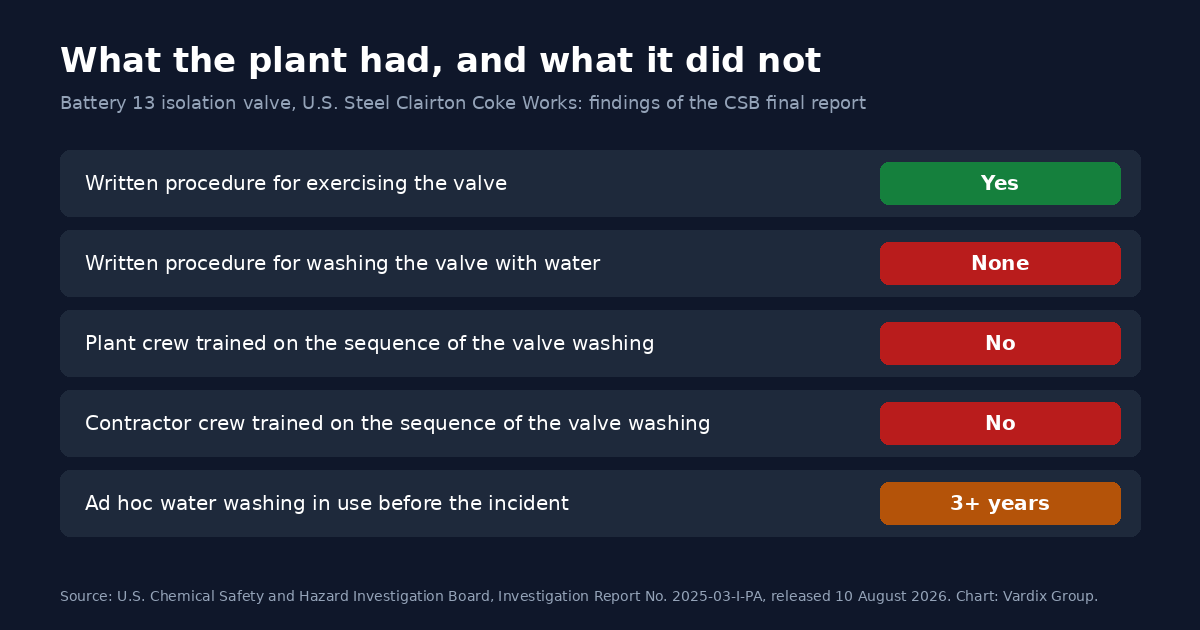
The findings, as the CSB final report states them. Chart: Vardix Group. © Vardix Group
Two findings, and the order they come in
The first of the report's key lessons for industry puts the two findings in order: if a task “can be performed incorrectly and in a way that could result in harm to people, property, the environment, or the community, there should be a detailed written procedure prescribing the correct way to perform the task, and workers should be trained on the procedure.”
First the procedure, then the training on it. In our reading, that order is the useful part for anyone who sells training into heavy industry. A training gap on a non-routine maintenance task is often a procedure gap one step earlier: the task has been done for years, it lives in the hands of whoever does it, and there is nothing written for a course to be built from. The Clairton report also shows the gap reaching past the plant's own staff, to the contractor crew that applied the water while plant employees operated the valve.
Where ROQED Mechanicum fits
ROQED Mechanicum is the industrial training platform that the group distributes. Equipment is rebuilt as photorealistic 3D models, and a trainee takes it apart part by part, in the order the instruction gives. Courses are built from the plant's own maintenance, repair or HSE instructions, with tasks assigned by job and specialty, and the same courses run on a PC, a mobile device, a VR headset or an industrial panel.
That addresses the second half of the CSB lesson: training people on a written procedure, step by step and in sequence, on a model that can be taken apart as often as training needs while the real unit keeps working. It matters most where the real unit cannot be stopped for practice: the crew learns the correct sequence on the model, as often as needed, instead of on live equipment.
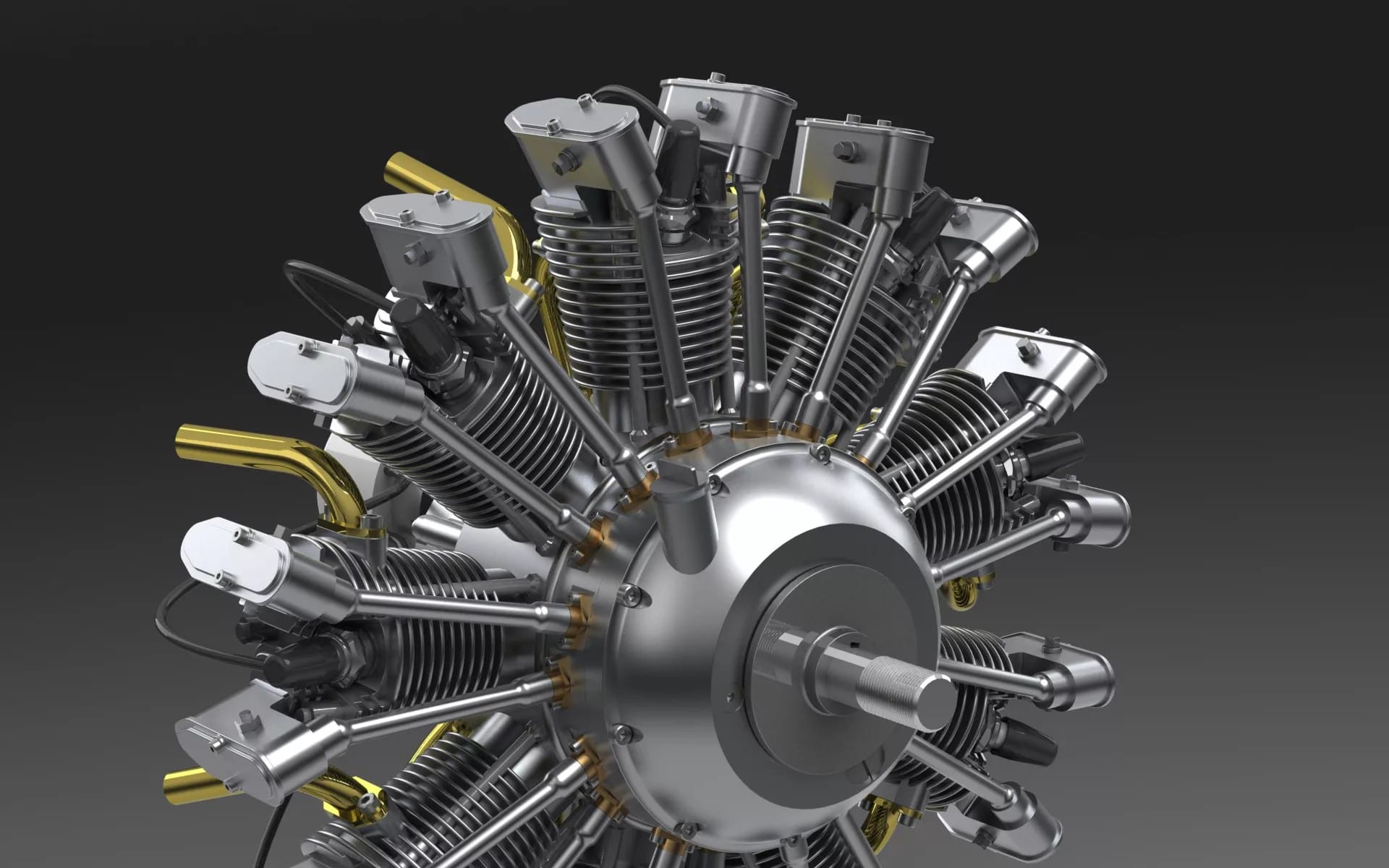
A radial engine modelled part by part in ROQED Mechanicum. © Vardix Group — ROQED Mechanicum
What it does not do
It does not write the missing procedure. A Mechanicum course is built from the plant's own instructions. Where no written procedure exists, as for the valve washing at Clairton, the first job is the procedure, written by the company together with the people who do the work.
It does not replace the rest of what the report recommends, such as hazard analysis, protection against overpressure and the siting of occupied buildings, nor the planning and work permit the report found missing on the day.
It trains only the people who are given access. The customer decides how many users there are, so whether contractor crews are included is a decision the plant has to make.
We do not claim that a 3D course would have prevented this explosion. The report's findings are broader than training, and the article does not argue otherwise.
For a partner selling into heavy industry
A report like this one gives an industrial distributor a concrete question to bring to a plant: which of your non-routine maintenance tasks have a written procedure, and who, including contractors, has been trained on it? Where the answer is “the procedure exists, the training does not,” ROQED Mechanicum is the product for that gap.
Partners work on authorised dealer or reseller terms. Installation, training, localisation and Level 1–3 support come from the VARDIX team that already delivers the product. Pricing is discussed in conversation, not published.