
On 21 September 2026 the Czech Ministry of Education, Youth and Sports (MŠMT) published methodological guidance to Decree No. 121/2026 Coll., the new rules on handling hazardous chemical substances and mixtures, dusts and biological agents in schools. The decree was signed on 24 June 2026, replaced Decree No. 61/2018 Coll., and has been in force since 1 September 2026. In the ministry's words, the main aim of the new rules is “to support high-quality and safe teaching of science and vocational subjects, not to restrict school experiments.”
The guidance, reference MSMT-15528/2026-1, is the practical reading of the decree for teachers: tables, model situations from practice and instructions for classifying substances. In our reading, it leaves standing two kinds of chemistry lesson — one where the class watches, and one where the class waits. That is the part this article is about, and it is where ROQED Science fits.
What the decree sets out
The decree works by a positive list. Its annexes define the hazard classes and categories that pupils may handle, and its sections 1 to 4 say who may handle each annex and on what terms. The result is a ladder of four rungs rather than a single permission:
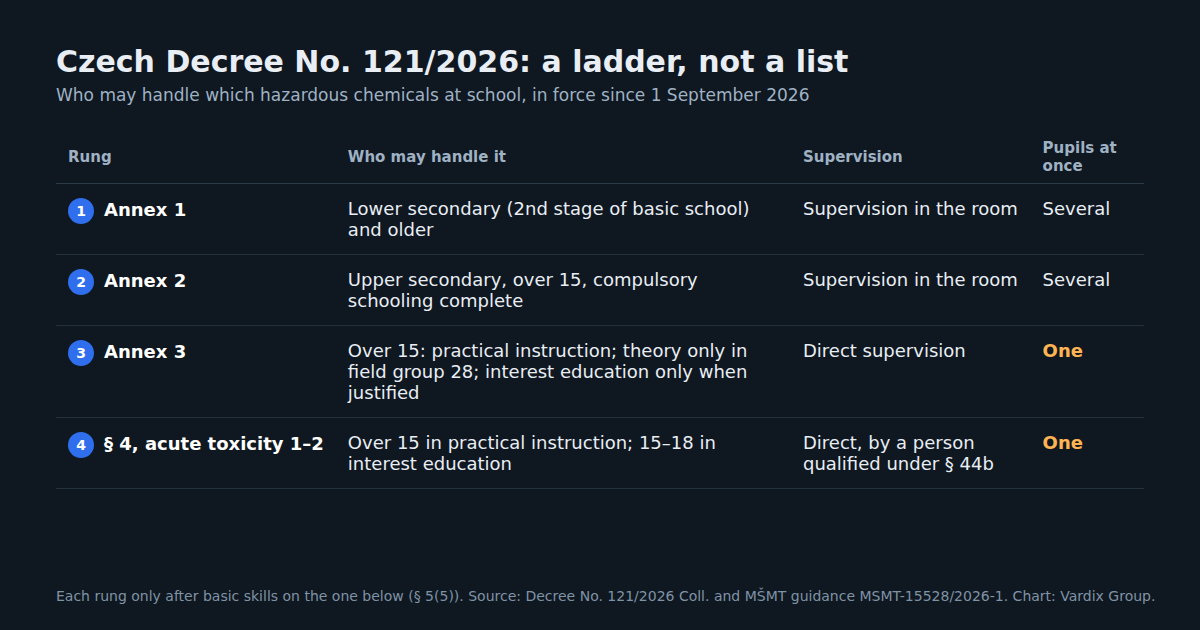
The four rungs as Decree No. 121/2026 Coll. and the MŠMT guidance set them out. Chart: Vardix Group. © Vardix Group
Pupils in the second stage of basic school may handle only the substances and mixtures in Annex 1. The guidance says so directly, and adds that first-stage pupils are not among the people the decree authorises at all, and that Annex 2, Annex 3 and the section 4 regime are not meant for basic-school pupils.
Annex 2 opens to secondary pupils over 15 who have completed compulsory schooling. Annex 3 opens to pupils over 15 in practical instruction, in theoretical instruction only in the chemistry-related field group 28, and to 15–18-year-olds in interest education only in specially justified cases. Substances classified as acutely toxic in category 1 or 2 (section 4) may be handled by pupils over 15 in practical instruction and by 15–18-year-olds in interest education, in both cases under a person qualified under section 44b of the Public Health Protection Act.
A pupil moves to a higher rung only after acquiring basic skills on the one below (section 5(5)). The guidance calls this the principle of gradual acquisition of skills.
For Annex 1 and 2 several pupils may work at once, with the supervisor present throughout and keeping every pupil who handles the substance in view; mere presence in the room, the guidance adds, is not enough. For Annex 3 and section 4 the decree requires direct supervision, and the guidance spells out what that means: the teacher watches only that one pupil for the whole activity, so only one pupil may handle the substance at a time. Neither form of supervision, it adds, can be carried out remotely through blended learning.
Before pupils handle a hazardous substance, the supervising person must explain and demonstrate the procedure in detail (section 5(6)).
The guidance also notes that the earlier exception which let adolescent pupils handle hazardous substances in preparation for an occupation, to the extent the framework curricula required, under section 12a of Government Regulation No. 361/2007 Coll. ended on 1 September 2026, when the decree took effect.
What the ministry recommends where pupils may not
The guidance is not a list of prohibitions, and it goes out of its way to say so. Chemistry, it says, is an experimental science, and the ministry recommends that experiments be a regular part of chemistry teaching rather than an exception reserved for specialised schools — ideally in every larger topic. Among its recommendations for doing that safely, the ones about the substance itself are substitution with a less hazardous one, lower concentrations and microscale work.
Where pupils may not handle a substance at their level, the guidance offers a safer substitute, a lower concentration, or the teacher's demonstration. The decree regulates pupils, not teachers, so a teacher may demonstrate even with substances pupils may not handle themselves, as long as the general legal requirements are met and pupils do not handle the substance during the demonstration. Its worked example is bromine, which falls under the section 4 regime; in ordinary school practice, the guidance says, a demonstration by the teacher or a safer substitute will usually be more appropriate. Its checklist for schools ends with the line this article takes its title from:
For experiments that are not suitable for pupils to carry out, consider a demonstration by the teacher instead of dropping them from teaching entirely.
Two lessons the rules leave standing
In our reading, this leaves a chemistry teacher with two situations that the rules make more common, not less.
The first is the lesson where the class watches. The experiment happens at the teacher's bench; the pupils see the colour change, the gas, the precipitate. What they do not see is what the decree's own classifications are about — why this substance sits on a higher rung than that one, and what is happening between particles while the flask changes colour. That part still has to be drawn on a board or described.
The second is the lesson where the class waits. On the Annex 3 and section 4 rungs, one pupil works under direct supervision while everyone else in the room needs something meaningful to do. The decree is right to demand that attention; it simply does not say what the other pupils learn in the meantime.
Where ROQED Science fits
ROQED Science is the interactive 3D classroom that the group distributes: physics, chemistry, biology and earth science taught through 3D models and simulations. Teachers build lessons from those models, and the whole class works in the same models. It runs on Windows and on the web, so a school can start without headsets, and it is already published in more than 18 languages.
That matches both situations above. Alongside a teacher's demonstration, the class can open the same process as a model and look at what the demonstration cannot show. While one pupil works at the bench under direct supervision, the rest of the class works in the model of the same topic instead of watching over a shoulder. And before a new procedure, a model is one more way to prepare pupils for what the supervising teacher will then explain and demonstrate in person.
ROQED Science: the class works in the same 3D models the teacher builds the lesson from. © Vardix Group — Vardix Group — ROQED
What it does not do
It does not replace the experiment. The ministry's guidance asks for more hands-on chemistry, not less, and a 3D model is not an argument for dropping an experiment a school can run.
It is not a compliance tool. It is not supervision, it is not the training the decree requires of supervising staff, and it does not replace the explanation and demonstration that section 5(6) requires the supervising person to give before pupils handle a substance.
It does not classify substances. Which rung a solution falls on depends, as the guidance stresses, on the classification of the actual form and concentration used, taken from its safety data sheet.
We do not claim that the decree calls for software, or that ROQED Science is in use in Czech schools. The decree and the guidance say nothing about digital tools; the fit described here is our own assessment.
For a partner in education
A rule change like this gives an education distributor a concrete question to bring to a school, a school chain or a regional authority: which experiments in your chemistry curriculum now sit on a rung your pupils cannot reach, or in the one-pupil-at-a-time regime — and what does the rest of the class do during them? Where the answer is “they watch” or “they wait”, ROQED Science is the product for that lesson.
Partners work on authorised dealer or reseller terms. Installation, training, localisation and Level 1–3 technical support come from the same VARDIX team that already distributes ROQED Mechanicum.