
In September 2026 the Nursing and Midwifery Council, the UK regulator for nurses and midwives, published an announcement titled “Adult Nursing, Mental Health Nursing and Children’s Nursing OSCE Announcement – September 2026”. It adds new stations to the objective structured clinical examination in the Council’s Test of Competence. Among them are new clinical skills stations: aseptic non-touch technique and medication administration via a nasogastric tube for children’s nursing, and a mental state examination, medication adherence and non-suicidal self-injury for mental health nursing. Candidates sitting their exam for the first time from Monday 26 October may meet any of them, and the Council tells them to use the updated marking criteria documentation, which includes the criteria for the new stations.
Those criteria are published as numbered tables. In the Council’s “Test of Competence 2021: Marking Criteria – Children’s Nursing”, marked “Updated September 2026”, each station is marked against its own criteria, some of them essential criteria a candidate must meet to pass, and an examiner can apply a red flag for any action that could harm a patient. The aseptic non-touch technique station alone runs to twenty rows, from introducing yourself and explaining the procedure, through cleaning the trolley from the farthest to the nearest point, to checking that the child is comfortable and can reach the call buzzer.
The same document carries a warning. The criteria are indicative, they change periodically with clinical best practice, and candidates should not try to memorise them. Both halves matter to anyone who sells clinical skills training: the table is what the performance is marked against, and the table has a version and a date.
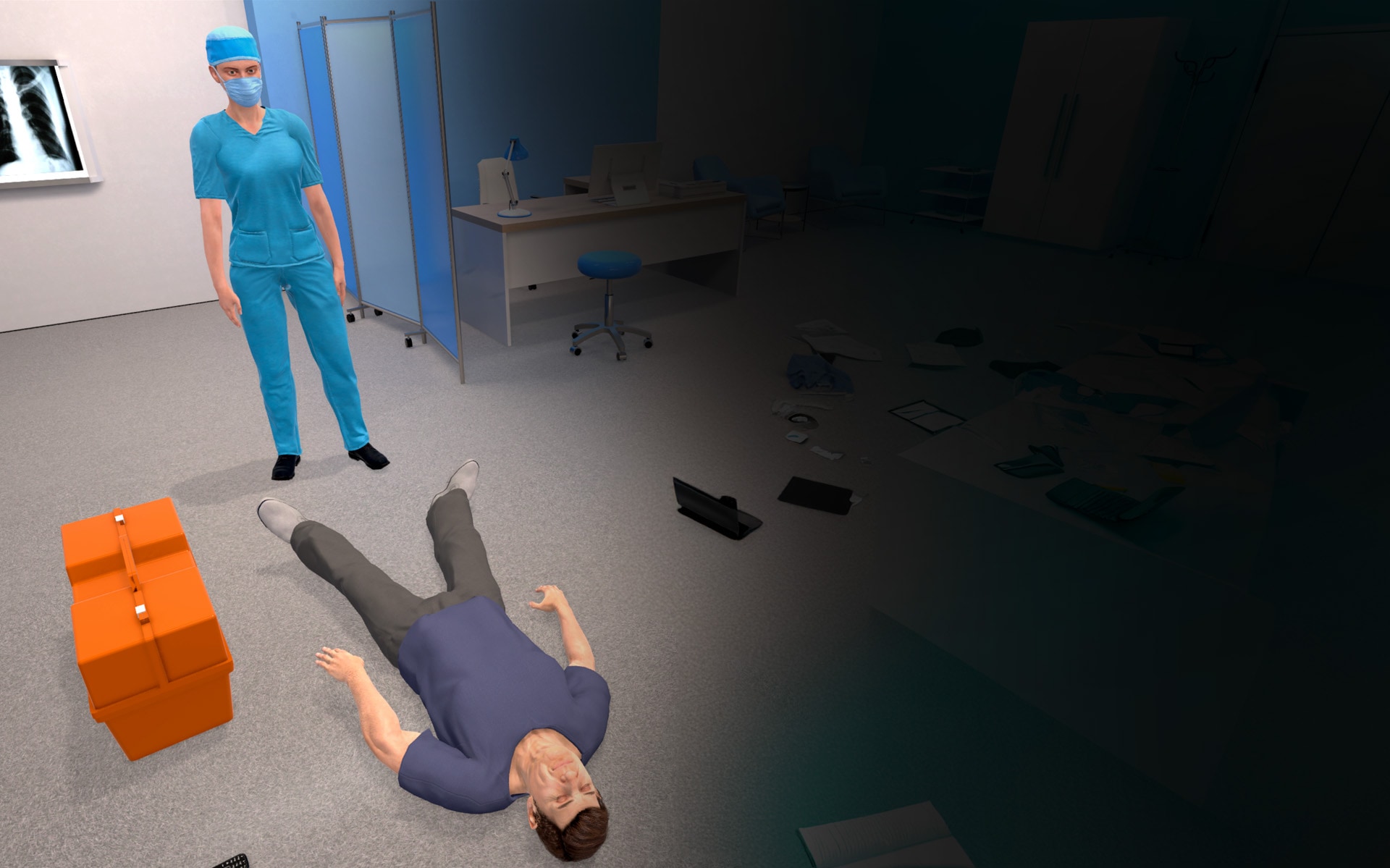
A procedure in VARGATES Medical is a sequence the student performs, step by step, in a simulated room. © Vardix Group — VARGATES Medical
A course is accepted against the same table
This is the problem the group’s own procedure courses are built around. A clinical procedure course is not accepted on how good it looks. It is accepted against the checklist a student is assessed on, row by row, which makes the wording of the course a compliance question rather than a style question. A course retold in its own words — accurate, readable, better written than the source — is still assessed against wording it never used.
So the rule is arithmetic rather than editorial: one row of the checklist is one frame of the course, and the frame’s description is the cell itself, character for character. Where a table puts two actions in one row, the course keeps them in one frame, and asks the student for their order only when the row itself states one.
At the end of August fourteen of our procedure courses went through this — among them auscultation of the heart and of the lungs, blood pressure by mechanical sphygmomanometer, intramuscular injection, catheter care and compounding a solution to prescription. Each was compared with its own checklist row by row. The comparison found what drift turns into once a course is a sequence a student performs:
a missing step: in the lung auscultation course the stethoscope head was never treated with the sterile wipe that had just been opened;
a third of a checklist never carried across: the liquid dosing course stood at twenty frames against thirty rows;
a clinical error: at the third to fifth intercostal space on the midclavicular line the student listened on both sides, where the checklist has the right side only;
a detail nobody had written down: an injection step had acquired “the upper outer quadrant of the buttock”, which the checklist does not say.
The intramuscular injection course shows why the check has to be mechanical. Its structure was already right: fifty-five frames against fifty-five rows. Its text was not. Of the thirty-seven descriptions compared, not one matched its cell word for word — “waste container class A” for “container for medical waste class A”, a digit where the table spells the number out. Each reads correct to a reviewer and fails a comparison, which is why the comparison is a script and its report states how many descriptions matched.

The VARGATES Medical platform, which a faculty's procedure courses are delivered on. © Vardix Group — VARGATES Medical
When the table changes
The Council’s September update is the shape of the problem in its plainest form: a revised table, a date on it, and a date from which it applies. A course built row for row from a table can be compared again on the day a new version arrives, and the report says exactly which frames moved. A course that paraphrased its table has to be reread by a person, row against sentence, every time.
Checklists also have defects of their own — typos, a mood that slips from imperative to infinitive. We correct those in the table itself, rebuild the course from the corrected table, list every changed cell, and send the table back to its author; otherwise the next version arrives with the same typos and the course quietly disagrees with the sheet it is marked against. Where a disagreement is not a typo, nothing is changed: matching the sheet outranks matching the other courses.
None of this asks a student to learn the table by heart, which is exactly what the regulator warns against. In a simulation the student performs the row rather than recites it, in the order the sheet sets, with a question where the sheet has a decision.
What a distributor can put in front of a faculty
A medical university, teaching hospital or clinical skills centre evaluating simulation content rarely has a reason to doubt how a course looks in a demo. The sharper question is what the course was compared against, and whether that comparison can be produced on request. For a partner selling VARGATES Medical, it is the question to be ready for in the first meeting rather than after an accreditation visit.