
On 1 October 2026 PepsiCo published a newsroom story, “Inside the virtual potato harvester: How PepsiCo and Grimme are helping growers protect quality and reduce waste”, about a training platform it built with the agricultural machinery manufacturer Grimme. At its centre is a digital twin of a potato harvester that replicates the machine’s internal mechanics and settings. Operators reach it on a VR headset, a smartphone or a tablet; they can walk around the machine, remove panels and try settings that would be impossible, or unsafe, in a real field, and learn best-practice operation in several languages. Pilots in Brazil and Mexico assessed bruising and operator performance before and after training, and PepsiCo reports an average 87% increase in bruise-free potatoes and a 1.7x reduction in severe bruising. The training has since been rolled out to Romania and Poland.
The story is candid about the reason. The people who drive these harvesters are often seasonal, remote or new to the equipment, so training every year is essential, but hard to deliver across thousands of farms and many languages. Bruising happens mostly during harvest, where speed, soil type, slopes and operator experience can affect the quality of the crop.
Training operators at scale has long been an issue for the industry but can result in a costly impact if harvesting equipment is not used effectively.
A model you can open is a different build
A good deal of the 3D content that already exists for machinery was made to sell it: outer surfaces, paint, a closed shape that turns on a stand. That is our assessment rather than a measured fact, and it matters here because the harvester in the PepsiCo story needs what a sales model can leave out. Panels have to come off. Behind them there has to be a mechanism, not an empty shell. A setting has to change something the operator can see. In our view, a model built only to look right from the outside cannot be turned into that by adding buttons; the inside has to be modelled first.
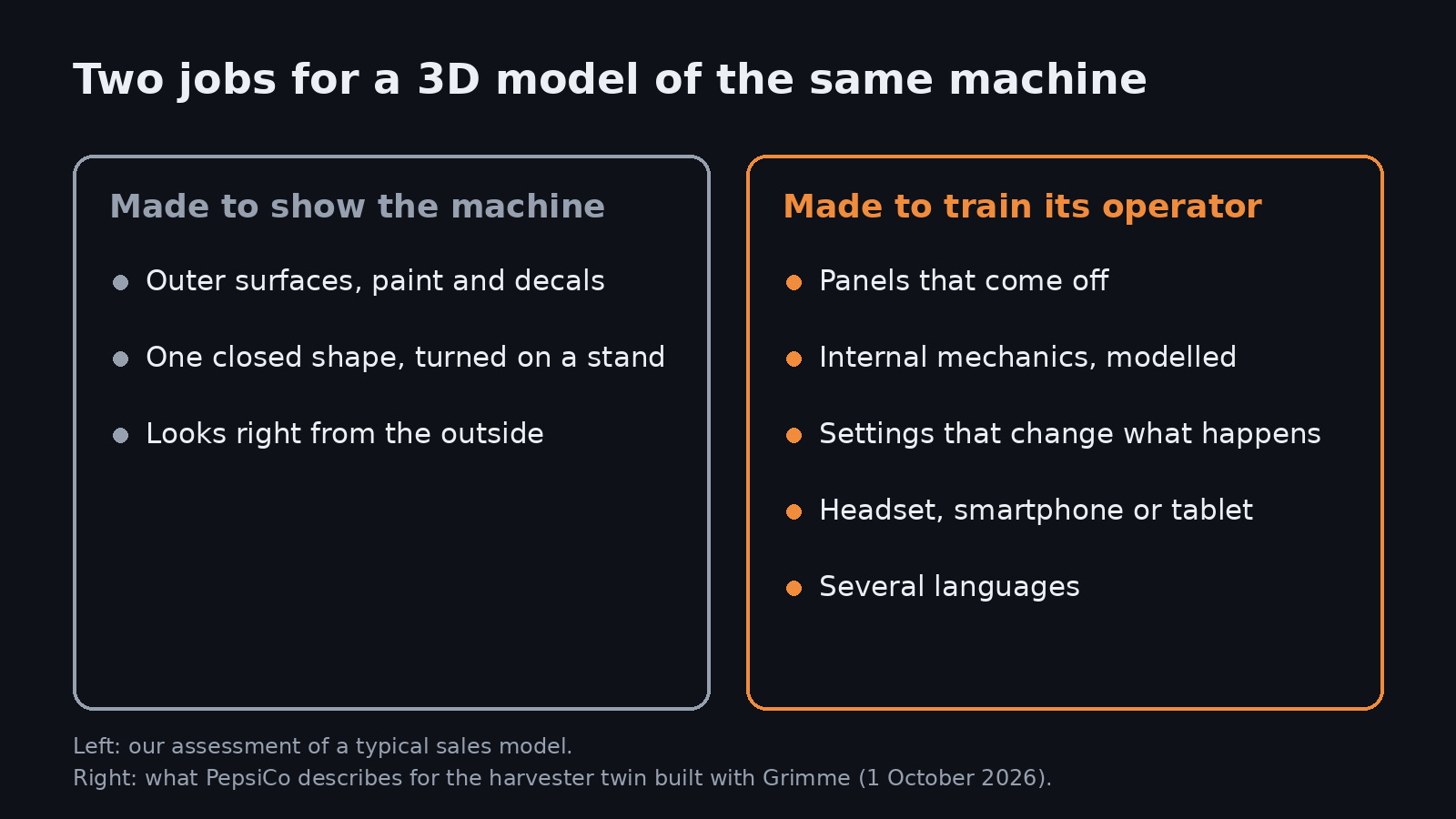
The left column is our assessment of a typical sales model; the right column follows PepsiCo’s description of the harvester twin. © Vardix Group
This is the work of our 3D Modeling & Content Development service. It builds technical models of machinery, equipment and components from CAD files or from scratch, prepared for real-time simulation and training, and real-time assets with textures and levels of detail set for standalone VR headsets and mobile AR. CAD files a manufacturer already has can be the starting point, because they hold the inside of the machine, which is exactly what a training model needs and a brochure render does not.
Built for the weakest screen
The PepsiCo story names a headset, a smartphone and a tablet, and says the training can be sent to any farm. In our view that list sets the hardest constraint on the model: the same machine, with its panels and mechanism, has to stay responsive on the weakest of the three devices, on a farm, on whatever phone the operator has. We think a model prepared for one powerful screen does not travel this way, and one prepared for the phone first usually does.
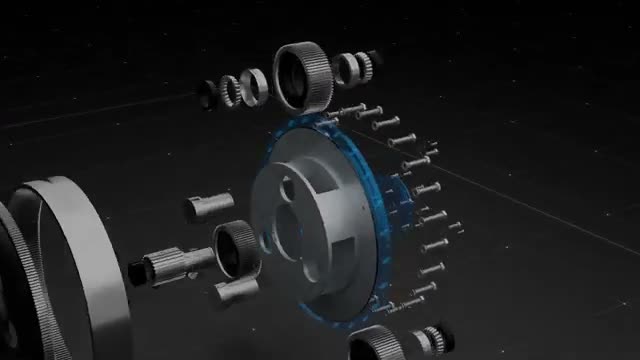
A gearbox taken apart along its axis, a frame from the product video of ROQED Mechanicum, another group product. It shows the kind of technical model that has an inside; it is not agricultural equipment. © Vardix Group — ROQED Mechanicum
What the pilot figures leave open
The 87% and 1.7x figures come from pilots run by PepsiCo and Grimme, as PepsiCo reports in its own story. The story does not give the number of operators or farms, and it attributes the result to the digital twin training, which teaches operators both how to run the machine and how to set it up; it does not break down how much each part contributed. It is a company newsroom report on a programme and does not cite a published study. PepsiCo also says the technology has been made available on a non-exclusive basis, so that others can benefit from it as well.
For a distributor, the buyers are the manufacturers of machinery and the large customers whose results depend on how that machinery is operated, the position PepsiCo is in with the growers who supply it. Manufacturers already hold the engineering drawings of their equipment. What, in our view, they usually lack is a model that opens.