
LATAM Cargo has started training warehouse staff in virtual reality at its Miami hub. The first phase covers about 550 employees, 250 of them forklift operators, according to the carrier's statement as reported by Air Cargo News on 15 October 2026 and by STAT Times on 16 October 2026. The simulators were developed with Academia LATAM, LATAM Group's internal training division, and STAT Times reports that they replicate the company's ground infrastructure.
Six pedestrian zones, three forklift modules
The scenarios cover six warehouse pedestrian zones and three modules for forklift drivers. The topics the carrier lists are dangerous goods segregation, cargo handling, pedestrian traffic flow and the separation of people from machinery. The system also records how long a trainee takes to respond to a contingency and how quickly and how well trainees identify and mitigate hazards.
Miami is not the first site. The carrier describes it as a scale-up of VR onboarding first rolled out at the Fast Air warehouse in Santiago, adding broader operational scenarios, and says it is assessing the system for other hubs in its network, including Brazil.
By placing our teams in critical operational scenarios within an exact replica of their daily work environment, we significantly close the gap between classroom theory and ramp practice.
A forklift course does not know where your walkway is
Every topic on that list depends on one specific building: where the walkway meets the forklift lane, where segregated cargo is kept, which door the trucks back into. A generic module can teach the controls of a forklift and the rules of right of way. It cannot show a new driver the blind corner in the hall where they will work on Monday.
In our reading, that is why the carrier put the word replica at the centre of its statement. A model of the actual floor turns training into a rehearsal of the shift the person is about to work, and the response-time measurement becomes a measurement of that floor's risks rather than of a textbook warehouse.
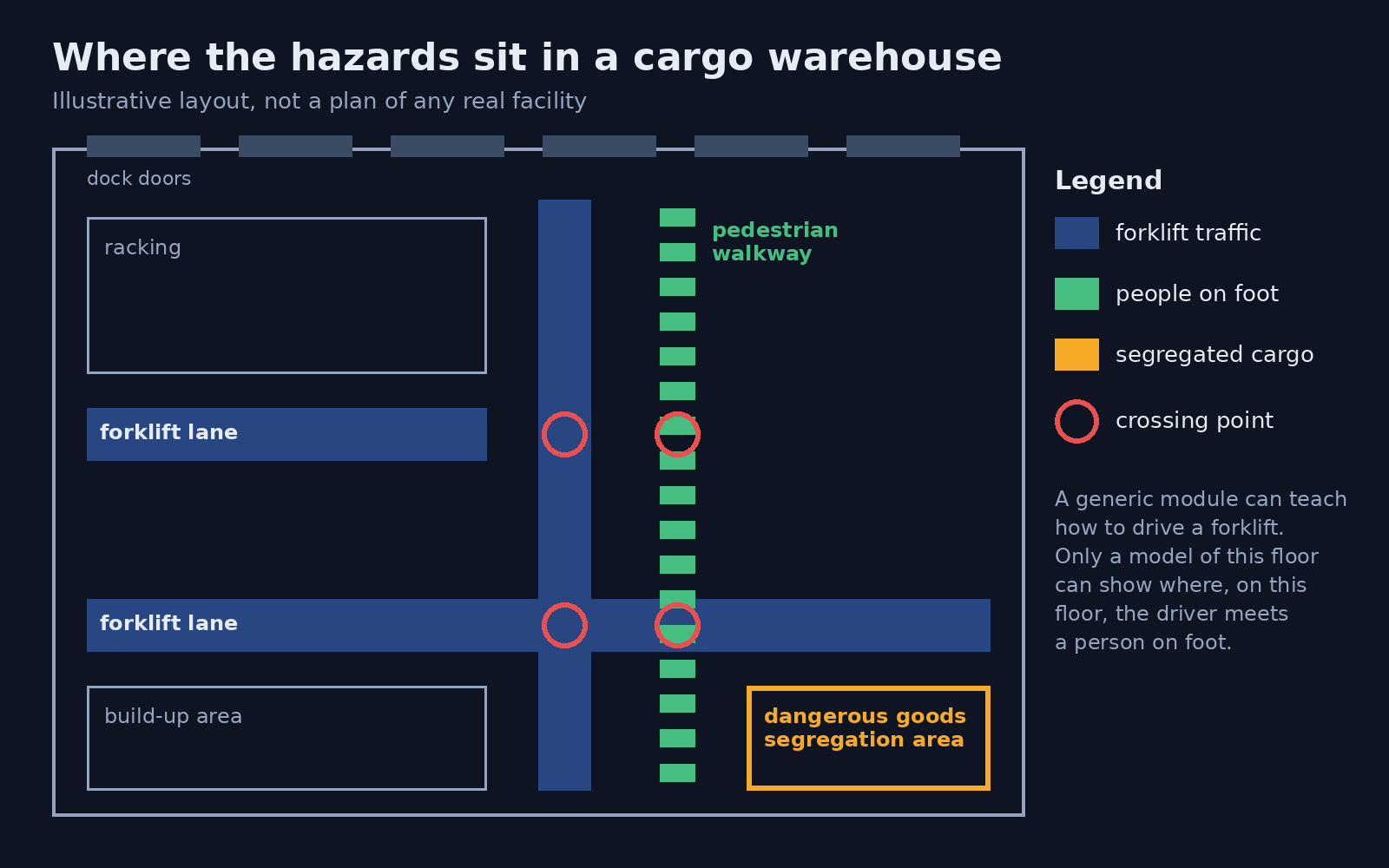
An illustrative layout, not LATAM Cargo's. Pedestrian flow, separation from machinery and segregated cargo are all properties of one building's plan. © Vardix Group
Every new hub is a new build
The expansion LATAM is assessing is where the cost of this approach shows. A hub in Brazil has its own doors, lanes and segregation areas, and a replica of Miami would teach the wrong building there. In our view, the engine, the scoring and the scenario logic can carry over from one site to the next, while the modelled floor and the scenarios tied to it have to be made again for each site.
The carrier has said what the system measures, not yet what it has changed: the statement as reported gives no figures on incidents or on time to competence. Results from Miami are the evidence other operators will look for.
Who builds the replica
An operator without its own training academy has to commission the replica as a development project: modelling the site, writing the scenarios, deciding what to score and connecting the results to the training records it already keeps. That is the work of our VR/AR/MR Development service: custom VR training built on Unity and Unreal Engine, with branching scenarios, scoring and LMS integration, including hazardous environment simulations and equipment operation training.
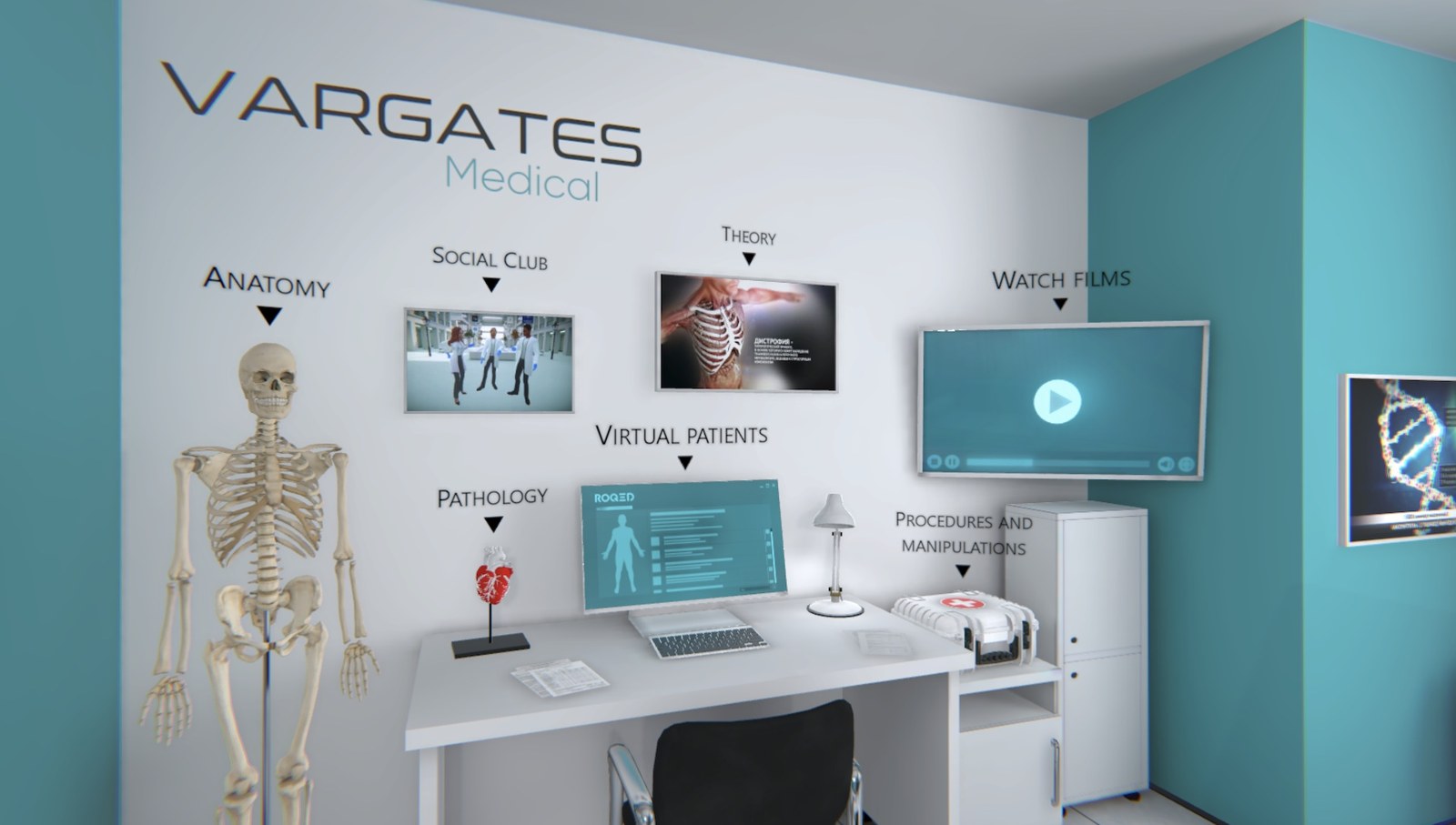
A virtual room in VARGATES Medical, a group product: each training module sits at its own place in a modelled space. © Vardix Group — VARGATES Medical
For a distributor, the opening is in the customer list: airports, cargo terminals, logistics parks and plants with forklift traffic each have a floor that, in our view, no catalogue product models. A partner who knows those customers brings the site and the brief; we build the simulator.