
On 2 November 2026, the opening day of ADIPEC in Abu Dhabi, the Society of Petroleum Engineers published conference paper SPE-236377-MS, “Virtual Reality Capability Platform for Safer, Faster Workforce Readiness in Upstream Operations”. Its authors, Abdullah Al Shaqsi and Mohammed Al Shureiqi of Occidental Oman, describe a VR programme started in 2017 across heavy-oil, light-oil and gas operations. According to the paper, more than 2,060 employees had completed VR training by the end of 2025, and programme records report an average 69% knowledge gain on structured pre- and post-assessments, with 98% satisfaction with the overall learning experience and its relevance to participants' roles.
The authors are explicit about what classroom teaching and supervised field exposure cannot do on their own. Both “remain essential”, the abstract says, “but they have practical limitations when the learning objective is to rehearse rare failures, complex troubleshooting sequences, or time-critical decisions without exposing people, equipment, or production to unnecessary risk.”
The list started with the machines, not the headset
Scenarios were “prioritized according to operational criticality, risk, complexity, and the value of safe repetition.” The resulting portfolio names specific equipment: the mechanical vapor compressor (MVC), the once-through steam generator, artificial-lift methods (beam pump, electrical submersible pump, progressive cavity pump and gas lift), gas turbines, plus road-safety scenarios. Each technical module follows the same three levels: component identification, working principles, and troubleshooting practice.
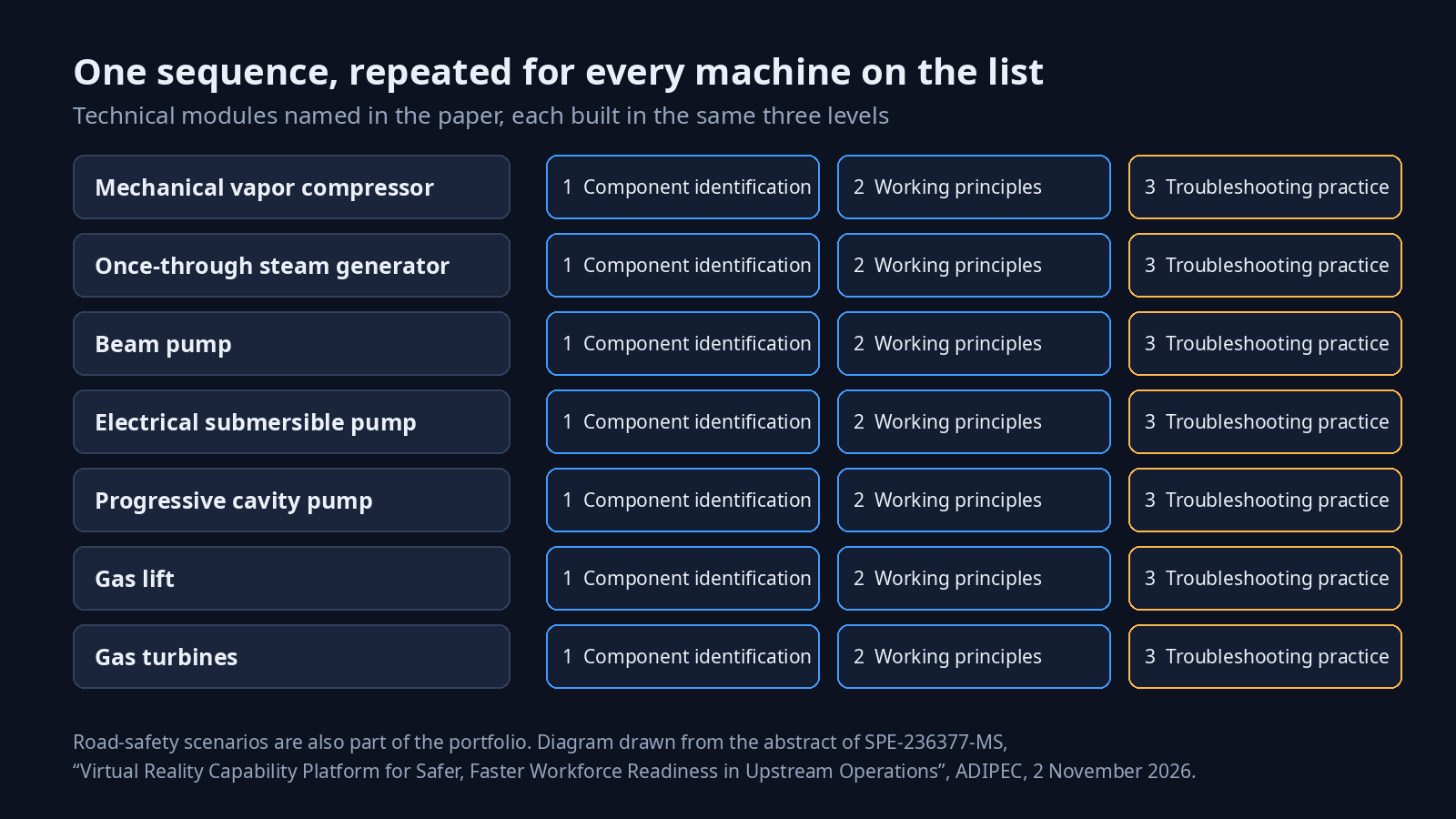
The technical modules named in the paper, each built in the same three levels. Drawn from the abstract of SPE-236377-MS, ADIPEC, 2 November 2026. © Vardix Group
The knowledge in the modules came from the operation itself. More than ten technical subject matter experts, departmental supervisors, learning specialists and line management contributed to development and validation, while ten young Omani developers took part in co-creation with international VR specialists. The platform is embedded in the Oman Technical Training Program and most operations and maintenance training programmes, and is used for targeted gap closure. Ten VR stations run at the Mukhaizna Learning Centre and six at the Safa Learning Centre, and eight road-safety inspectors were trained to deliver sessions themselves. The authors put their contribution plainly: it is “the operating model around the technology”.
A generic course teaches a pump; this one teaches the operator's pumps
In our view, this is the detail a distributor should take from the paper. Troubleshooting a compressor on a particular site depends on how that unit is installed, instrumented and maintained, and the people who know that are the operator's own engineers and supervisors. A catalogue course can explain how a type of machine works. It is much less likely to rehearse the fault sequence the customer's maintenance team actually worries about, and that is where the paper's selection criteria, risk and the value of safe repetition, point.
That is the kind of build our VR / AR / MR Development practice does: custom VR, AR and mixed-reality training on Unity and Unreal Engine, including equipment operation, hazardous-environment and emergency-response scenarios, and scenario-based learning with branching, scoring and LMS integration, with SCORM and xAPI in the stack. Set against the operating model the paper describes, a project of this kind has to cover the following:
| Described in the paper | What the build has to allow |
|---|---|
| Scenarios ranked by criticality, risk, complexity and the value of safe repetition | A ranked equipment list agreed with the customer before production starts |
| Subject matter experts, supervisors, learning specialists and line management in development and validation | Fault steps written and signed off by the people who maintain the machine |
| The same three levels for every technical module | One module structure reused, so each new machine follows the pattern of the last |
| Embedded in the Oman Technical Training Program and most operations and maintenance training programmes | Delivery inside the customer's existing courses, with results sent to their LMS |
| Structured pre- and post-assessments | The same assessment run before and after each module |
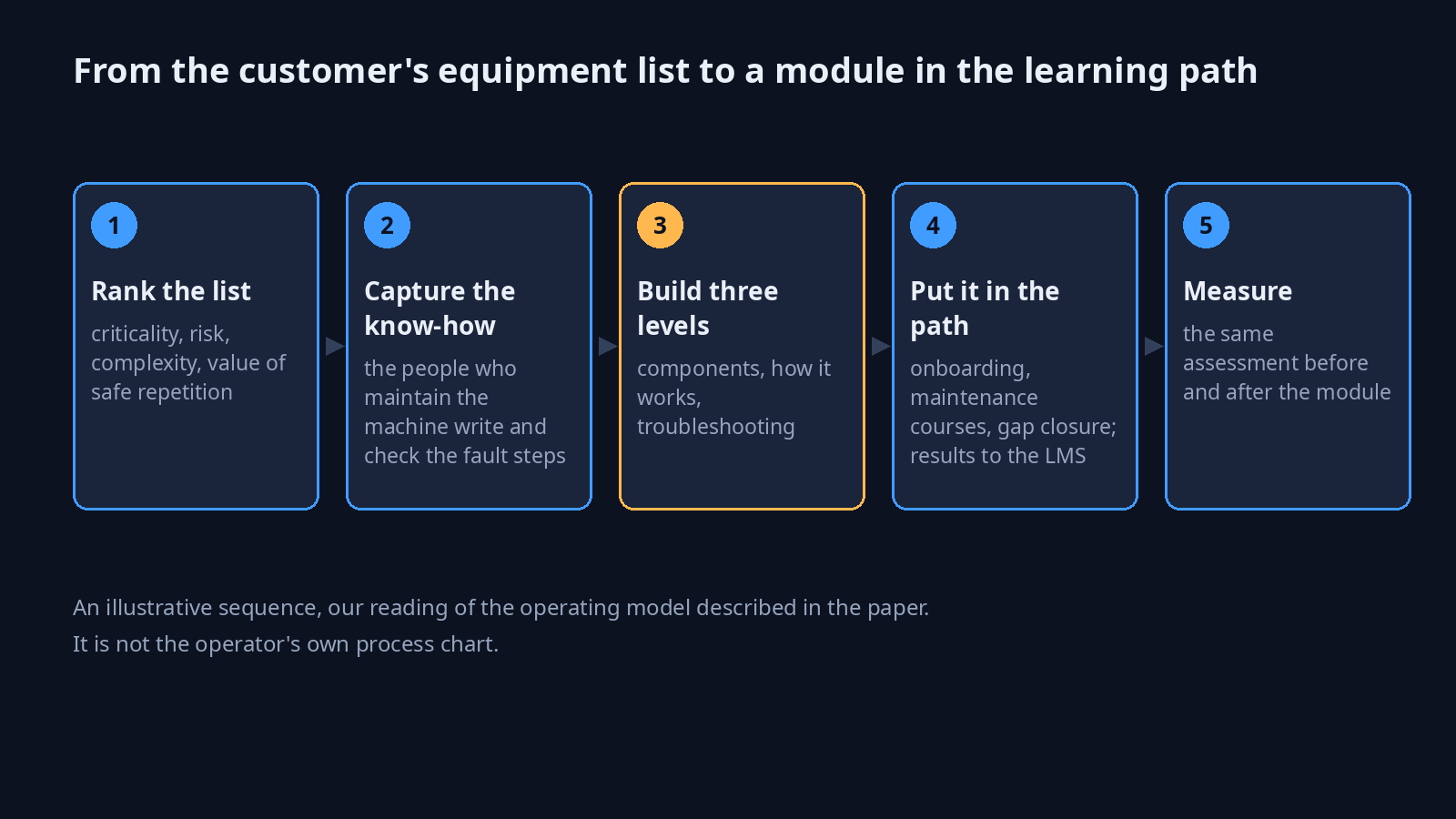
An illustrative sequence: our reading of the operating model described in the paper, not the operator's own process chart. © Vardix Group
Knowledge gain is not the same as fewer shutdowns
The figures in the abstract come from the operator's own programme records: knowledge measured before and after training, and satisfaction with the experience. The abstract reports no comparison group and no change in incidents, downtime or time to repair, so it supports the claim that people learned the material, not yet the claim that the plant runs better. A partner who quotes the paper should quote it in that form.
For partners whose customers run rotating equipment, steam, compression or artificial lift, the paper is still a useful opening. It was written by an operator for other operators, and it moves the first meeting away from hardware and towards a question the customer can answer at once: which failures on our own equipment would we most like our people to have seen before they meet them on shift?