
On 18 June 2026 the U.S. Attorney's Office for the Southern District of Florida announced that the owner and operator of two South Florida nursing schools had pleaded guilty, after a two-week trial in Fort Lauderdale, to conspiracy to commit wire fraud and conspiracy to commit money laundering. The press release, titled “Owner of Two South Florida Nursing Schools Pleads Guilty in Fraudulent Nursing Diploma Scheme”, says that evidence at trial established that between 17 April 2018 and 8 October 2025 she was responsible for 2,956 fraudulent nursing diplomas issued through the schools. Approximately 2,274 of the people who obtained those credentials passed nursing board examinations, which allowed them to obtain nursing licences and work as nurses in Florida and across the country.
The mechanism is spelled out in the same release. The diplomas and transcripts “falsely represented that purchasers had successfully completed the academic and clinical requirements of the schools”, and those documents let the purchasers sit the national board examinations. The case is part of the second phase of Operation Nightingale, which has brought fraud-related charges against 13 defendants; in the first phase, 30 defendants were charged and convicted in 2023. State authorities have since terminated both schools.
What a piece of paper cannot say
Every step after the school in that chain trusted a document that said training had been completed. A printed certificate can state that. It cannot show whether the issuer's own records agree with it. Without a public check, confirming that means contacting the issuer by letter or phone.
It is worth being precise about the limit. In the Florida case the records were sold by the person running the schools, and no verification page run by a dishonest issuer would have exposed that; that took an investigation. What a public check does change is everything downstream of an honest issuer: an employer, a regulator or a training centre can confirm in seconds that a certificate exists in the issuer's records, who it belongs to and what exactly it certifies.
How VARGATES Medical answers it
VARGATES Medical is the group's clinical VR simulation platform for medical universities, teaching hospitals and clinical-skills centres: anatomy, surgical rehearsal and multi-user clinical cases on one XR engine, with learning analytics and LMS integration so training data flows into existing student record systems.
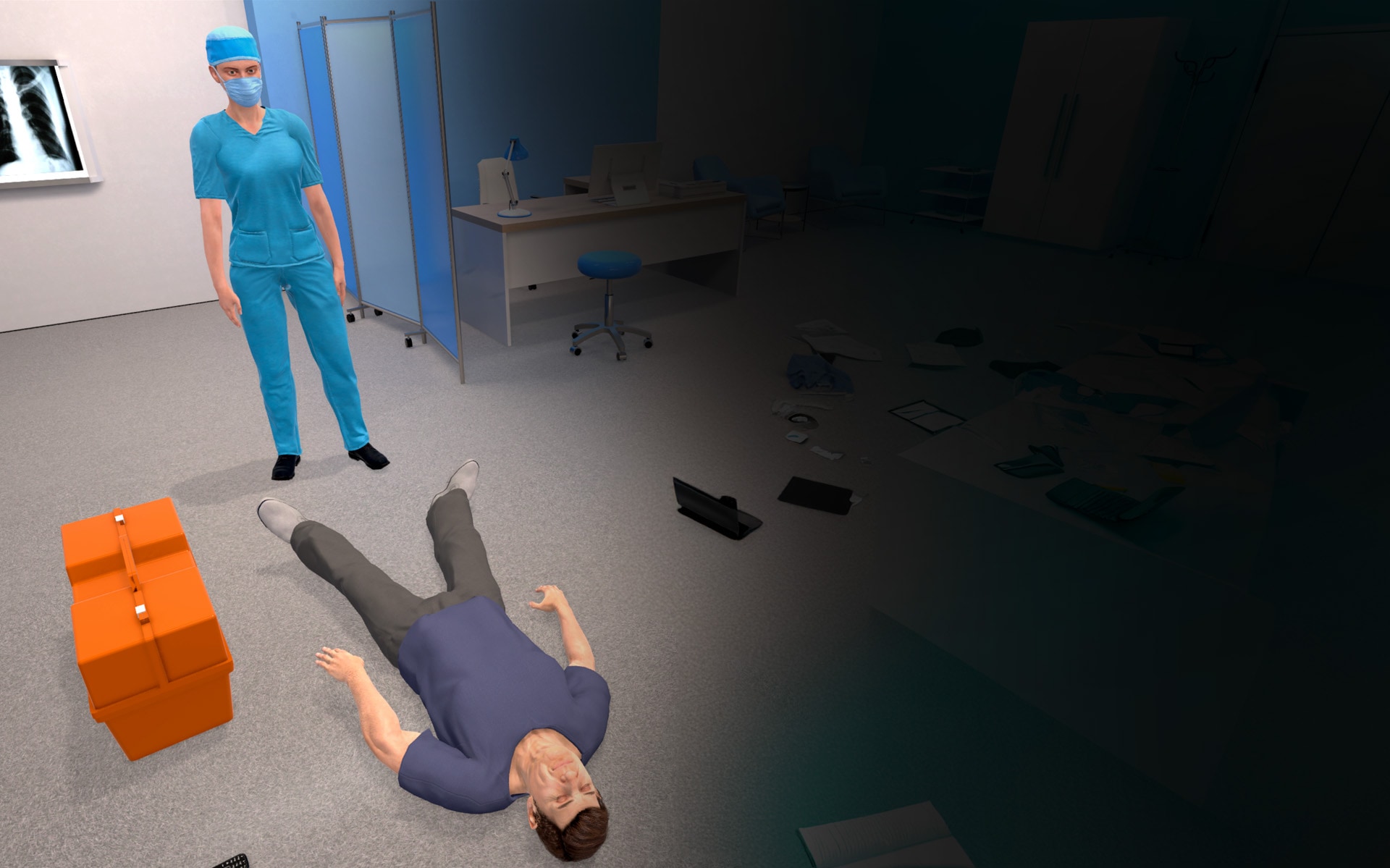
A clinical training scenario in VARGATES Medical. © Vardix Group — VARGATES Medical
Certificates issued by the course library that is moving into VARGATES Medical carry a QR code. Since 15 September 2026 that code leads to a public certificate page on the platform itself; the platform’s own certificates already had a verification address of their own. Scanning it needs no account and no sign-in: the page is built to be opened by a stranger holding a printed diploma. For a certificate that exists, it shows the holder, the course, the issuer and the dates, a QR code back to the same page, and two downloads: the diploma and the knowledge-check protocol.
The page always states what the certificate certifies. By default that is completion of training, and it says explicitly that it is not a licence. After the Florida case that sentence matters: the fraud worked by letting a training document stand in for something it was not.
The page also keeps apart two answers that are easy to merge. A mistyped or unknown identifier gets a plain “not found”. If the verification service itself cannot be reached, the visitor sees an amber notice that verification is unavailable right now, not a rejection. A holder of a genuine certificate is never told it is invalid because a server was down.
Stated plainly
The diploma and the protocol are generated at the moment they are downloaded, so any copy downloaded now carries the current address. Copies downloaded before 15 September carry an older address: either the platform’s own verification page, which on 16 September still answered a certificate identifier from this library with a red “invalid” verdict, or, for copies made before a configuration fix in early September, a development address that leads nowhere. They have not been counted.
VARGATES Medical, the group's clinical VR simulation platform. © Vardix Group — VARGATES Medical
Why it matters to a partner
The buyers of VARGATES Medical are medical universities, teaching hospitals and clinical-skills centres, and the natural partner is a distributor who already sells simulation, anatomy or LMS into that buyer. When an employer or a regulator wants to check a certificate issued on this platform, the answer is a public verification page, not a phone call.
Partners take authorised dealer or reseller terms and co-marketing, while VARDIX runs onboarding and Level 1–3 support. A partner adds a clinical product without standing up a new platform.
Any supplier that issues credentials can be asked three questions that take a minute to answer honestly: where does the printed code resolve, what does the page say when the verifier is down, and what happens to copies printed before the address last moved. For VARGATES Medical the first two are answered above, and the third is stated as it stands.