
On 8 September 2026 the journal Advances in Medical Education and Practice published “A Case-Driven and Knowledge Graph-Supported Approach to Pathology Education: Effects on Knowledge Retention and Clinical Reasoning”, by a team from the Department of Pathology at Peking University Health Science Center. The paper addresses what the authors, in their conclusion, call the “long-standing dilemma in pathology education”. Traditional pathology teaching, the authors write, is “organized around disciplinary divisions” and presents “etiology, pathogenesis and pathological changes in a fixed sequence”. In their view this contributes to “two key problems: fragmented knowledge and inert knowledge”, and “students often struggle to apply theoretical knowledge to real clinical scenarios.”
Their answer was to rebuild one module, Urinary System Pathology, around clinical cases instead of textbook chapters. The course ran for six class hours in three sessions, taught by the same senior instructor, to “54 third-year medical students from an intact class” in the five-year clinical medicine programme. In the paper’s example, minimal change disease, the instructor’s questions walked students from the clinical diagnosis to the pathological changes, the clinicopathological correlation and the mechanism. Behind the cases sat a knowledge graph on an online education platform: 1490 knowledge nodes linked to micro-lectures, “201 high-resolution digital slides” and exercises.
The reported numbers are encouraging. Median scores on the three in-session tests were “76.6%, 87.8%, and 85.9%, respectively”. Fourteen days after the course, “the closed-book median percentage score was also higher than that of the three in‑session tests (89.0% vs 83.5%, P = 0.016)”. In a retrospective self-assessment, students’ self-rated ability to diagnose renal disease rose “from 2.0 to 4.4”. There was a cost too: “14.8% of participants reported challenges related to course pace and excessive cognitive load”.
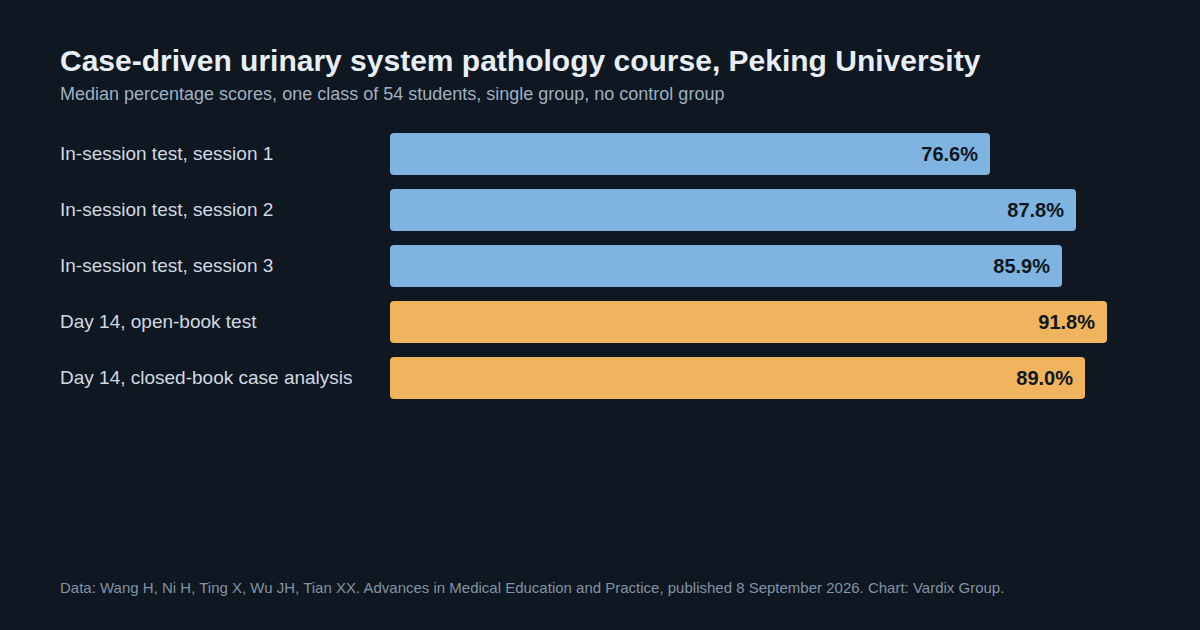
Median scores reported by Wang et al., Advances in Medical Education and Practice, 8 September 2026. One class of 54 students, no control group. Chart drawn by Vardix Group from the published figures. © Vardix Group
What the study does and does not show
The authors are careful about their own evidence, and a reader should be too. They describe “a single-group, longitudinal design” that “lacked a fully parallel, blinded control group undergoing traditional instruction”. The sample is one class at one institution, and the day-14 test “only captures short-term knowledge retention”. Their conclusion is that the model “was associated with improved student performance in our cohort”, and that “a controlled study is required to determine whether the intervention itself caused the observed improvement.”
So this is not proof that case-driven teaching works better. It is a well-described attempt to fix a problem the authors state plainly: “students often struggle to apply theoretical knowledge to real clinical scenarios.”
Why it matters for a pathology department
A department that wants to try something similar needs more than a set of cases. Students were guided from a patient with oedema and foamy urine to the pathological changes in the kidney and their mechanism, with digital slides linked as resources in the graph.
Where Pathology3D fits
Pathology3D is a 3D screen simulator for general and special pathological anatomy in the group’s portfolio, distributed to medical and pharmacy universities. A student selects a disease or syndrome, loads the target 3D organ and modifies it at the macro level with pathomorphological parameters, stage by stage. At the micro level the case is matched against histological preparations, and a results table then analyses the student’s answers, so progress can be followed by the student alone or with a teacher. It runs on Windows, Linux and macOS.
Its work is built around the organ itself: the same disease, seen on the 3D organ and then matched against histological slide images, in one exercise.
The Pathology3D page on vardix.com, where the product is described and a demo can be requested. © Vardix Group
What it does not do
Pathology3D is not a knowledge graph and not a library of clinical case presentations; the course redesign in the study is the teachers’ work, and no tool replaces it or the instructor who runs it. The study did not use or assess Pathology3D. The fit described here is our reading of the problem the authors describe, not a finding of their paper, and we make no claim about test scores.
For a partner in medical education
If you work with medical or pharmacy universities, this study is a published, measured description of a problem the authors call long-standing, and they call for “multi-center longitudinal designs with control groups” next. A department that wants to try 3D organ work inside its own case-based course can start with a demo and a pilot; we handle deployment and training end-to-end. If you sell into these universities, the partnership programme is the place to start.