

On 15 September 2026, at the NSC Safety Congress & Expo in Indianapolis, Prent Cline, acting deputy director of OSHA's Directorate of Enforcement Programs, presented the agency's preliminary list of the ten most frequently cited standards, covering 1 October 2025 to 31 August 2026. Fall Protection – General Requirements led for the 16th consecutive fiscal year, with 4,041 violations. Eighth, with 1,273, was a standard about training itself: Fall Protection – Training Requirements, 29 CFR 1926.503. The slides were published by Safety+Health, the National Safety Council's magazine, which also reported that the standards making up the Top 10 were unchanged from fiscal year 2025.
Occupational Health & Safety's report of the same session, published on 16 September, summarised what OSHA found under that standard: "Common problems included employees receiving no training, new workers beginning work before being trained, missing elements in training and a lack of certification." That sentence is the magazine's summary of the presentation. The words it quotes from Cline himself are about the list as a whole:
These are all issues that seem to crop up again and again.
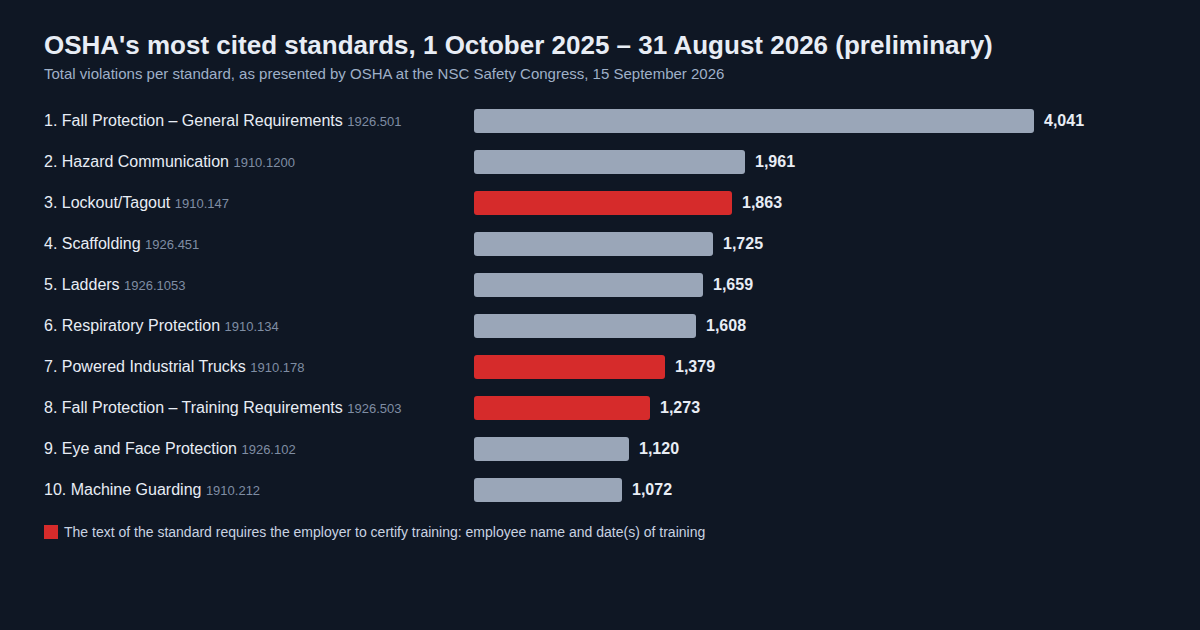
The numbers are OSHA's preliminary figures, from the slides presented on 15 September 2026. The highlighting and the chart are ours. © Vardix Group
What a training certificate has to say
Three of the standards on the list do not stop at requiring training. Their own text requires the employer to certify it and says what the certification has to contain; 1926.503 calls it a written certification record.
Fall Protection – Training Requirements, 1926.503(b): "The written certification record shall contain the name or other identity of the employee trained, the date(s) of the training, and the signature of the person who conducted the training or the signature of the employer." The standard adds: "The latest training certification shall be maintained."
Lockout/Tagout, 1910.147(c)(7)(iv): "The employer shall certify that employee training has been accomplished and is being kept up to date. The certification shall contain each employee's name and dates of training."
Powered Industrial Trucks, 1910.178(l)(6): "The certification shall include the name of the operator, the date of the training, the date of the evaluation, and the identity of the person(s) performing the training or evaluation." Paragraph (l)(4)(iii) of the same standard requires an evaluation of each operator's performance at least once every three years.
The counts in the chart cover each standard as a whole. A lockout/tagout citation can be about a missing procedure rather than a missing certificate, and the slides do not break the numbers down by clause. What the list does show is that these three standards, whose text asks the employer to certify training, were cited 4,515 times between them in eleven months, and that the one devoted entirely to training was cited 1,273 times.
Why the record is the hard part
According to the same report, Cline said construction's fragmented structure can make oversight especially challenging as different crews and subcontractors move through jobsites. For powered industrial trucks, the report lists training and evaluation as recurring issues, along with failing to provide refresher training when needed.
Our view, and it is a view rather than a measurement: what goes missing is usually not the session but the proof of it. A paper sign-in sheet stays at the site where the crew was trained; the crew moves on. A refresher is due on a date that someone has to remember. And a new worker can start on a Monday before anyone has checked whether the induction was done. None of these is a question of whether the company believes in training. Each is a question of where the name, the date and the trainer are written down, and whether they can be found when an inspector asks.
Where KNOWIKA fits
KNOWIKA is the group's corporate learning platform for mining, oil and gas and heavy industry. It is built around the employer's side of training: a company invites its employees, assigns courses, follows progress in reports and issues certificates. Subject experts build courses themselves in a drag-and-drop editor, with templates for safety instructions and equipment manuals.
Two properties matter for field sites such as a mine or a rig. Training works on a phone at the mine or the rig, with an offline mode for sites without a connection. And the platform is offered for deployment inside the customer's corporate network, including installation without internet access for closed sites, as a project scoped with the customer. Interface, content, tests and certificates are available in Kazakh, Russian and English.
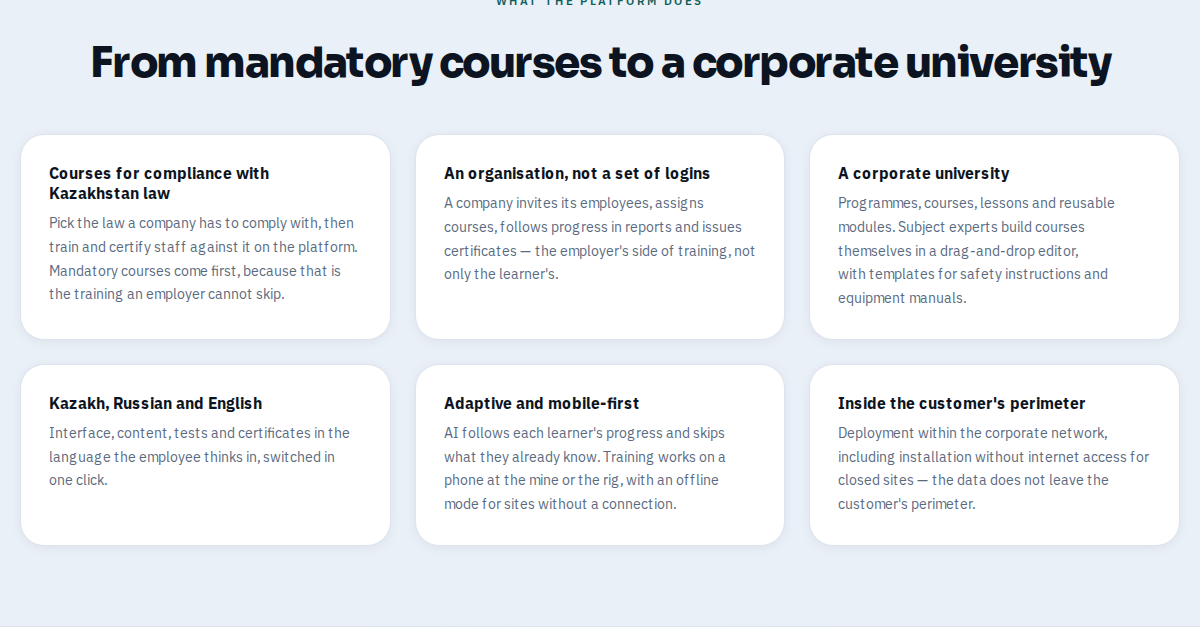
What KNOWIKA does, from its page on vardix.com. © Vardix Group — VARDIX
What it does not do
It does not make a record compliant with a particular standard by being installed. The standard decides what the certificate must carry; 1926.503, for example, asks for the signature of the trainer or the employer. Whether a given certificate meets a given rule is for the employer and its safety adviser to confirm, jurisdiction by jurisdiction.
Its ready-made mandatory courses are written for Kazakhstan law, not for OSHA standards. Elsewhere, course content comes from the company's own subject experts.
It does not replace hands-on instruction or the competent person a standard requires. 1926.503 asks for training by a competent person qualified in the listed areas; a platform keeps the record of it and can deliver the theory, not the practice on the equipment.
For distributors
OSHA's list is a United States list. Our assessment is that the question behind its training standards (who was trained, on what, when, and by whom) is not a United States question: industrial buyers are ready to discuss it in terms of records rather than in terms of courses, and this is where a learning platform earns its place. Training partners, integrators and distributors who already work with mining, energy, construction and manufacturing customers can bring them KNOWIKA.