
On 29 October 2026 RSC Education posted a short notice titled “Goodbye to our screen experiments”. The society has closed its titration and aspirin synthesis screen experiments “while we consider options for a long-term replacement”. The notice, written by David Sait, programme manager, education platforms and data, at the Royal Society of Chemistry, gives the reason in a single sentence: launched over 10 years ago, “the software they used has aged and cannot be maintained.”
According to the same notice, the simulations helped “hundreds of thousands of students” practice carrying out titrations and prepare to synthesise aspirin in their school classroom. They were originally developed with Learning Science and the University of Bristol. The RSC says it is keen to provide a modern replacement and is working to identify suitable support to help develop the next generation of online practical experiments for school students; it gives no date. Until that replacement exists, a teacher who sent the class to practise titrations on screen before the practical has no RSC version to send them to.
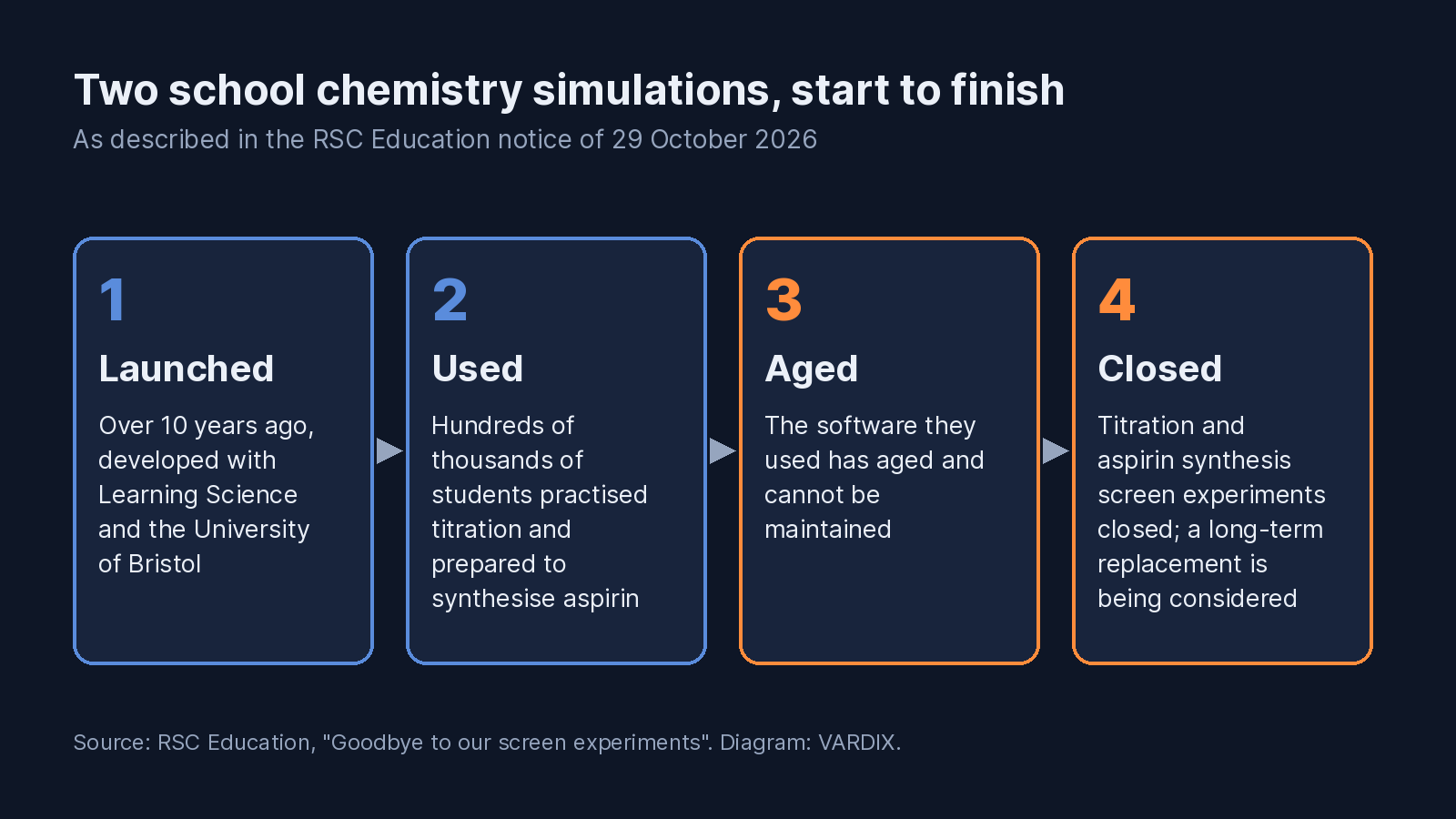
The life of the two screen experiments, as the RSC Education notice of 29 October 2026 describes it. Diagram by VARDIX. © Vardix Group
The question nobody asks on adoption day
What ended here is not the idea of practising a practical on a screen. The notice says the opposite: the society wants a modern version. What ended is one piece of software that, in the notice’s words, “has aged and cannot be maintained”. In our view this is a common fate of a tool built once, by a project or a partnership, without a team whose ongoing job is to keep it current: over ten years, the computers and browsers a school uses change, and software has to change with them.
For a school, this becomes a question that is rarely asked at the moment a tool is adopted: when the simulation stops working, who repairs it, and who is paid to? In our view, a resource offered without a commercial relationship answers with goodwill. Goodwill is real, but it runs on someone else’s budget and priorities, and a teacher cannot plan a scheme of work around that.
What a licence pays for besides the models
ROQED Science is the interactive 3D classroom from ROQED, which VARDIX distributes to partners who sell into education. It covers physics, chemistry, biology and earth science through 3D models and simulations: teachers assemble lessons from them, and the class works in the same models. It runs on Windows and on the web, and it ships in more than eighteen languages. It is sold under licence. Installation, training, localisation and Level 1–3 technical support come from the VARDIX team.
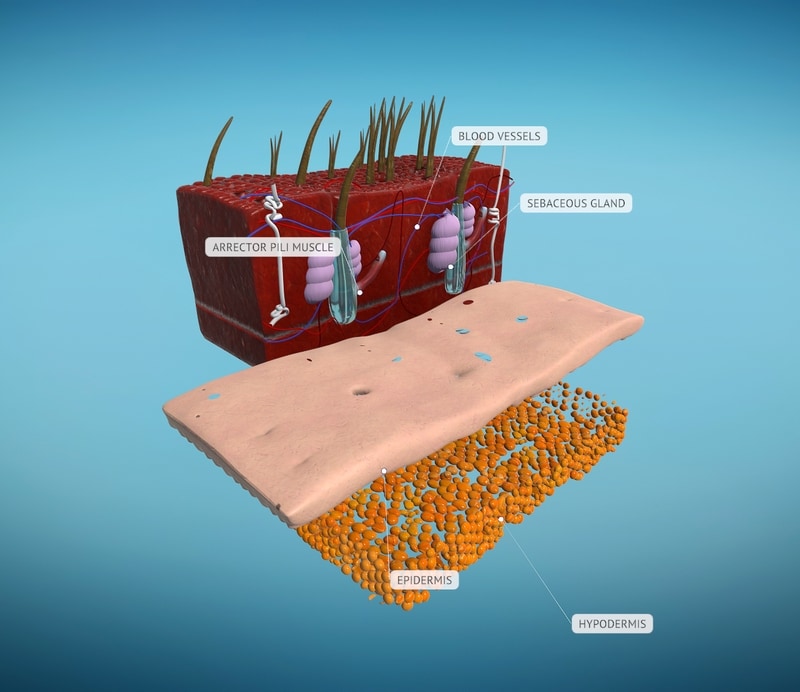
A labelled 3D model of skin layers, one of the biology models shown on the ROQED Science page. © Vardix Group — ROQED Science
We are not claiming that ROQED Science contains titration or aspirin synthesis simulations that replace the two the RSC has closed. A school looking for exactly those should check the current catalogue in a demo before buying. Nor, in our reading, does a screen take the place of the bench: the RSC notice itself describes its experiments as helping students practise and prepare to synthesise aspirin in their school classroom.
Opening a school meeting after a closure like this
A distributor who calls on schools and ministries meets teachers who built lessons around free tools, and a notice like this one turns a vague worry into a concrete question: what happens to my lesson plan when the tool disappears? A licensed product with a named support chain answers that question directly. In our assessment it is a stronger opening than a feature list, because it speaks to the risk the buyer has just watched happen to someone else.