
Eighty-six sixth-year medical interns at Karadeniz Technical University in Trabzon, Türkiye, each managed six screen-based virtual-patient cases twice: before and after an eight-week emergency medicine internship. The cases covered cardiac, pulmonary, abdominal, central nervous system, internal medicine and other emergencies. The study, “Medical interns’ performance on screen-based virtual patient assessments before and after an emergency medicine internship” by Tacettin Karaman, Sinan Paslı and colleagues, was published in BMC Medical Education on 21 October 2026 as an early version of an accepted, peer-reviewed article. The authors start from a known weakness: the effect of an emergency medicine internship is usually judged by self-assessment or supervisor ratings, which, they write, correlate weakly with objective performance.
After the internship, almost every number on the screen improved. The overall case-management score rose from 69.2 to 83.4. Correct final diagnosis rose from 85.7% to 98.4%, correct disposition from 70.5% to 93.0%, and time to disposition fell from 399 to 336 seconds. Five of the six stage scores the platform produced improved significantly.
Review of systems was the step that stayed flat
The one stage that did not change significantly was review of systems. It moved by 2.7 points (p = 0.087). In their conclusion the authors write that review of systems and intervention scores “remained comparatively lower than those of other domains”, even though intervention showed the largest gain of any stage.
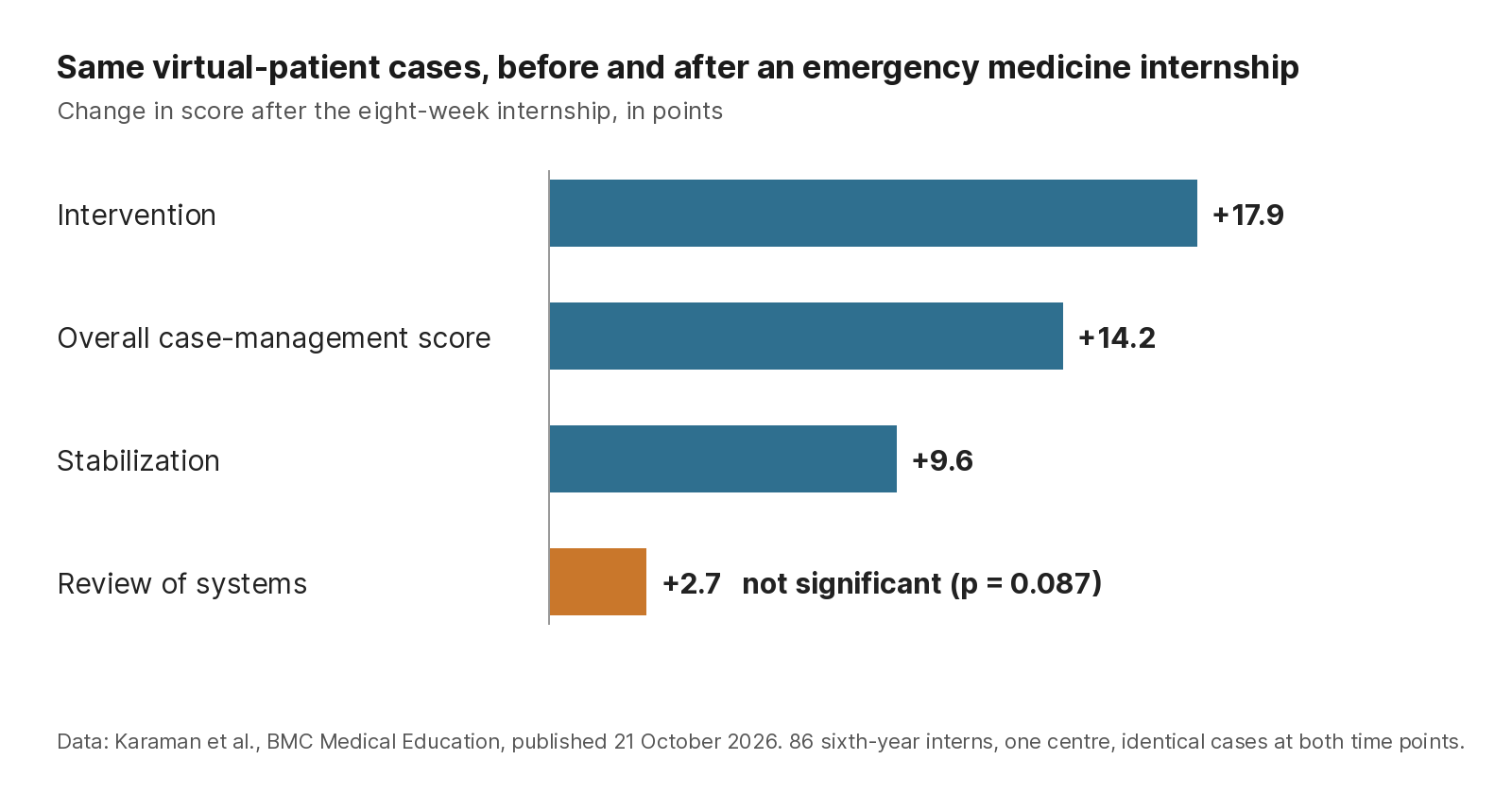
Stage scores from the published abstract. The overall score and the final diagnosis improved; the review-of-systems stage did not change significantly. © Vardix Group
The authors are careful about what this proves. The same cases were used at both time points and there was no comparison group, so the result should be read, in their words, as “temporal improvement in simulation-based performance rather than definitive evidence of internship effectiveness or transfer of learning to clinical practice.” They still see a role for this kind of test: screen-based virtual-patient simulation “may provide standardized assessment data” for a broader programme of assessment.
Two questions to ask of any virtual-patient test
We read the study less as a verdict on the internship and more as a buyer’s checklist for a faculty that wants to measure clinical reasoning on a screen. First, does the platform report each step of the consultation separately? In this cohort the overall score and the diagnosis rate rose sharply while review of systems did not; a single total would have hidden that. Second, are there enough distinct cases that a re-test is not the same patient again? The authors themselves point to the identical cases used at both time points as one reason their result cannot be read as proof that the internship taught what the scores show.
A consultation the student has to conduct
VARGATES Medical is the group’s clinical simulation product for medical universities, teaching hospitals and clinical-skills centres. Its virtual-patient mode is built around the whole consultation: the product site describes students who “interview patients, perform examinations, order diagnostic tests, make diagnoses, and prescribe treatment plans.” It also describes structured assessment modes in which a student can “track your performance, identify knowledge gaps, and review detailed results”, and instructor dashboards that “track every session, score, and error.”
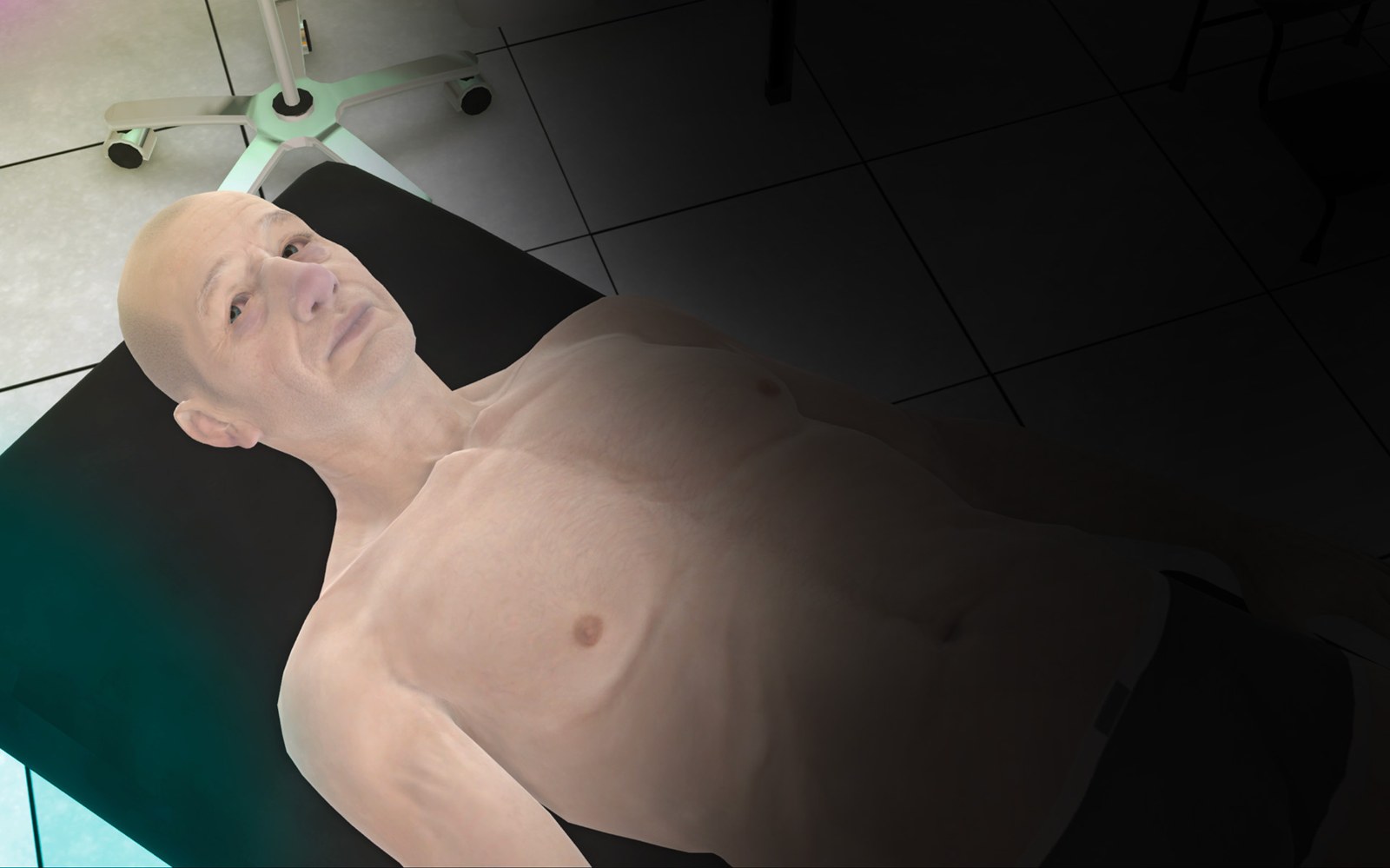
A virtual patient in the VARGATES Medical clinic. The interview is a step the student carries out, alongside the examination, tests and diagnosis. © Vardix Group — VARGATES Medical
The Trabzon study did not use VARGATES Medical, and nothing in it is evidence about our product. What it gives a faculty is a sharper brief. Before relying on any platform, ours included, for a before-and-after measurement, the faculty should see in a demonstration how results are broken down by step and how many different cases exist in the specialties it teaches.
For a distributor, that brief is a better opening than a feature list: ask the faculty what its internship assessment measures today, and whether anyone would notice if one step of the consultation stood still.