
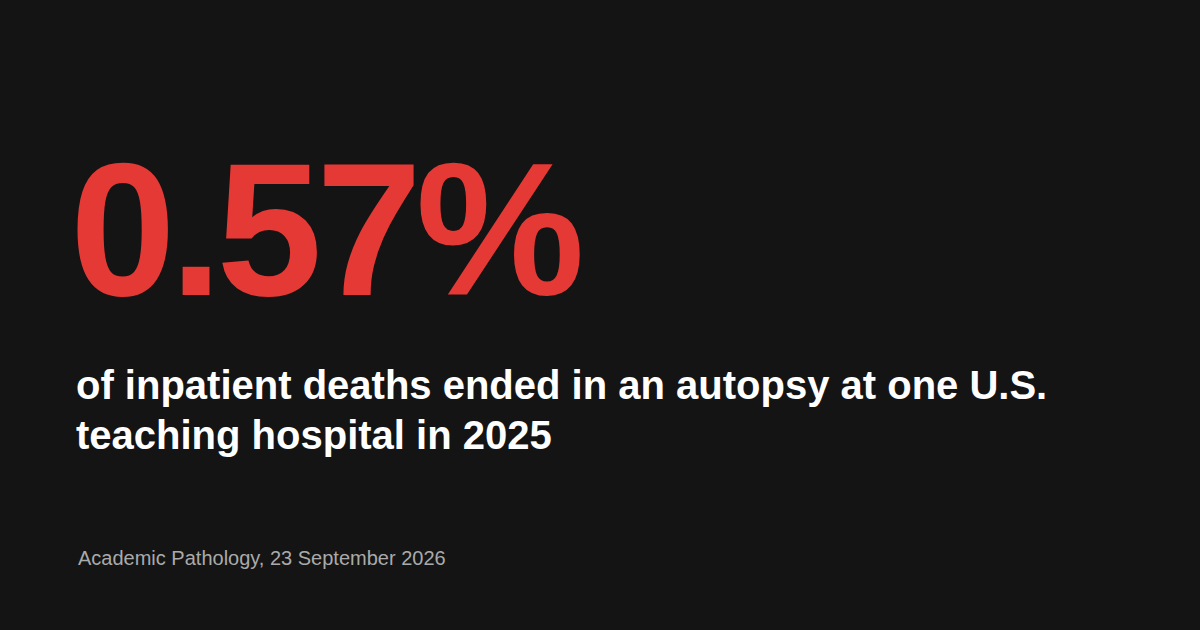
On 23 September 2026 the journal Academic Pathology published “Closing the gap: A workflow-based analysis of postconsent failure to restore hospital autopsy utilization”, by a team from the Department of Pathology at Texas Tech University Health Sciences Center El Paso. The authors went through 4,229 inpatient deaths at their own institution between 2019 and 2025. Hospital autopsies, the kind that needs a family’s consent outside a medical examiner’s jurisdiction, fell from 3.9% of that year’s inpatient deaths in 2019 to 0.57% in 2025, while inpatient mortality was rising; from 2021 through 2025 the rate stayed at or near 1%.
Consent was sought in only 6.8% to 9.1% of deaths in any year, and the authors find the greatest loss after it had been obtained: the share of consents that turned into an actual autopsy fell from 52% in 2019 (14 of 27) to 8% in 2025 (4 of 48), with a rise to 20% in 2024 along the way. In an audit of 140 consent forms from 2023 to 2025, forty percent were rated low quality, and pathology staff were involved in two of them (1.4%). Of 40 clinical residents surveyed, recognition of when an autopsy is indicated varied, and 95% said they had never attended one.
Even the modelled fix leaves the rate at half the benchmark
The authors modelled what fixing the process could buy. Better consent forms alone project the rate to about 1.36%; better recognition of indications alone, to 0.83%. In their combined scenario it reaches about 2.5%, 4.4 times the 2025 figure and half of the 5% academic benchmark; reaching 5% takes both steps raised further. Their conclusion is to repair the workflow and restore the autopsy’s place in quality assurance and medical education. Nothing in this article argues against that.
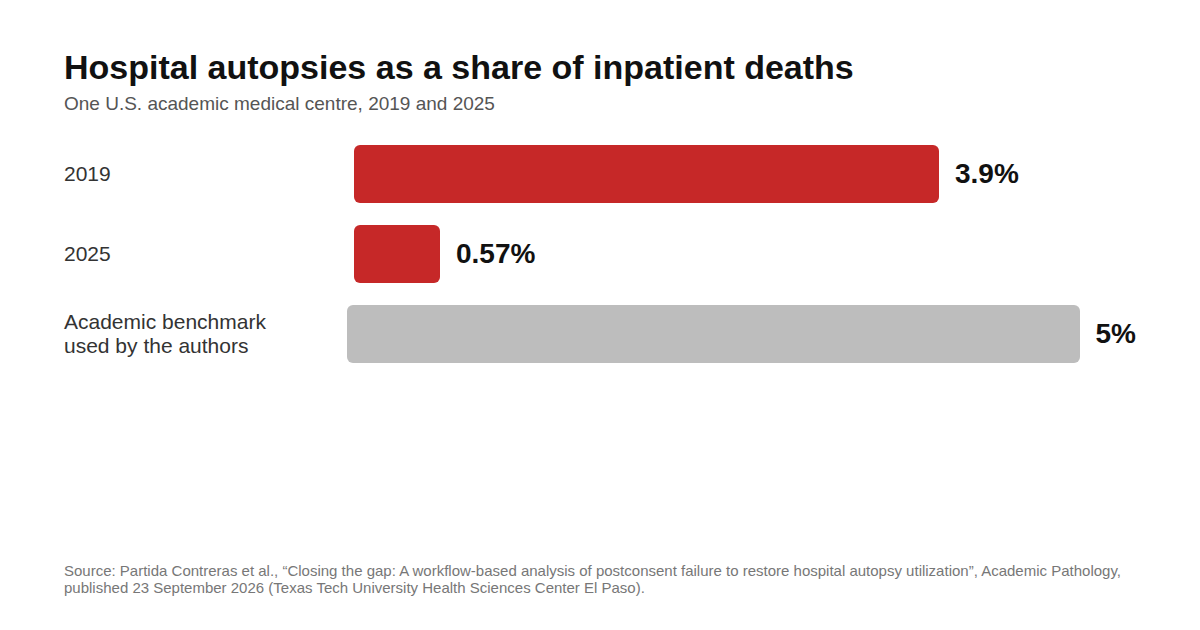
Figures from Partida Contreras et al., Academic Pathology, 23 September 2026. One institution; the chart shows the first and last year only. © Vardix Group
A course timetable cannot run on a death rate
In our view a department teaching general and special pathological anatomy has to show every student in a cohort the same macroscopic changes, in a set order, every semester, and cases that arrive when a patient happens to die of a given disease cannot carry that plan. At this hospital their share of deaths fell by more than four-fifths between 2019 and 2025. The study covers one hospital in one country and does not measure teaching outcomes, so the link to teaching is ours; its authors do note in the introduction that autopsy remains essential for medical education, and we read the residents’ answers as a sign of how little of it trainees there now see.
Where a 3D organ fits, and what it cannot replace
Pathology3D, which the group distributes to medical and pharmacy universities, is a 3D screen simulator for general and special pathological anatomy. A student picks a disease or syndrome, loads the target 3D organ, changes it stage by stage at the macro level, then matches the case against photographs of histological slides; a results table then analyses the answers. It runs on Windows, Linux and macOS, which in our view makes it easier to run the same exercise for every student rather than for whoever was on rotation when a case came in.
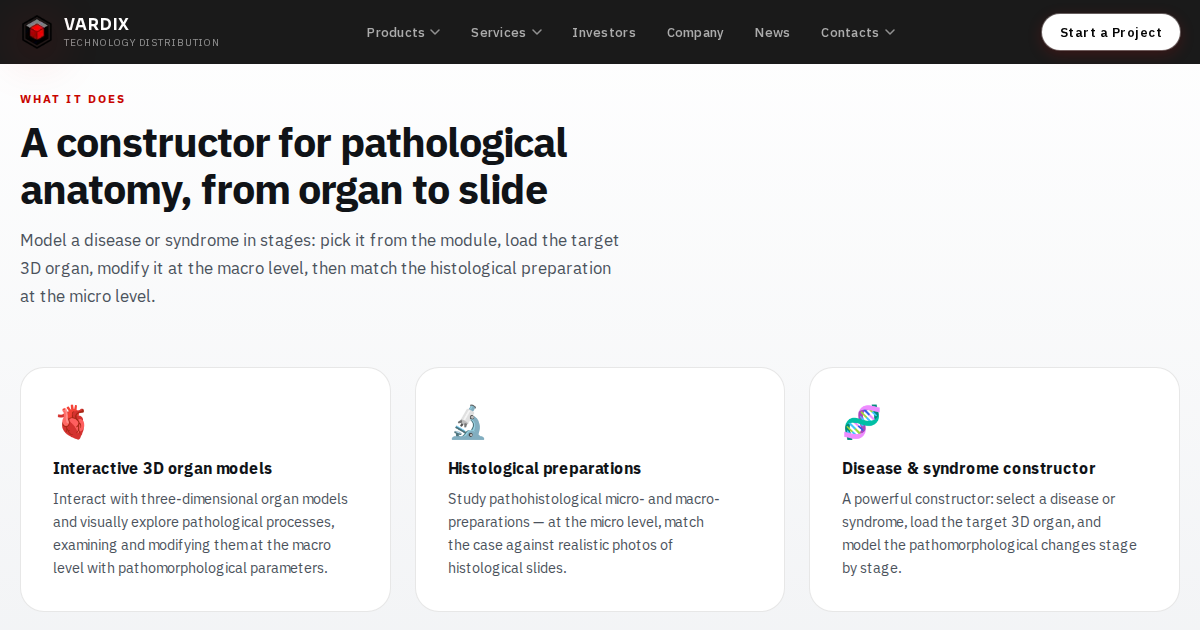
Pathology3D: from the 3D organ to the histological slide. © Vardix Group
A screen model does not do the autopsy’s other work: checking a clinical diagnosis against what was actually found, catching complications, feeding a hospital’s quality review. That work belongs to the post-mortem, and the Texas Tech team is right to want it back. This article cites no study measuring what Pathology3D does to learning outcomes, and we do not claim one.
The question to put to a pathology department
Ask the head of pathology at a medical university you already call on: where did your students see a whole organ with a given lesion last year, and how many of them saw it?