
On 26 October 2026 the Industrial Court of New South Wales sentenced Toll Transport Pty Ltd in SafeWork NSW v Toll Transport Pty Ltd (No 2) [2026] NSWIC 63, a decision of Chin J, Vice President. The case goes back to 20 December 2022 at the company’s Banksmeadow site in New South Wales, where a packline operator had his left ankle crushed while using a crowbar to dislodge a pallet jammed on a “bag line” conveyor that packaged, wrapped and stacked 25 kg bags of polyethylene beads. He remained trapped for about ten minutes. The company pleaded guilty; SafeWork NSW announced the conviction on 28 October and noted that the company has the right to appeal against its sentence.
The machine’s own Operation & Maintenance Manual, which the company held, had the safe order in print: “Under no circumstances should personnel walk on or cross any conveyors when the system is not isolated. This is automatic machinery and could start without warning.” Before any repair or maintenance it required the main isolator and the compressed air supply to be switched off and kept isolated with locks or tags, and it told the reader to “ensure all operators and maintenance personnel are trained in the location and operation of the Main Isolator.” The court found that the operator, in that role since about February 2022, was given neither that manual nor the company’s lockout procedure. He had learned the methods for clearing jams informally from other operators and did not know that, unless the line was isolated, the conveyor would resume its automatic cycle the moment the pallet came free. The judgment calls it “a virtual procedural vacuum”, and records that the need for a written procedure for clearing jams had been identified before the incident, in a 2021 plant audit commissioned by the company and in a 2021 hazard identification, without one being written.
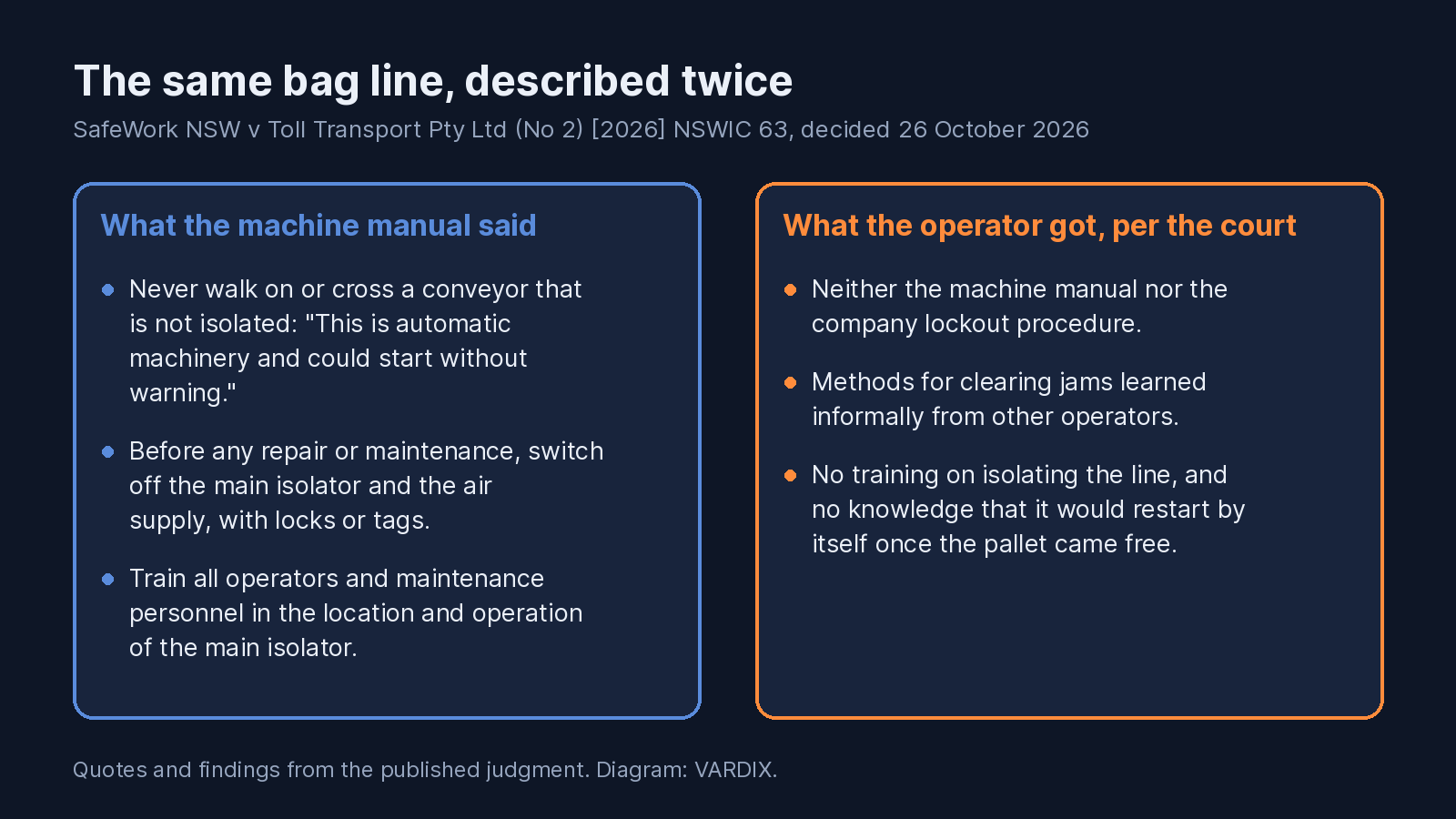
The bag line as the manual describes it and as the operator knew it, from the published judgment. Diagram by VARDIX. © Vardix Group
What the court said about “administrative” measures
The manual had the order in print, and the company had its own lockout procedure as well. What failed, in our reading, is the step between the document and the person standing on the wrapper turntable with a crowbar. The court was explicit that this step is not a lesser matter: it said it was not satisfied that so-called “administrative” measures are inherently incapable of eliminating safety risks, and wrote that “it was critical for packline operators to understand and have access to adequate and enforced safe operating procedures that required the prior isolation of the bag line.”
The dangerous detail is also the one that is hardest to pick up by watching colleagues: a conveyor that sits still while a pallet is jammed and moves on its own as soon as it is freed. In our view, the place to learn that a machine behaves this way is not in front of the pallet.
A course assembled from the plant’s own instruction
ROQED Mechanicum is ROQED’s industrial training platform, which VARDIX distributes to partners who sell into plants. Equipment is rebuilt as photorealistic 3D models, and a course is put together from the customer’s own maintenance, repair or HSE instructions, so the trainee opens the machine part by part in the order the instruction gives. The same course runs on PC, mobile, a VR headset or an industrial panel, and it can be connected to the customer’s existing ERP or LMS. Installation, training, localisation and Level 1–3 support come from the VARDIX team.
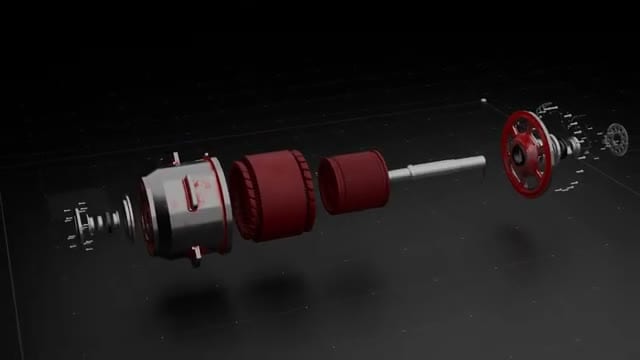
An electric motor taken apart in ROQED Mechanicum, a frame from the Mechanicum 3D page. © Vardix Group — ROQED
A 3D course does not replace a lock, a tag or a supervisor who checks them, and the court’s word was “enforced”, not only “taught”. None of this implies a ready-made model of this particular bag line: courses are built on the customer’s own equipment and instructions. What a course built from the manual can do, in our assessment, is turn the isolation step in the manual into a step the trainee has already rehearsed before the first jam.
A check a distributor can run at any plant
For a distributor who already sells into plants, the judgment suggests a plain question for the next meeting: for each machine your people clear or repair, can you show they were trained on the manufacturer’s isolation steps, and how? If the answer is a binder in an office, the plant has the gap this court described. That is the buyer’s own risk speaking, and a demo on the plant’s own equipment is the natural next step.