
The Michigan Department of Education's October 2026 science newsletter, sent on 7 October 2026, lists how the state's 2026–2027 School Aid Budget supports science. Under Section 36a, the department writes, a Committee for STEM Achievement will “evaluate and create ranking list of” STEM tools or services for classroom instruction for pupils in grades 3 to 8 that the committee determines to have “a high likelihood or demonstrated history of increasing student STEM outcomes.” Districts and intermediate school districts will then apply for Section 36a grant funds “to purchase from lists created by the committee.” How to take part in the committee, the department says, “will be forthcoming.”
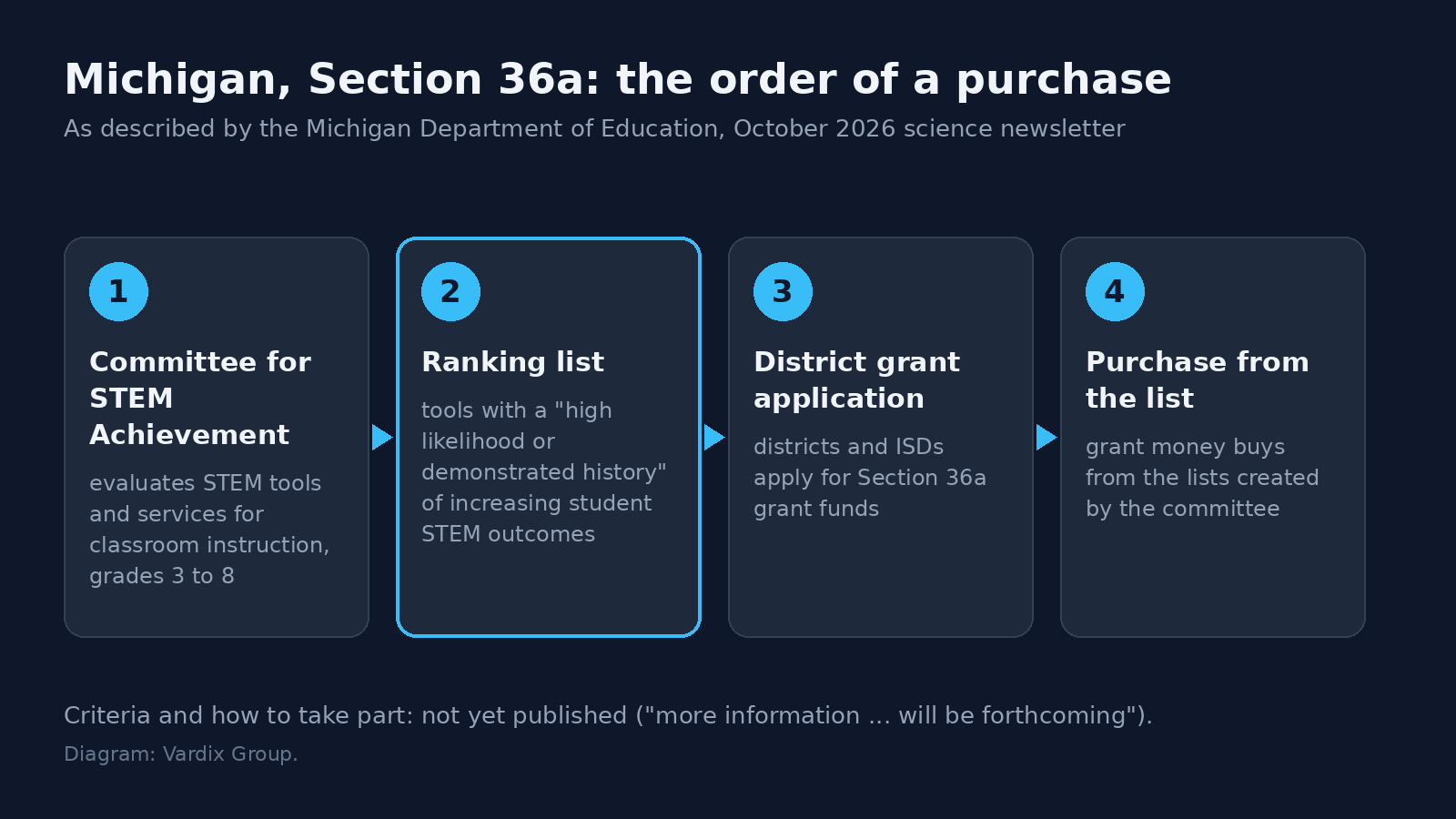
Section 36a in four steps, as the department's October 2026 newsletter describes it. © Vardix Group
A product off the list has no grant money behind it
A district that likes a product it cannot find on the committee's list has no Section 36a money to buy it with. For anyone who sells into schools, that moves the real decision to the committee's ranking, well before a district fills in a grant application.
The committee's criteria have not been published yet. What the newsletter already fixes is the test and the audience: outcomes for students, judged as a likelihood or a track record, for classroom instruction in grades 3 to 8. A feature list answers neither.
Evidence on simulations is real, and uneven
A systematic review published in Discover Education on 16 October 2026 — “A systematic review of digital competence in physics education in the era of industry 4.0” by Nurazmi and Bancong — synthesised seventy studies, including work on augmented and virtual reality, digital simulations and virtual laboratories in physics teaching. Its abstract reports that these technologies “can facilitate conceptual visualization, inquiry, engagement, and laboratory-related learning when aligned with appropriate pedagogical strategies,” and that “the evidence remains heterogeneous” across research designs, contexts, infrastructure and teacher preparedness. The review covers secondary schools, teacher education and higher education, not the early grades.
A committee asked to rank tools by likely outcomes will, as we read these two documents, favour software that works inside a teacher's lesson, with a defined grade fit, over software that promises results on its own. That is also where the review places the effect.
What a classroom tool has to show
ROQED Science is the group's interactive 3D classroom for physics, chemistry, biology and earth science, which ROQED describes for middle and high school students. Teachers build lessons from its 3D models and simulations, classroom-management tools run the lesson across a whole class rather than a single demo seat, and it runs on Windows and the web in eighteen languages, so a pilot does not depend on headsets.
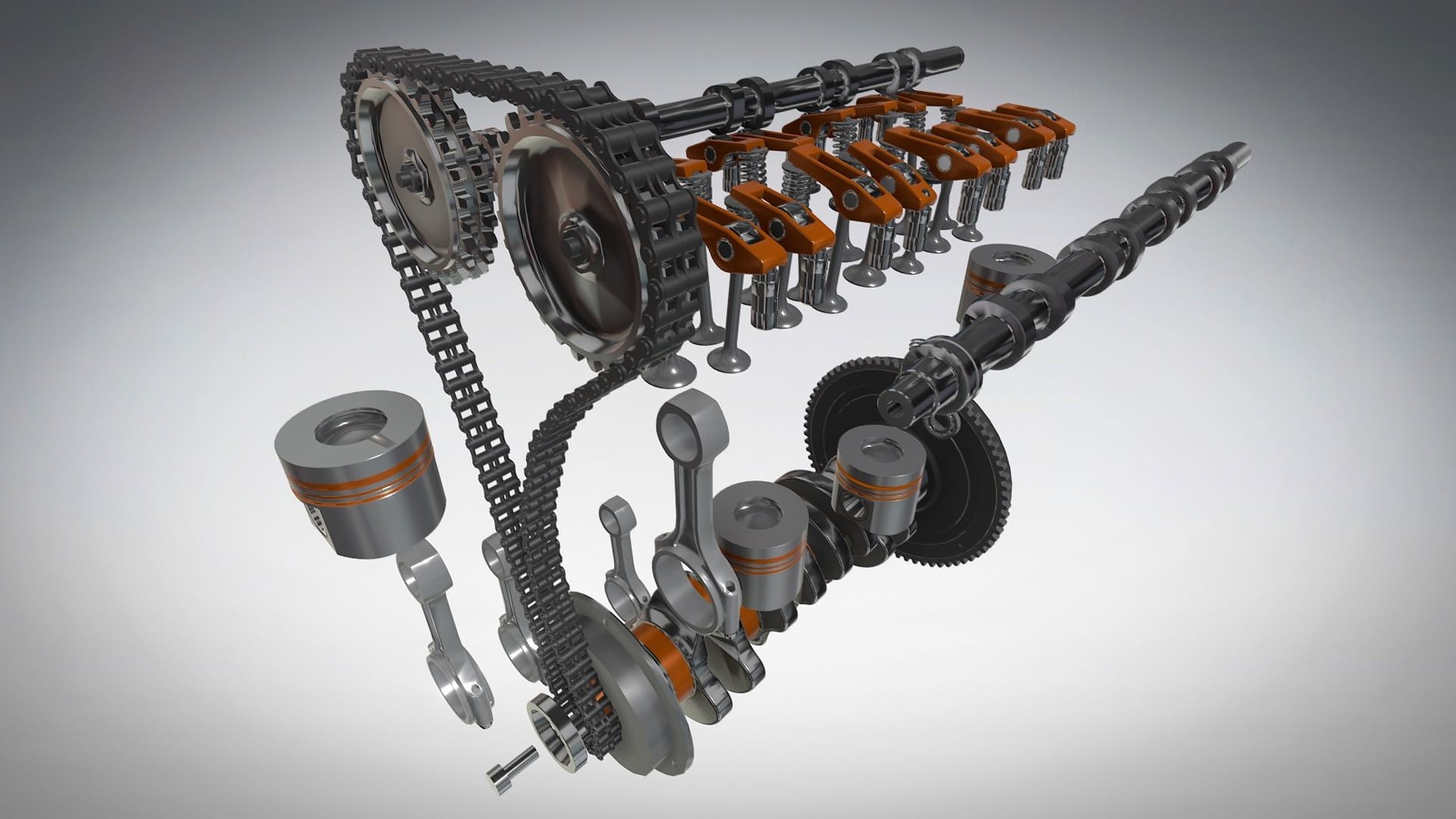
Study mode in ROQED Science: a 3D model the class can rotate and explore from any angle. © Vardix Group — ROQED
Michigan's band starts at grade 3, while ROQED positions the product for middle and high school, so the overlap is the upper end of that band. And the list does not exist yet: nothing here says the product is on it or has applied to it.
For a partner who sells to schools and ministries, procurement built around an approved list rewards the partner who prepares the evidence and the grade mapping before the call opens — how the tool is used in a lesson, for which grades, and what outcomes it has been measured against — rather than the one who arrives after it.