
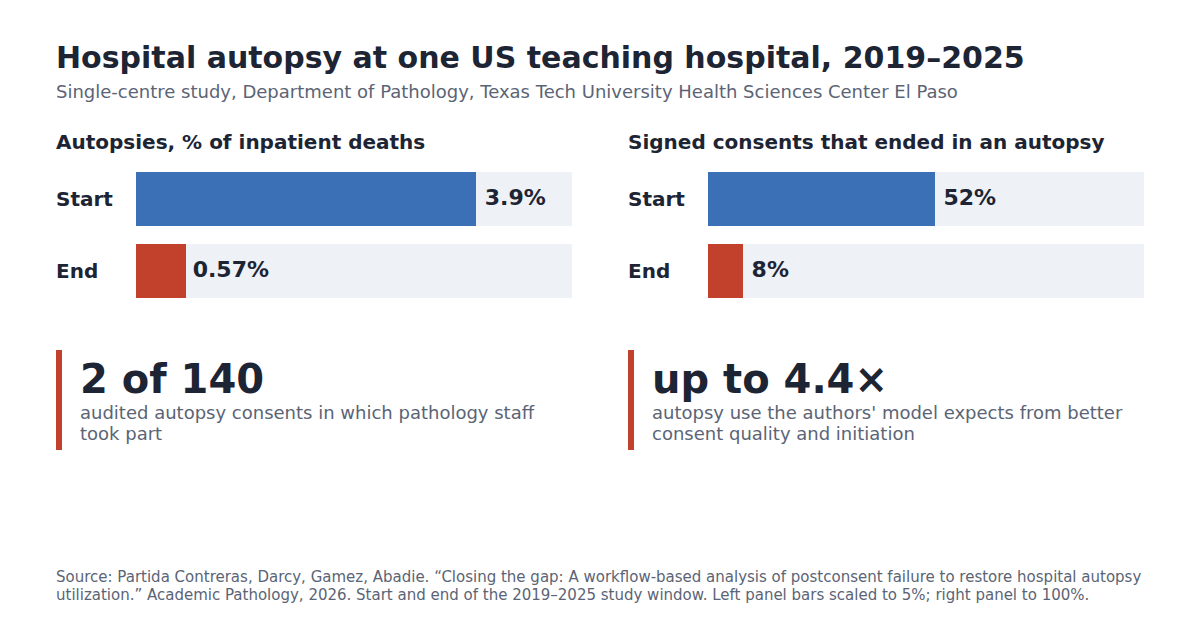
On 23 September 2026 the journal Academic Pathology published online a study by four authors from the Department of Pathology at Texas Tech University Health Sciences Center El Paso — Alejandro Partida Contreras, John Darcy, Roberto Gamez and Jude Abadie — titled “Closing the gap: A workflow-based analysis of postconsent failure to restore hospital autopsy utilization”. Over the 2019–2025 study window at their hospital, autopsies fell from 3.9% to 0.57% of inpatient deaths. The loss was not only families saying no: the share of signed consents that actually ended in an autopsy fell from 52% to 8%, which the authors read as cases lost inside the autopsy workflow after consent had been obtained.
Figures from the study in Academic Pathology (2026). © Vardix Group
The authors audited 140 autopsy consents. Pathology personnel were involved in only 2 of those 140. Their workflow model suggests that targeted improvements in the quality and initiation of consent could increase autopsy use up to 4.4-fold.
It is one hospital and one study. But the direction is not local. On 24 September 2026 About Manchester reported that the need for invasive post-mortems in Rochdale, Bury and Oldham could be reduced by up to 80%, through a post-mortem CT imaging service the Coroner’s Office for Greater Manchester runs with the NHS, Anubix and TIC Health, sparing bereaved families further distress. That is a good reason. Our reading is that for teaching the effect is the same as in El Paso: fewer organs on the table.
What the autopsy room used to teach
For a doctor in training, the autopsy was where a disease stopped being a paragraph and became an organ: the whole organ, in three dimensions, at the stage the patient actually reached. That is our reading as a distributor of medical education tools, not a finding of the El Paso paper. The paper’s remedy is a consent workflow, and for a hospital it is the right one.
A department of pathological anatomy has a narrower and more immediate question. If the autopsy room is no longer a reliable classroom, where do its students see the macroscopic picture of a disease before they move to the slide?
Where Pathology3D fits
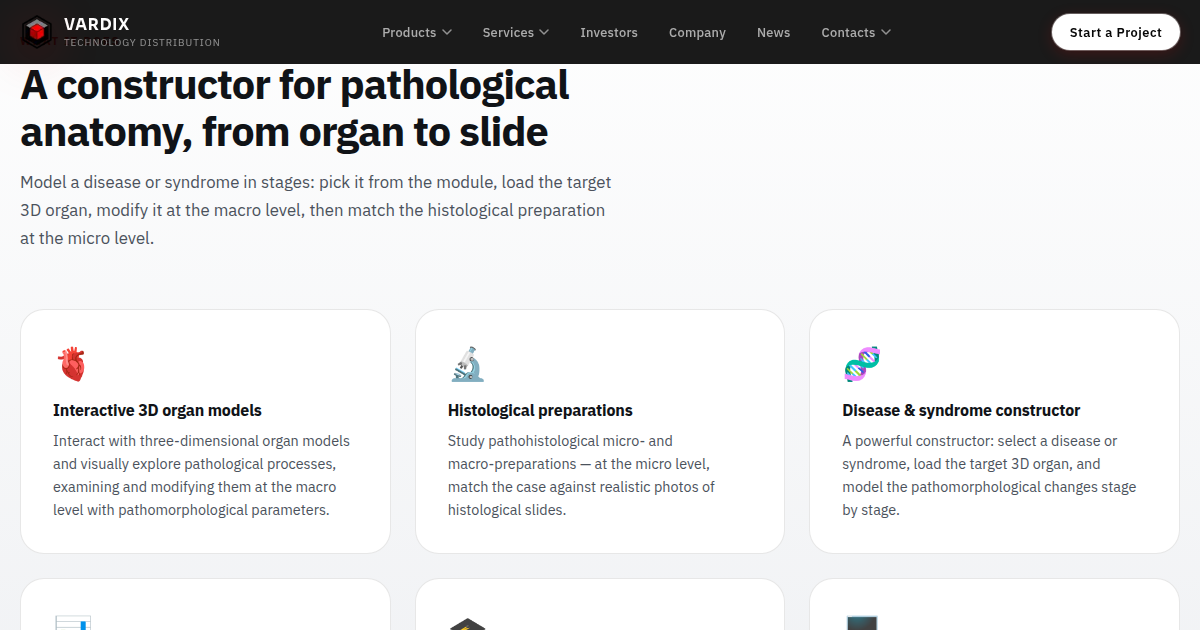
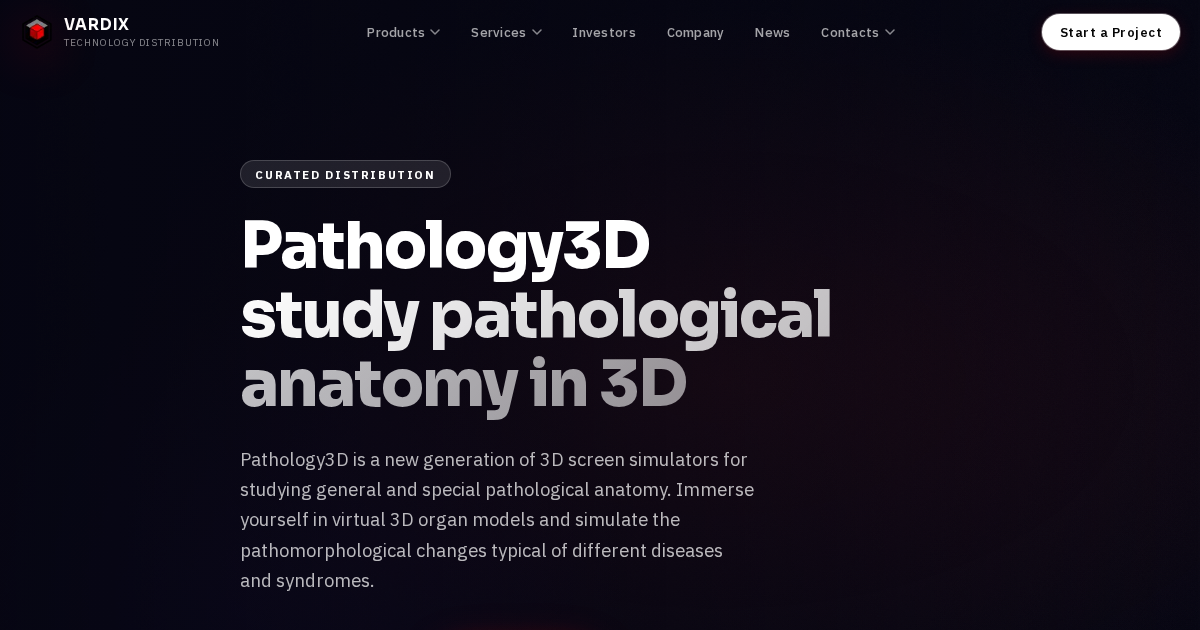
Pathology3D is a 3D screen simulator for general and special pathological anatomy, which VARDIX distributes to medical and pharmacy universities. A student selects a disease or syndrome, loads the target 3D organ and models the pathomorphological changes stage by stage at the macro level, then matches the case against photographs of histological slides at the micro level. A results table analyses the student’s answers afterwards. It runs on Windows, Linux and macOS.
Pathology3D: general and special pathological anatomy on 3D organ models. © Vardix Group
What it does not do matters as much. It does not bring autopsies back, it does not teach the consent conversation that the El Paso authors identify as the bottleneck, and it is not a substitute for the diagnostic and quality-control role of a post-mortem. It addresses one part of what the autopsy used to give a student: seeing what a disease does to an organ, when it is needed in the course rather than when a case happens to arrive.
For distributors
The buyers are departments of pathological anatomy at medical and pharmacy universities, and the conversation with them does not need a claim that 3D is better than an autopsy — we know of no evidence for that. It needs the simpler point the El Paso numbers make for us: the macroscopic stage of pathology can no longer be left to the supply of autopsies, and a 3D organ model can be put into the timetable. If your territory includes medical schools, we would like to talk.