

On 4 November 2026 the journal Trials published “The role of information and consent forms in patients’ decision-making regarding participation in oncology clinical trials”, a qualitative study by Bettina Couderc and colleagues at the Claudius Regaud Oncopole and Inserm–Toulouse University in France. The team interviewed 29 cancer patients recently enrolled in clinical trials, 18 physicians involved in including them and 15 clinical research nurses. The journal is sharing the peer-reviewed, accepted version early; a final Version of Record will replace it.
Sixty-five percent of the patients said they had not read the information and consent form before signing, or had only skimmed it. The forms averaged 35 pages and were described as lengthy, repetitive and legalistic, closer to documents that protect sponsors than to tools for understanding. Trust in the physician, mentioned by 86% of participants, was the main determinant of consent, often together with a sense of having no therapeutic alternative. The physicians confirmed that consent rested on the relationship rather than on the written form, and most admitted they do not read the forms in full themselves.
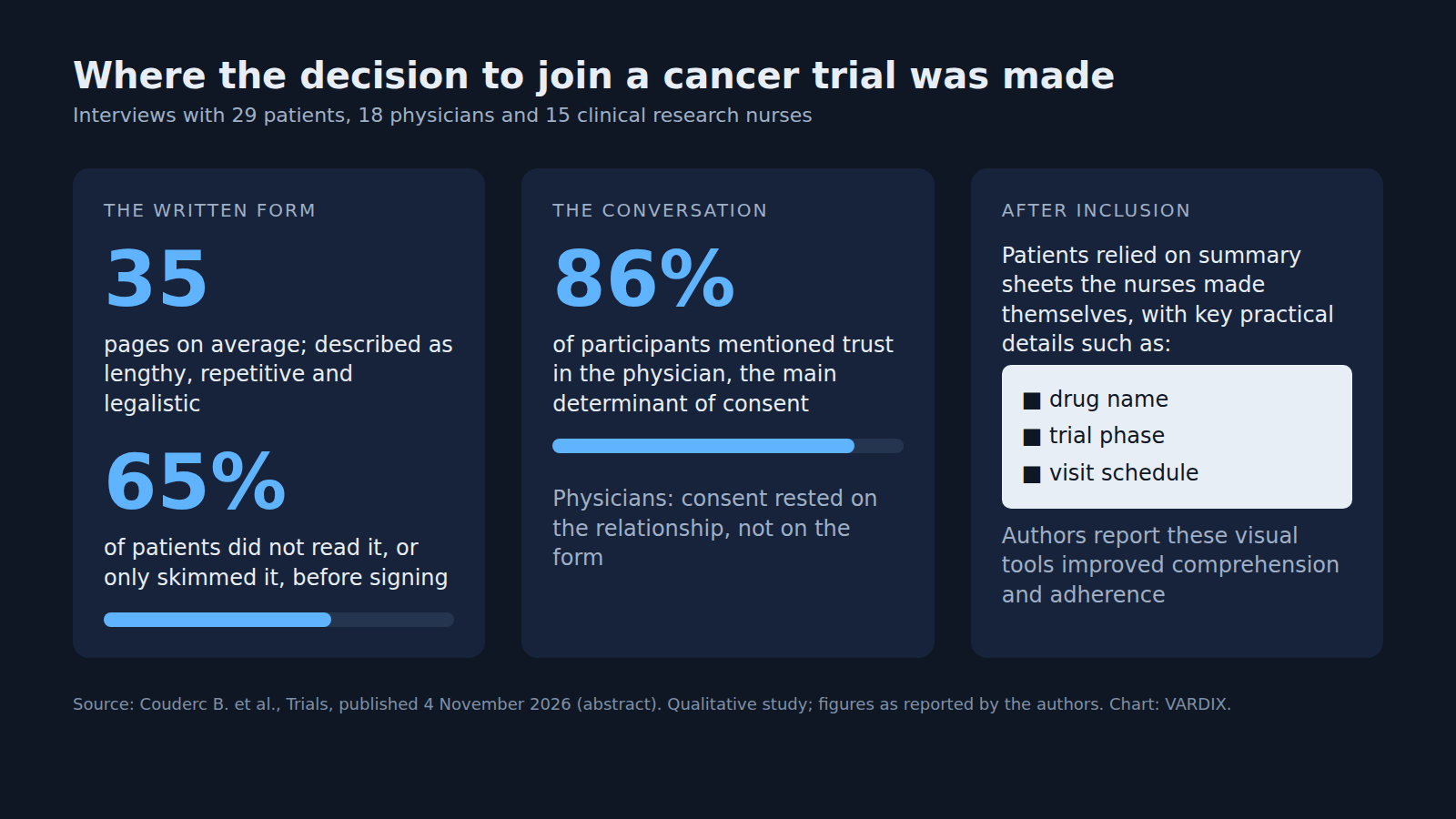
Figures as reported in the abstract of the study by Couderc et al., Trials, 4 November 2026. © Vardix Group
The summary sheets the nurses developed
After inclusion, the nurses noted, patients rarely went back to the form. They relied on simplified summary sheets the nurses had developed, with key practical details such as drug name, trial phase and visit schedule. According to the abstract, these visual tools improved comprehension and adherence. In a qualitative study that is the nurses’ own account rather than a measured effect, and it is still the most practical finding in the paper.
The authors do not propose dropping the form. They call it legally indispensable and ask for it to be restructured: concise, emphasising the trial rationale, phase, benefit–risk balance, alternatives and visit schedule, with regulatory detail moved to annexes, and complemented by clear oral discussion.
What a film can carry that a sheet cannot
Some of the elements the authors emphasise, such as the trial phase and the visit schedule, are easier to show than to describe, and in our view so is how an investigational drug is meant to act. That is the work of Medical 3D Films: mechanism-of-action and patient-education animation for pharmaceutical companies, medical device manufacturers, universities and healthcare institutions. Our patient-education animations already explain diagnoses and treatment pathways; a film built for trial participants is a natural extension, which we would scope with the client. Unlike a long form, a film can be watched again at home before the next appointment.
The abstract does not mention films, and the study did not evaluate them. A film does not change where the decision is made: it supports the physician’s conversation and the weeks after inclusion, it does not replace the signed form, and it must not soften the parts the form exists for, risks and alternatives among them. In our view such a film is most useful when it is planned together with the participant information for the trial, rather than produced later as promotional material.

A visual from the Medical 3D Films page on vardix.com. © Vardix Group — VARDIX
Who will ask for this
We expect the interest to come from pharmaceutical companies sponsoring trials, from hospitals and universities that run them, and from their patient-education teams. For a distributor already working with pharmaceutical or hospital clients, the study offers a concrete opening: not a nicer video, but the material patients already reach for after they sign. Every project we produce is reviewed by a qualified medical advisor before delivery, with subtitle delivery in the languages required.