
On 30 September 2026 one sentence changed in the brake-system training rules for American freight and other non-passenger trains. The U.S. Federal Railroad Administration (FRA) final rule “Permitting Use of Computer-Based, Three-Dimensional Simulation for Periodic Refresher Training on Brake Systems”, published in the Federal Register on 31 August 2026 (91 FR 55784, docket FRA-2025-0127), amends 49 CFR 232.203(b)(8). Railroads may now meet the hands-on portion of periodic refresher training for employees who inspect, test or maintain brake systems with “a simulation that is instructor-led, computer-based, and three-dimensional”, provided the training is documented as required in paragraph (e) of the same section.
Until then the rule named one way, besides hands-on training itself, to meet the hands-on requirement: observation and evaluation of actual performance of duties. A railroad that wanted 3D simulation to count as the hands-on portion had to ask for a waiver. FRA granted the first in 2012, to BNSF Railway, for web- and desktop-based software called the Air Brake System Virtual Training Environment; Norfolk Southern, Canadian Pacific, CSX and Canadian National later received waivers of their own. According to the rule, BNSF reports more than 72,000 training events for over 25,000 employees on that software. From 30 September no waiver is needed, and the option is open to all railroads, not only those granted a waiver. FRA’s stated reason is that freight cars of many types move freely between railroads, and a 3D simulation gives employees randomized scenarios on equipment types that may not otherwise be readily available for hands-on training, with real-time feedback on their performance.
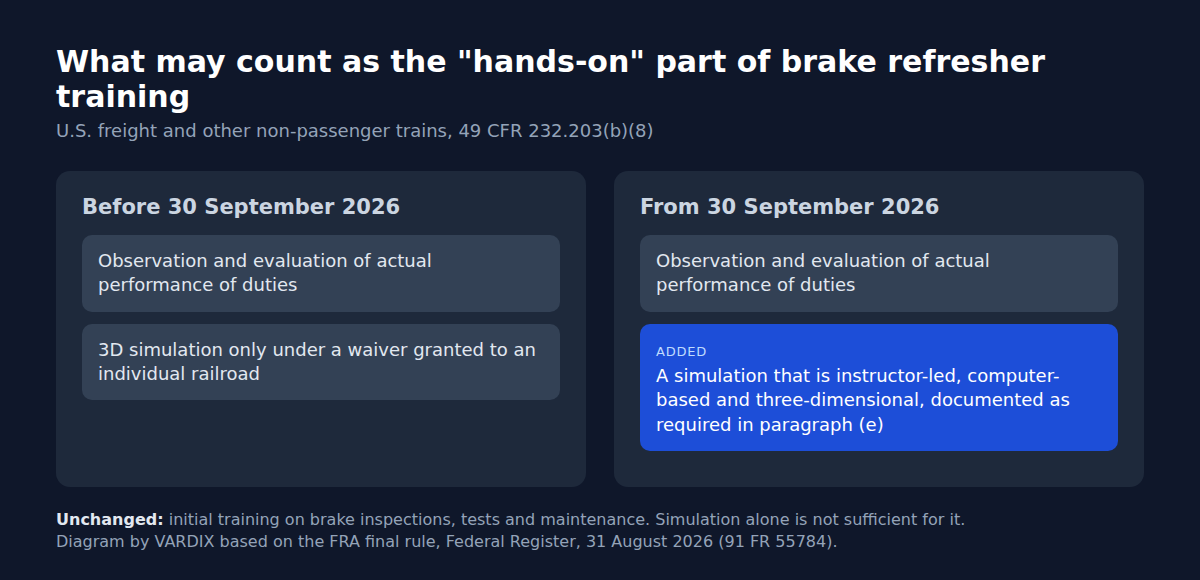
What may count as the hands-on part of brake refresher training under 49 CFR 232.203(b)(8), before and after the FRA final rule took effect. Initial training is unchanged. © Vardix Group
Two words that were not in the proposal
The proposal FRA published in July 2025 spoke of “three-dimensional virtual simulation”. The final text reads differently: one change answers a union comment, the other corrects FRA’s own wording.
Instructor-led. The Brotherhood of Locomotive Engineers and Trainmen told FRA that on one Class I railroad’s computer-based refresher course, feedback was not given continually during the course, and only a final score was generated at the end. FRA agreed that an instructor’s active involvement is essential and wrote it into the rule: the simulation must be led by an instructor qualified under part 232.
Computer-based. FRA dropped the word “virtual” because it may be read as only the immersive kind that needs a headset and hand controllers. According to the rule’s preamble, “computer-based” is “generic enough to include” all 3D simulation types, including the lower-fidelity ones traditionally run on a desktop, laptop or tablet.
The amended sentence also carries a condition: the training must be documented as required in paragraph (e) of the same section.
What the unions objected to, and what survived in the rule
Four labour organisations generally opposed the proposal: BLET, the Brotherhood of Railway Carmen, SMART Transportation Division and the AFL-CIO Transportation Trades Department. Many of them argued that computer-based training cannot replace real-world training and does not expose workers to unpredictable elements such as weather or physical and sensory inputs. According to the carmen, a keyboard and mouse cannot provide the experience of manipulating and inspecting equipment in person. The carmen added a narrower point: virtual training often generalises brake system features, fails to reflect differences between railroads and does not usually keep up with updated rail car designs.
FRA kept the change but drew its limits. Simulation counts only for refresher training; on its own it is not sufficient for initial training. It has to be as effective as the other hands-on methods. And FRA writes in the preamble that if an employee fails to show the required knowledge or abilities in a simulation, it expects the railroad to supplement it with other refresher training that, for example, involves manipulating and inspecting equipment in person.
A model of the operator's own equipment
Part of the carmen’s objection is about content rather than the screen. A model of a generic brake teaches the average car, and the average car is not the one in the yard. That is the problem ROQED Mechanicum, ROQED’s industrial training platform sold to distributors through VARDIX, is built around. Its courses are made from the customer’s own maintenance, repair or HSE instructions: photorealistic 3D models of industrial equipment, taken apart step by step, part by part in the order the instruction gives. The same course runs on a PC, a mobile device, a VR headset or an industrial panel, so the desktop form named in FRA’s preamble is one of the options rather than a downgrade. ROQED Mechanicum can also be integrated with the customer’s existing LMS or ERP.
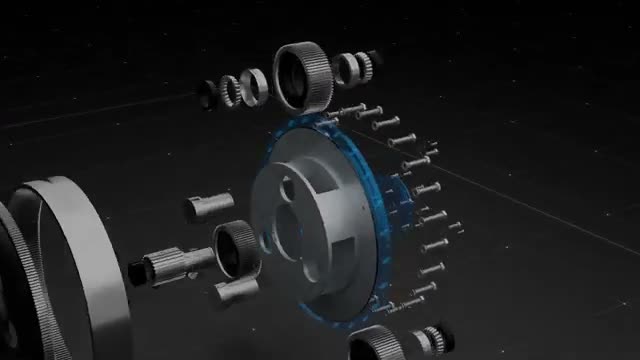
A gearbox taken apart in ROQED Mechanicum, a frame from the product video on its VARDIX page. It shows the kind of model a course is built on, not rail brake equipment. © Vardix Group — ROQED
The equipment shown on Mechanicum’s VARDIX page is a gearbox, an electric motor, a mining excavator and a radial engine, not rail brakes; a course for a railroad would be built from that railroad’s own instructions, which is the point of the product. And nothing here makes a course compliant with the FRA rule by itself: the instructor, the qualification and the records are the railroad’s responsibility.
Where the rule stops
This is a U.S. rule, and other regulators decide for themselves. A partner who offers 3D training to an operator as a replacement for the yard would be selling something the regulator that accepted it did not grant. What the rule does settle is two parts of a defensible offer: a qualified instructor leading every session and training documented as the rule requires. The carmen’s objection suggests a third: content built from the operator’s own equipment and instructions.