
On 8 September 2026 the journal Frontiers in Medicine published “AI-driven virtual standardized patients combined with scenario-based simulation in anesthesiology training: a randomized pilot study”, by Xiaohua Wang and colleagues at Zhongnan Hospital of Wuhan University. Sixty students on a professional master’s programme in anaesthesiology were randomised into three arms of twenty, and every arm received the same 16 hours of teaching.
The arms differed only in how those hours were spent. The first had conventional teaching. The second had scenario-based simulation with structured debriefing. The third had the same simulation pathway, except that four 1-hour sessions with AI-driven virtual standardized patients replaced four hours of conventional case discussion. The platform used in the study, named in the paper as CliniTrek, offered voice-based preoperative interaction and perioperative decision training.
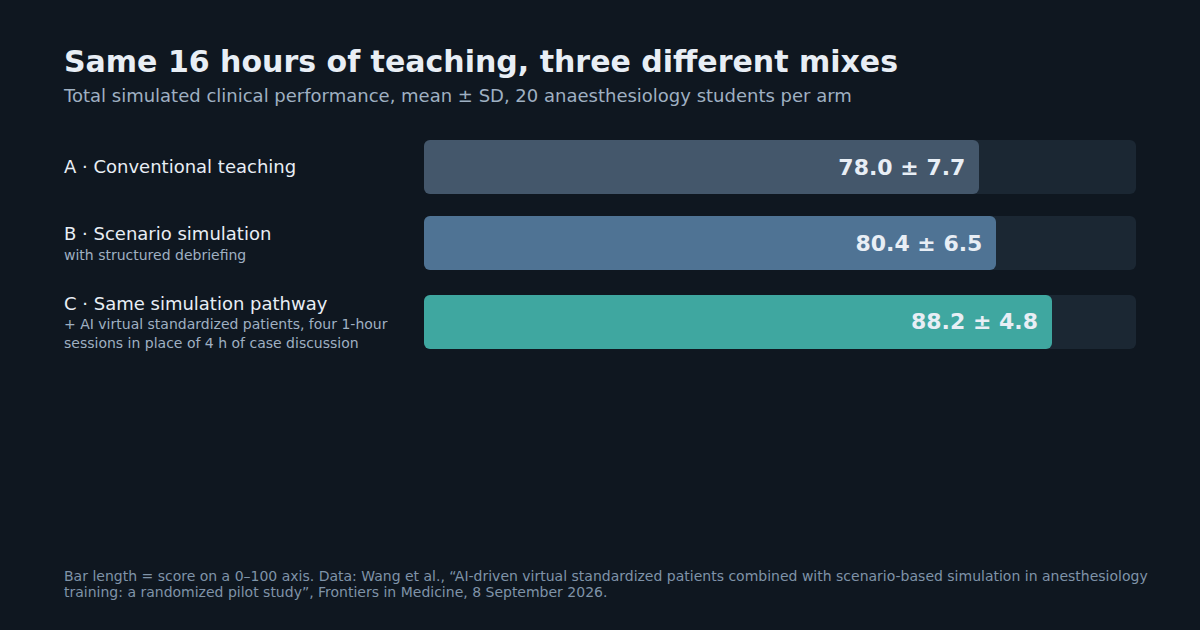
Same timetable, three mixes. Figures as reported in the paper; the chart is ours. © Vardix Group
What the numbers say
On total simulated clinical performance, the arm with virtual patients scored 88.2 ± 4.8, against 78.0 ± 7.7 for conventional teaching and 80.4 ± 6.5 for simulation with debriefing (F(2, 57) = 13.72, P < 0.001). The paper also reports between-group differences in the theoretical examination, the skills examination and teaching satisfaction.
The detail a buyer should notice is the one that did not change: the timetable. Nobody got extra hours. Four hours moved from talking about a patient to talking to one, and that is the comparison a faculty actually faces, because teaching hours are the budget that does not grow.
What the authors say it does not show
The paper is candid about its limits, and a distributor who repeats the headline without them will be corrected by the first clinician in the room. The authors describe the study as single-centre, modest in size and short-term, and list, among other things:
no retention or workplace-performance endpoints;
an assessment case that stayed within the same crisis domain as the training;
a locally developed scoring rubric;
a baseline-adjusted participant-level analysis (ANCOVA) that was post hoc rather than prespecified;
complete raw logs of the AI interactions that were not available.
Their conclusion is correspondingly narrow: the combination was associated with better short-term performance on aligned anaesthesiology crisis tasks, and the authors write that the findings do not establish comprehensive crisis resource management competence, definitive effectiveness or durable transfer to clinical practice.
The question to ask of any virtual patient
Our reading of the paper is that its most useful line for a buyer is the last item in that list. If the complete record of what the virtual patient said to each student is not available, nobody can go back and check what a given student was actually taught, and nobody can assess the conversation itself — only its outcome on a later test.
So when a faculty compares simulation platforms, the question is not only whether the virtual patient talks back. It is whether every session leaves a record an instructor can read. VARGATES Medical answers that on its own product page, which describes AI-driven patient simulations alongside learning analytics that track every session, score and error, with instructor dashboards on student progress, in a browser or a VR headset.
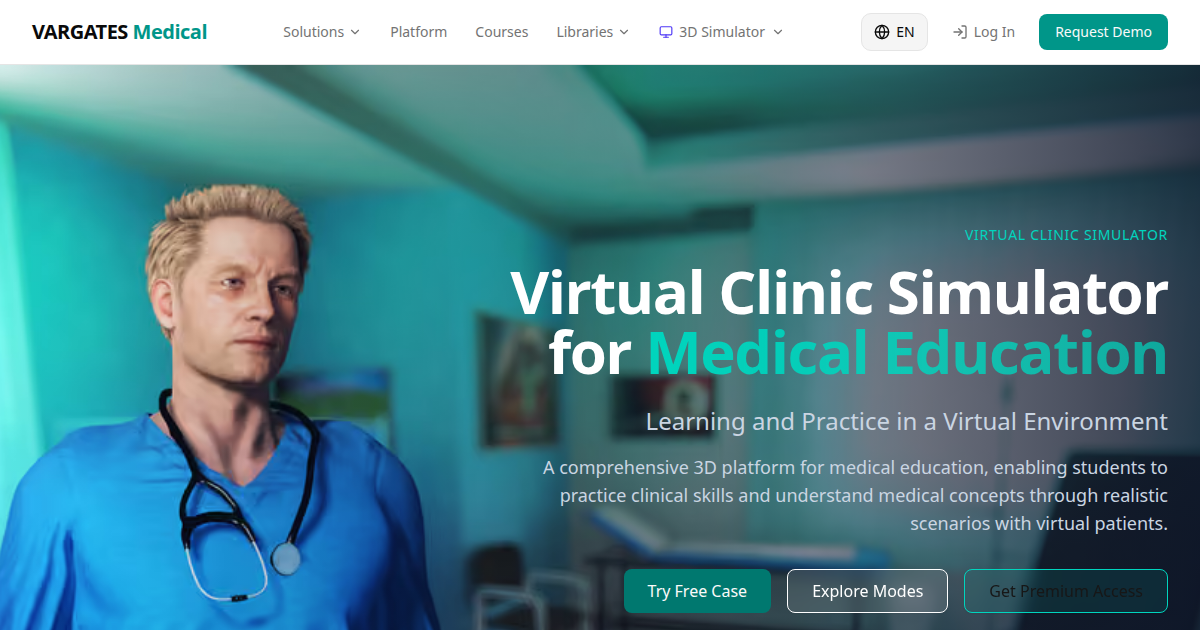
VARGATES Medical, the group’s clinical simulation product, at medical.vargates.com. © Vardix Group — VARGATES Medical
What this means for a distributor
The buyers are the ones you may already sell to: medical universities, teaching hospitals and clinical-skills centres. The conversation this study supports is not “add more simulation hours”, which a curriculum committee rarely has, but “change what four of the existing hours are spent on”. VARGATES Medical lets a partner add that clinical line without standing up a new platform; VARDIX runs onboarding and the support chain.