
On 30 October 2026 the Western Cape Education Department published a statement by the province’s Minister of Education, Jaco Londt, headed “Ardagh and WCED partner to strengthen STEM education in Western Cape schools”. Ardagh Glass Packaging-Africa and the department signed a memorandum of understanding at the company’s manufacturing plant in Bellville, in a deal facilitated by Edu Invest, powered by Wesgro. The Ardagh for Education Programme, run by the non-profit Programme for Technological Careers (PROTEC), will choose participating schools from a pool of 64 — 41 primary and 23 secondary — in Bellville, Athlone and Strand. A first cohort of eight high schools is scheduled to start in 2027, with further cohorts phased in over seven years.
The release is specific about what a participating school receives. Mathematics and Science teachers across Grades 4 to 12 get 90 hours of training workshops and 36 hours of in-school support over two years, with ongoing access to online learning resources and professional learning communities. Practical work is to come from “a PROTEC/Ardagh science resource centre in the form of mobile science labs which will visit participating schools to facilitate classroom demonstrations and experiments.” Coding and robotics arrive through teacher training and school-based clubs. The release says the programme builds on similar initiatives already under way in other parts of South Africa.
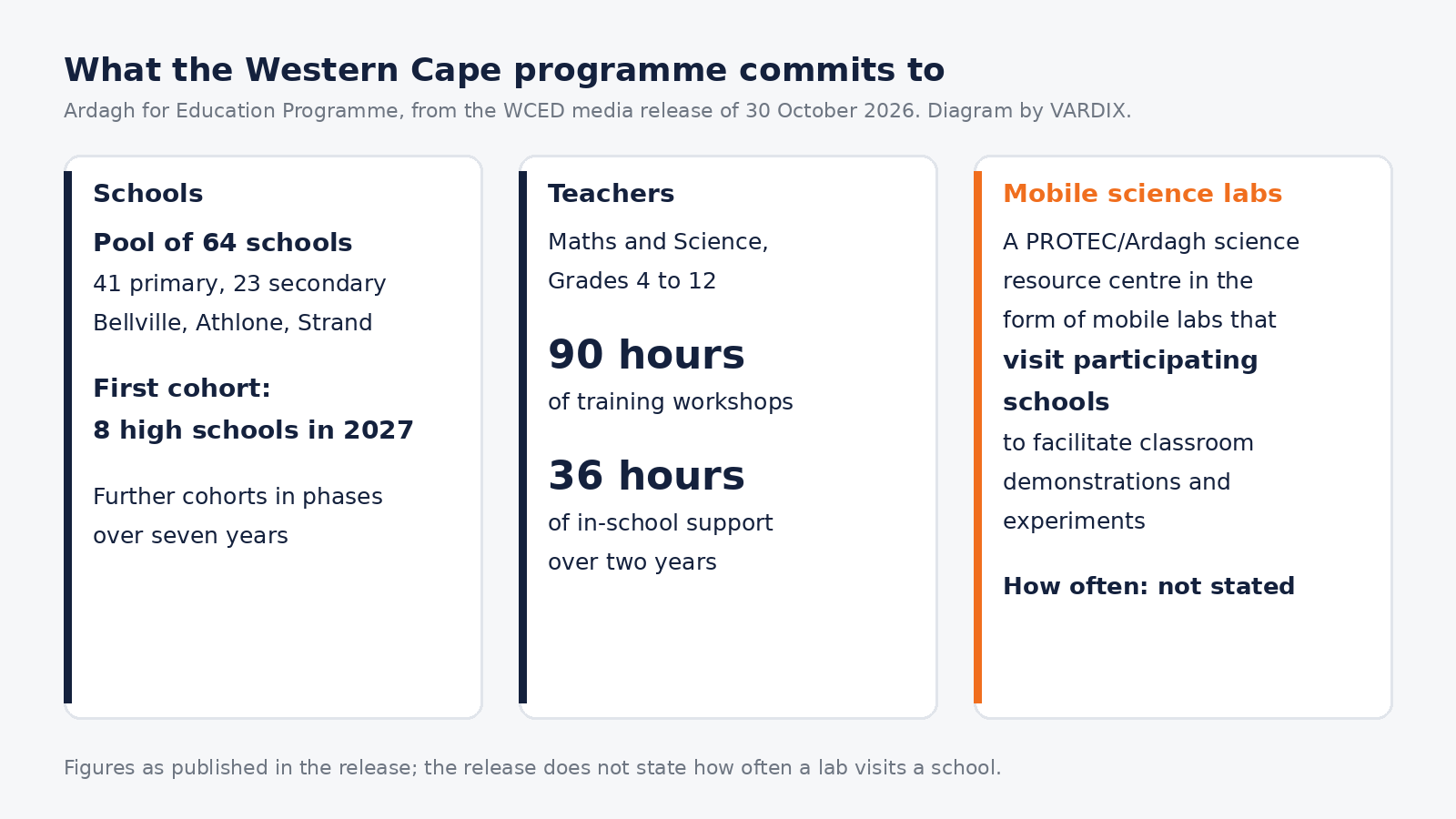
What the programme commits to, as published in the WCED media release of 30 October 2026. The release does not say how often a mobile lab reaches a school. Diagram by VARDIX. © Vardix Group
What the release leaves unstated
The release does not say how often a mobile lab reaches a given school, and we do not guess. Nor does it say what equipment the participating schools already hold. A lab that travels between schools is, by its design, at any one of them only part of the time.
Minister Londt put the aim as “increasing the Maths and Science footprint in schools across the province and improving learning outcomes in these subjects.” In our view, a footprint of that kind is made in ordinary lessons. A class that has watched an experiment still has to come back to it the following week, reason about what it saw and connect it to the next topic — and by then the apparatus has moved on to another school.
What stays in the classroom when the lab moves on
ROQED Science is ROQED’s school product, which VARDIX distributes to partners who sell into education. Physics, chemistry, biology and earth science are taught through interactive 3D models and simulations. Teachers build lessons from those models, the class works in the same models, and classroom-management tools run a lesson across a whole class rather than a single demo seat. It runs on Windows and on the web, so a pilot starts on the computers a school already has, with no headsets, and ROQED publishes it in more than eighteen languages.
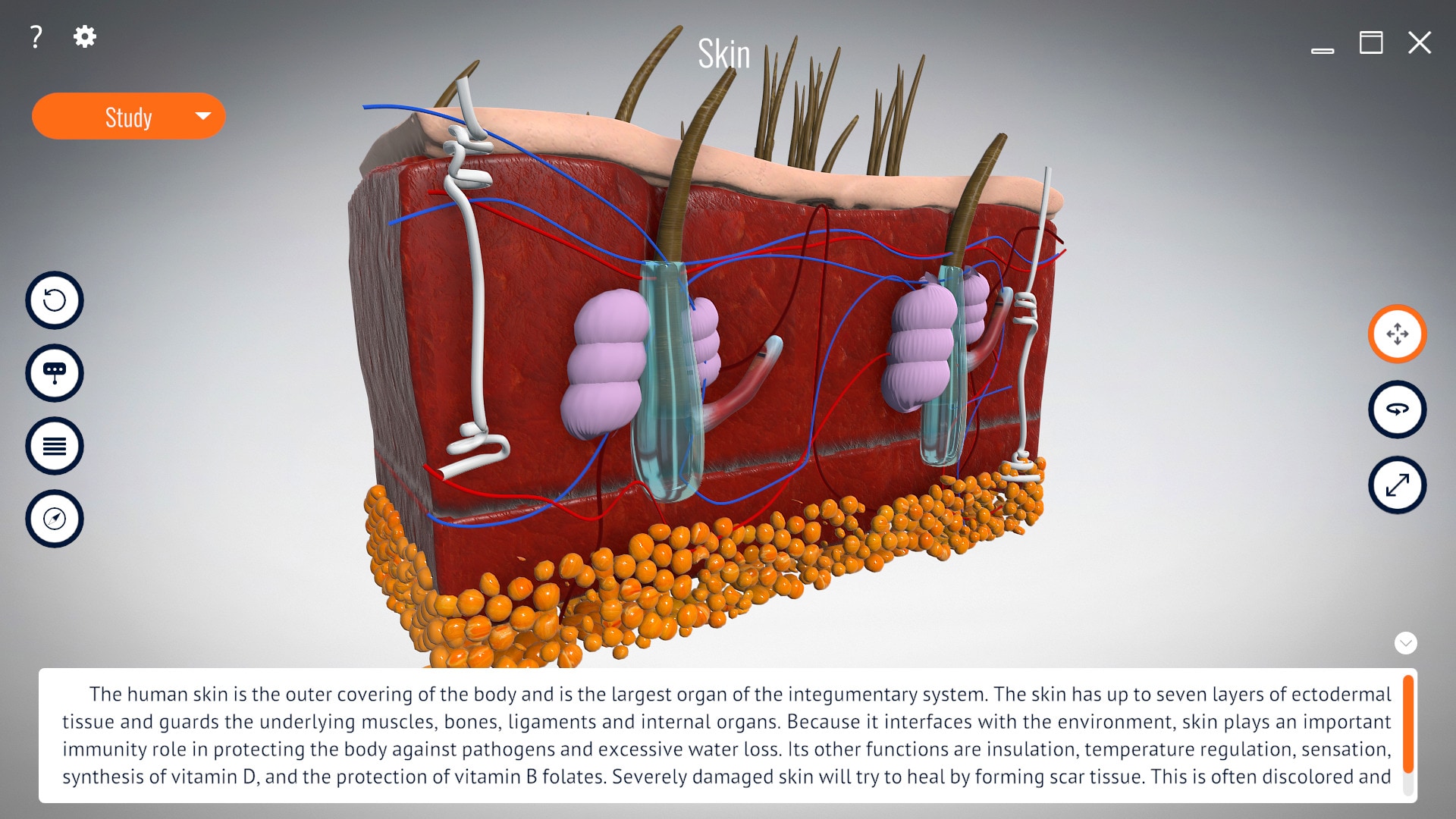
A biology model in ROQED Science: a 3D cross-section of human skin with the explanation panel open, a frame from the ROQED Science page on vardix.com. © Vardix Group — ROQED
None of this replaces a demonstration a learner watches or an experiment a learner runs, and the programme rightly puts both in front of the class. Nor does the release say anything about computer rooms in the participating schools; a school without working computers is not a customer for any classroom software. Nothing here implies that VARDIX or ROQED is involved in the Western Cape programme. What a 3D classroom adds, in our assessment, is a model the teacher can open again in the weekly lesson they run alone, for example the layers of the skin, turned and taken apart by the class while the teacher asks what each part does.
A second kind of buyer behind school science
The release also shows who is paying. As it puts it, the initiative forms part of Ardagh’s broader commitment to “investing in education in communities surrounding its manufacturing operations”, and Edu Invest, powered by Wesgro, facilitated the partnership. For a distributor who calls only on ministries and school chains, we read that as a second door: industrial companies that fund education programmes near their plants, and the organisations that connect them with schools.
The useful question for such a programme is a plain one: between the funded hours and the visits, what do the participating teachers use in the other lessons, and whose budget covers it? Where no line in the programme answers that, a distributor has something specific to propose.