
On 7 October 2026 the Monetary Authority of Singapore issued its Guidelines on Artificial Intelligence Risk Management for financial institutions. They apply to all financial institutions and to all forms of AI technologies, and they follow a consultation MAS ran in November 2025. The Guidelines take effect on 7 October 2027 and may be phased in: the expectations in Sections 3 to 4 apply from that date, those in Sections 5 and 6 by 7 October 2028.
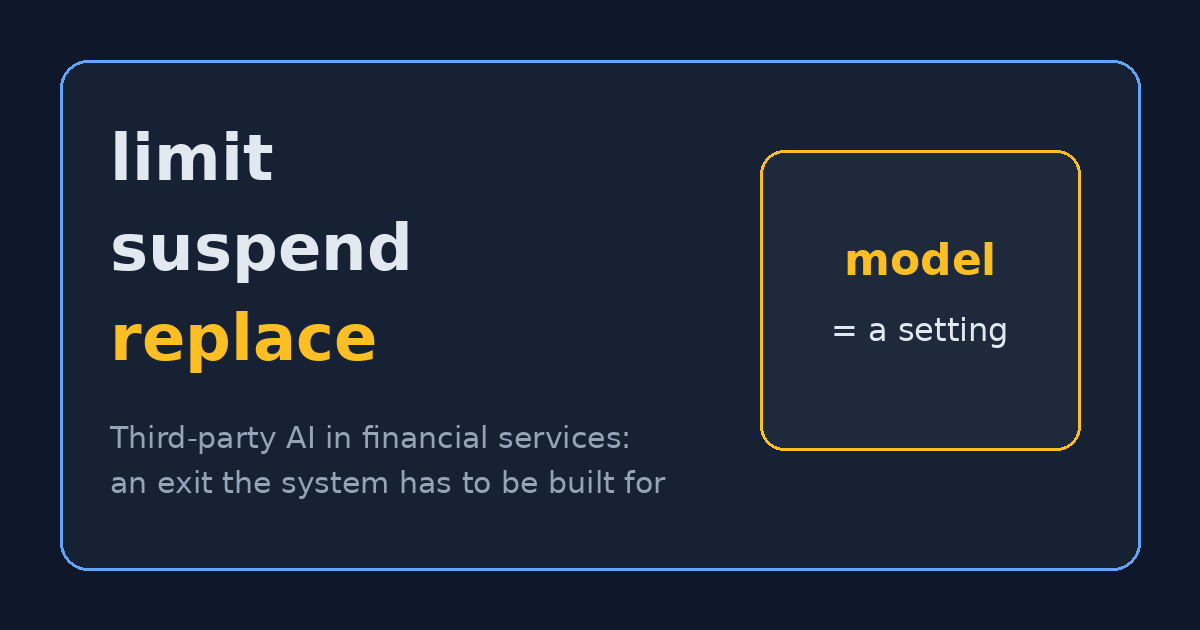
The passage that reaches furthest beyond the bank is the one on third-party AI. An institution remains accountable for AI used in its services even when somebody else built it. It is expected to obtain sufficient assurance, assess whether the service is suitable and add compensating controls where assurance falls short. And if the risks cannot be brought within its risk appetite, MAS says it should consider limiting, suspending or replacing the use of the third-party AI service.
Limiting is easy; replacing is not
In our experience the word that matters there is the last one. Limiting and suspending can be done to almost any system by turning features off. Replacing is a different matter: it is cheap only if the model is not where the institution's facts, history and working logic live. When prompts, retrieved documents and answers exist only inside one vendor's product, replacing that vendor means rebuilding the product, and an option that costs a rebuild is rarely exercised.
The rest of the release points the same way. Institutions are expected to keep an inventory of their AI use, assess how material each use is, and apply controls covering data governance, testing, human oversight, cybersecurity, monitoring and change management, in proportion to the risk. MAS also intends to consult the sector in 2027 on what further guidance on agentic AI would be useful.
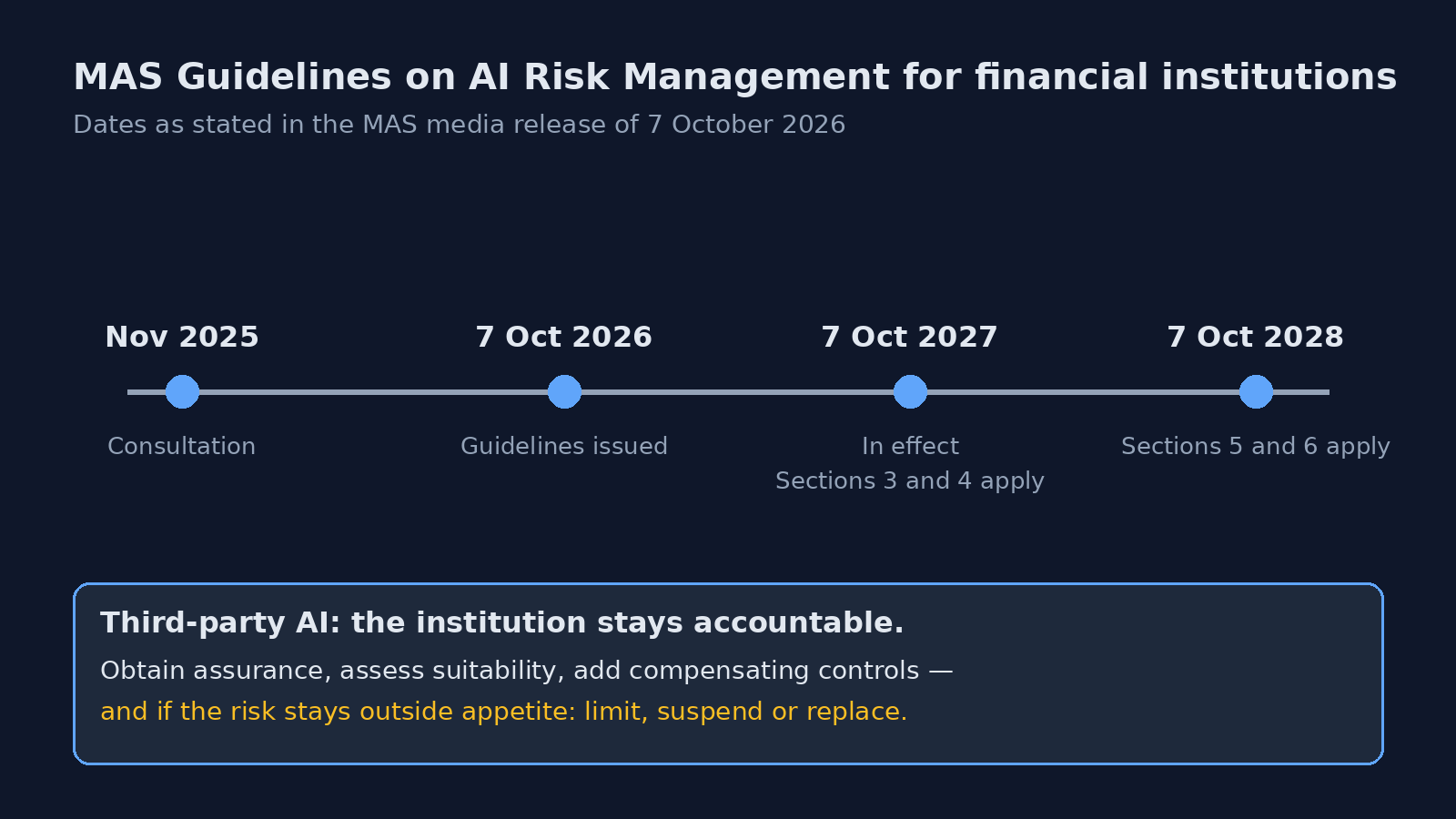
Dates from the MAS media release of 7 October 2026 © Vardix Group
What sits underneath the model in our integrations
Our AI / LLM Integration practice is built around the layer those expectations keep returning to. What the system may treat as true is stored and versioned in the client's own database, and the model reads it rather than remembering it. The model provider is a configuration setting, so a change of vendor, price or hosting is a change of configuration rather than a rewrite. Hosting, including self-hosted open models, is chosen against where the data is allowed to live.
Operation is part of the build, not an afterthought: we log what was asked and what was answered, track spend per interaction and review the cases the model got wrong. We hold our own work to the same rule. In VARGATES Virtual Worlds, where a model narrates and arbitrates over a live information model, the narrator model is configurable for exactly this reason.
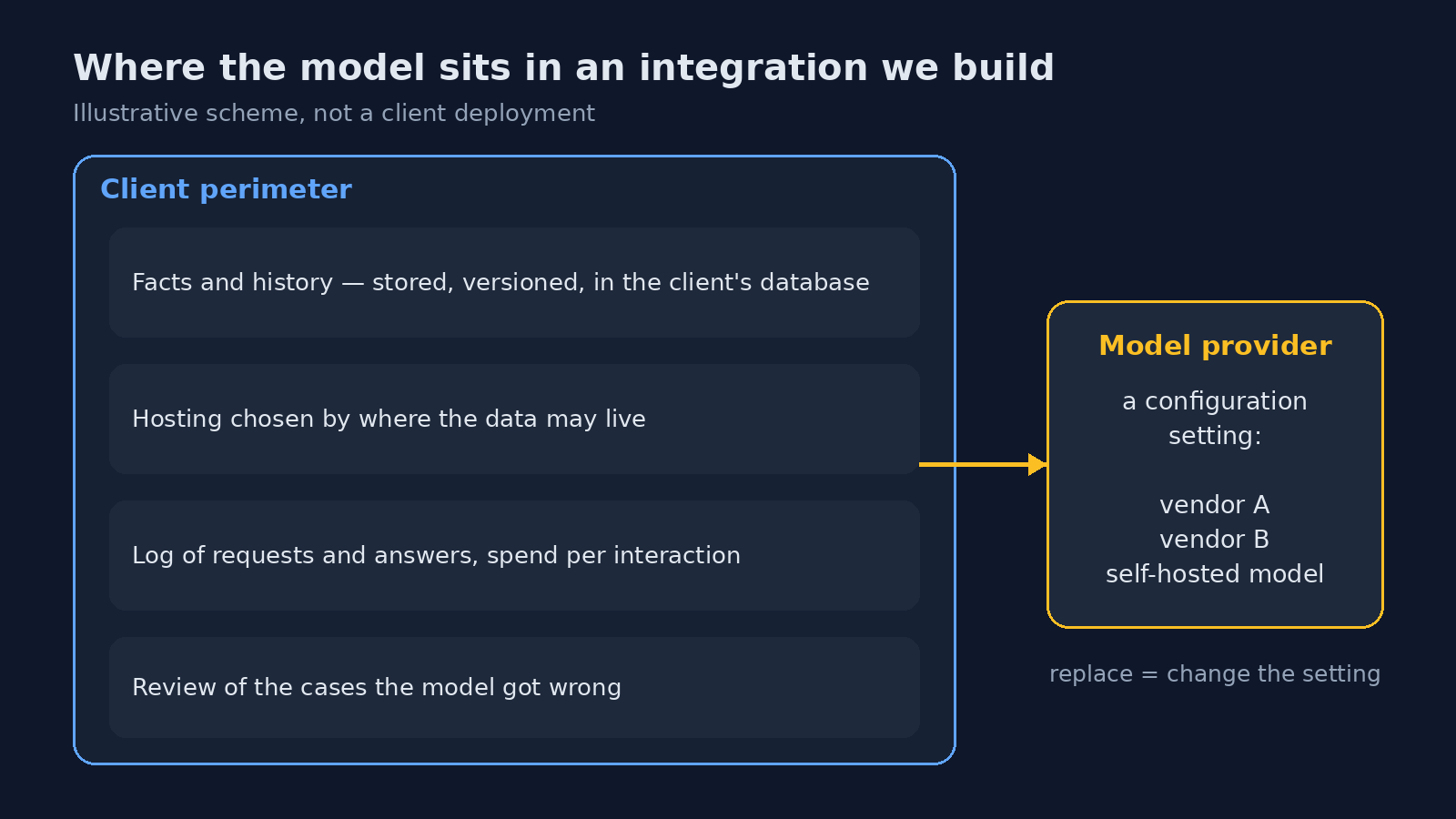
Illustrative scheme of the approach, not a client deployment © Vardix Group
None of this makes a deployment compliant on its own. The Guidelines are principles-based and risk-proportionate, and in our reading what counts as sufficient assurance is for the institution and its supervisor to judge, not the team that wrote the integration. They are addressed to financial institutions in Singapore; elsewhere they are a reference point rather than an obligation. What the architecture changes is narrower and practical: when an institution's own assessment says limit, suspend or replace, the third option exists without starting over.
Three answers to have ready: facts, logs, switch-off
Where the facts live, what is logged, and what it takes to switch the model off or swap it: a partner selling AI work to banks, insurers or payment firms should be able to answer all three in the first meeting with a risk or compliance team, well before 2027. That is the conversation we prepare our partners for, and the one the integration is designed to survive.