Page

Vardix Physics LABS

The VARDIX Physics LAB 3D platform is a product based on the most advanced 3D graphics and computer animation solutions. Conducting virtual experiments using this product is a fascinating process. The application contains more than 80 virtual 3D laboratory instruments and is the ideal environment for preparing and conducting experiments for physics labs of any complexity.

January 21, 2023/vardix-labs-physics-3d
Vardix Physics LABS

Virtual Physics Lab

The VARDIX Physics LAB 3D platform is a product based on the most advanced 3D graphics and computer animation solutions. Conducting virtual experiments using this product is a fascinating process. The application contains more than 80 virtual 3D laboratory instruments and is the ideal environment for preparing and conducting experiments for physics labs of any complexity.

Our application is maximally optimized, which allows you to get realistic graphics even on weak computer systems.

Benefits of Vardix Physics LAB

  • Thanks to the game form of the application and thought-out scenarios, the interest of students is stimulated, thereby improving the absorption of the material.
  • The simulator allows the student to recreate an experience of any complexity, with no limitations on space or resources.
  • Develops spatial thinking of students.
  • The reduction in school hours does not affect the process of creating an experience, all the information the student needs is right there in the app.
  • Conducting experiments in the virtual world is financially profitable, unlike in real life, on special equipment.
  • By conducting experiments in a virtual laboratory, the risk of injury during experiments is minimized.
LABORATORIES SECTIONS CASES MODES OF OPERATION

Application Features

  • Correct simulation of physical processes: gravity, combustion, evaporation, friction, etc.
  • A complete set of tools and instruments that are required for each experiment.
  • Photorealistic graphics.
  • Our own virtual laboratory
  • Students are able to construct their own experiments
  • An extensive database of experiments covering the entire high school physics course
  • Comparison of the work of the elastic force with the change in the kinetic energy of the body
  • Study of elastic deformations.
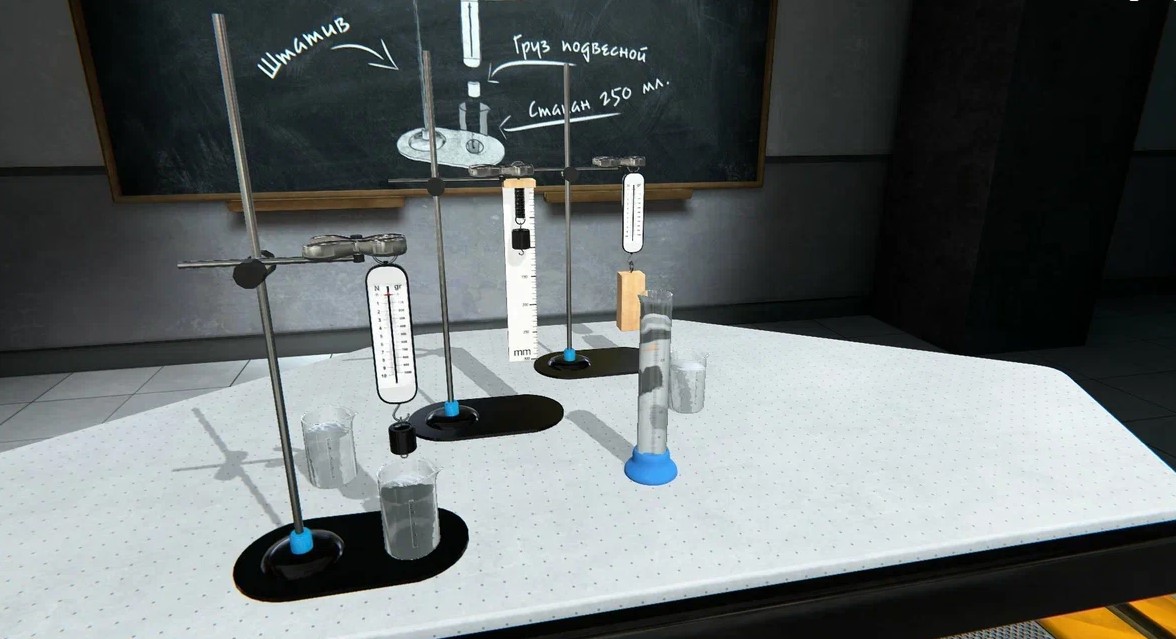
  • A study of Archimedes' law.
  • Check the condition of floating bodies in a liquid.
  • Determination of work performed by uniformly lifting a body
  • Determination of the lever equilibrium condition.
  • Determination of the coefficient of performance of the inclined plane.
  • Comparison of the amount of heat when mixing water of different temperatures.
  • Determination of the specific heat of ice melting.
  • Assembling an electrical circuit and measuring current and voltage in its various sections.
  • Investigation of the dependence of current intensity on the voltage on the circuit section. Checking Ohm's Law.
  • Study of series and parallel connection of conductors.
  • Measurement of work and power of electric current.
  • Studying the properties of a permanent magnet and imaging magnetic fields.
  • Assembling an electromagnet and studying its action.
  • Determination of the acceleration of the body in equi-accelerated motion.
  • Study of the motion of a body thrown horizontally.
  • Determination of the acceleration of gravity using a mathematical pendulum.
  • Determination of surface wave propagation velocity.
  • Investigation of the dependence of the range of the body on the throwing angle.
  • Determining the density of liquids and solids.
  • Determining atmospheric pressure.
  • Comparison of molar heat capacities of metals.
  • Measuring relative humidity.
  • Measurement of the surface tension of water by droplet detachment and liquid elevation in a capillary.
  • A study of Ohm's law for a circuit section.
  • Study of mixed connection of conductors.
  • Determination of the EMF of the current source and its internal resistance.
  • Study of the phenomenon of electromagnetic induction.
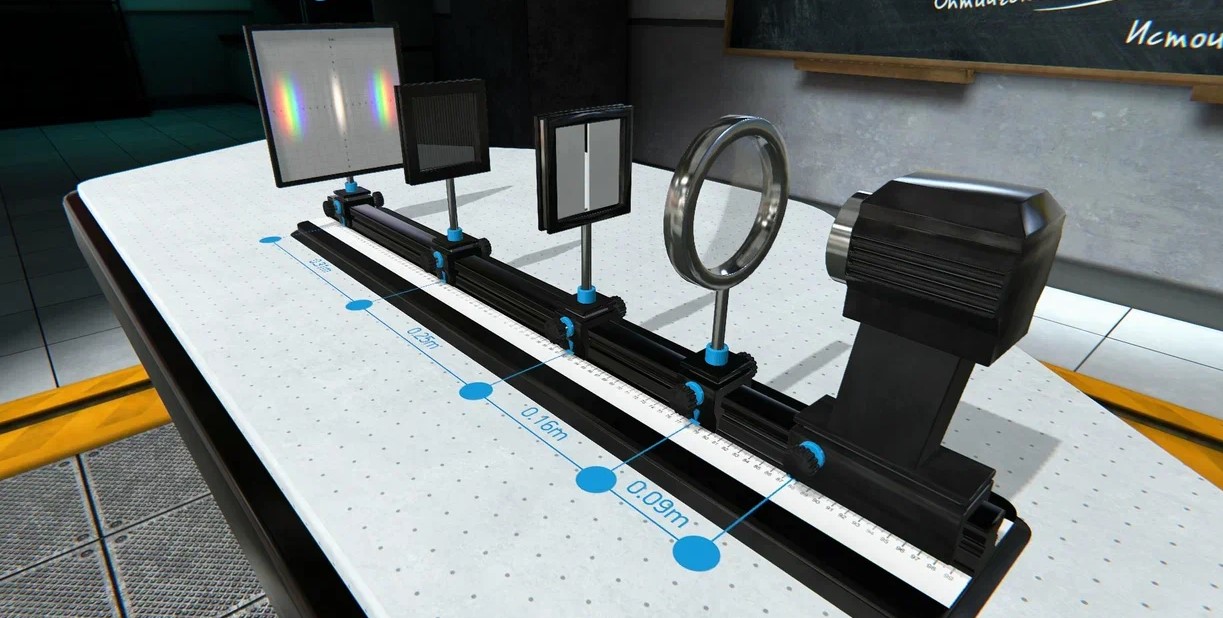
  • Determination of the wavelength of light using a diffraction grating.
  • Determination of the refractive index of glass with flat-parallel plates.
  • Determination of focal length and optical power of the collecting lens.